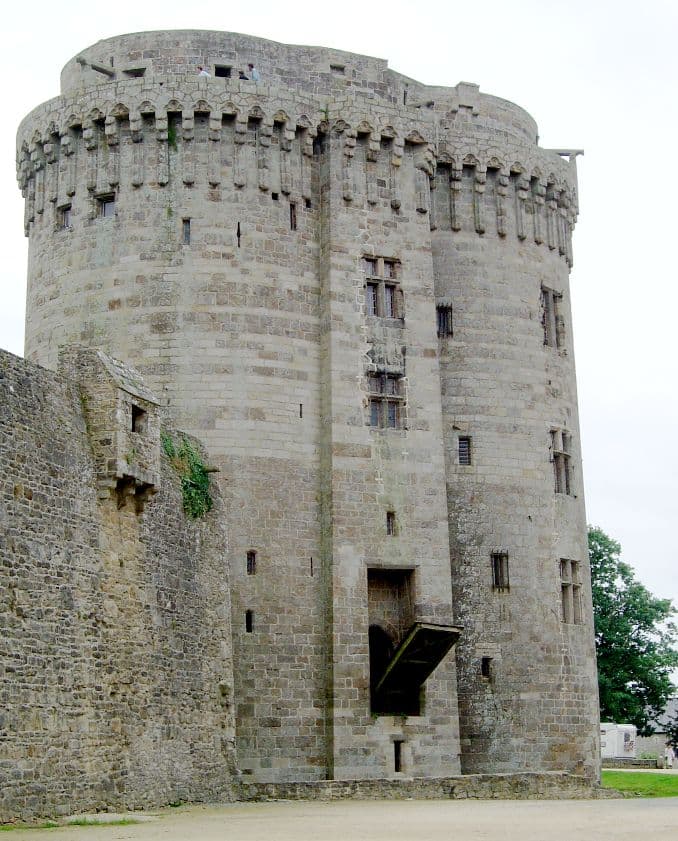
Dinan Castle
Dinan Castle, also known as Château de Dinan or Donjon de la duchesse Anne, is a striking medieval fortress located in the historic town of Dinan in the Côtes-d'Armor department of Brittany, France. This castle stands as a powerful symbol of ducal authority and medieval military architecture, prominently positioned on the edge of the town's ancient ramparts. The castle's imposing keep rises 34 meters high near the Saint Louis gate, commanding views over the town and surrounding landscape.
The castle's origins trace back to the turbulent 14th century, built between 1382 and 1384 by John V, Duke of Brittany, amid the aftermath of the War of the Breton Succession. This period marked a transition from wooden fortifications to robust stone structures designed both for defense and noble residence. The keep was constructed to assert ducal control over Dinan, a town that had supported his rival, Charles de Blois. Its architecture combines military functionality with princely grandeur, featuring two tall circular towers joined by a square projection, surrounded by a moat and accessed via a drawbridge. The defensive design includes extensive machicolations that allowed defenders to repel attackers effectively.
Medieval origins and early history
Before the current stone keep, an earlier motte-and-bailey castle known as the “vieil chastel” or “Châteauganne” occupied a nearby promontory during the 11th century. This wooden fortress played a notable role during the siege of 1064–65, when Conan II, Duke of Brittany, defended it against the forces of Harold Godwinson and William of Normandy. Although that early castle was destroyed around 1170, its archaeological remains provide insight into the region's early medieval fortifications.
Architectural features and defensive design
The Château de Dinan is a classic example of a hill castle, integrating its massive keep into the town's medieval ramparts which extend approximately 2,600 meters around Dinan. The keep itself is a formidable structure composed of two large round towers connected by a square block on the west side. Originally, it contained six floors, including a kitchen, banquet hall, formal chambers, a chapel, and private apartments, reflecting the social hierarchy and living standards of the nobility.
Surrounding the keep is a deep moat and a drawbridge that provided dual protection: against external enemies and potential unrest within the town. The battlements are supported by robust machicolations—stone projections with openings that allowed defenders to drop stones or boiling liquids on attackers below. These features highlight the castle's dual role as a military fortress and a princely residence.
Late 16th-century expansions and modifications
In the late 16th century, the castle underwent significant changes under Philippe Emmanuel, Duke of Mercœur, who was the Governor of Brittany and leader of the Catholic League during the French Wars of Religion. Between 1595 and 1598, he reinforced the castle by adding the Porte du Guichet, originally a city gate, and the Tour de Coëtquen, a 15th-century artillery tower. These were connected by the souterrain Mercœur, an underground passage allowing secure movement between the towers.
The upper courtyard was redesigned as a fortified bastion, with curtain walls featuring machicolations directed not only outward but also toward the town itself. This unusual defensive measure was intended to suppress potential uprisings within Dinan, reflecting the tense political climate of the era.
Transition to prison and modern use
By the 17th century, the castle's military importance waned, and it was gradually abandoned as a fortress. However, its robust construction made it suitable for use as a prison from the early 18th century onward. During this period, the castle housed various prisoners, including English naval captives during the 18th century. Structural modifications were made to accommodate its new function, such as replacing the original slate roof with a flat terrace and converting the chapel's apse into a new entrance.
In the 19th century, the castle continued to serve as a prison before being acquired by the town of Dinan in the early 20th century. Since 1908, it has functioned as a municipal museum, showcasing the region's history and the castle's architectural heritage. Although the museum collections were relocated in 2015, the castle remains a significant cultural monument and tourist attraction.
Preservation and cultural significance
The Château de Dinan was officially classified as a historic monument in 1886, recognizing its architectural and historical importance. Restoration efforts have been ongoing since 2014, supported by archaeological research that has enhanced understanding of the castle's construction phases and historical context.
Today, the castle stands as one of Brittany's finest examples of medieval military architecture, combining defensive ingenuity with residential elegance. Its well-preserved keep, moat, drawbridge, and curtain walls offer visitors a tangible connection to the region's turbulent history and the legacy of the Breton dukes.
Visiting dinan castle
Visitors to Dinan can explore the castle's exterior and the surrounding medieval ramparts, which provide panoramic views of the town and the Rance River valley. Although the castle itself has experienced periods of closure, it remains a focal point of Dinan's historical landscape. The site offers insight into the evolution of fortifications from the 11th century through the Renaissance and into the modern era.
The castle's location on Rue du Château places it within easy reach of Dinan's charming old town, known for its timber-framed houses and cobbled streets. The castle's museum function has helped preserve its interiors and artifacts, enriching visitors' understanding of Brittany's medieval past.
Frequently asked questions (FAQ)
- When was Dinan Castle built and by whom?
- Dinan Castle was built between 1382 and 1384 by John V, Duke of Brittany, to assert ducal authority over the town.
- What architectural style characterizes Dinan Castle?
- The castle is primarily Gothic in style, featuring defensive machicolations, round towers, and a fortified keep.
- Can visitors explore the interior of Dinan Castle?
- The castle has served as a museum since the early 20th century, although access to the interior may vary depending on restoration work and opening hours.
- What is the significance of the Tour de Coëtquen at Dinan Castle?
- The Tour de Coëtquen is a 15th-century artillery tower added in the late 16th century to strengthen the castle's defenses against evolving military threats.
- How does Dinan Castle reflect the history of Brittany?
- Dinan Castle embodies the region's medieval history, including the War of the Breton Succession, the French Wars of Religion, and the evolution of military architecture.
- Is Dinan Castle accessible to visitors year-round?
- Visiting hours may vary seasonally; it is recommended to check local tourist information for current opening times.

Information
Current owner
Municipality
Website
Visit websiteAddress
Rue du Château, Dinan, Côtes-d'Armor, Brittany, France
Sources & official resources
Verify the information above using these authoritative references.
Loading map...
Visitor reviews
No reviews yet. Been here? Write the first review and help other travelers!
Write the first reviewVisited this castle? Share your experience
Your review helps other travelers and adds first-hand knowledge to our encyclopedia.



