Castello Maniace
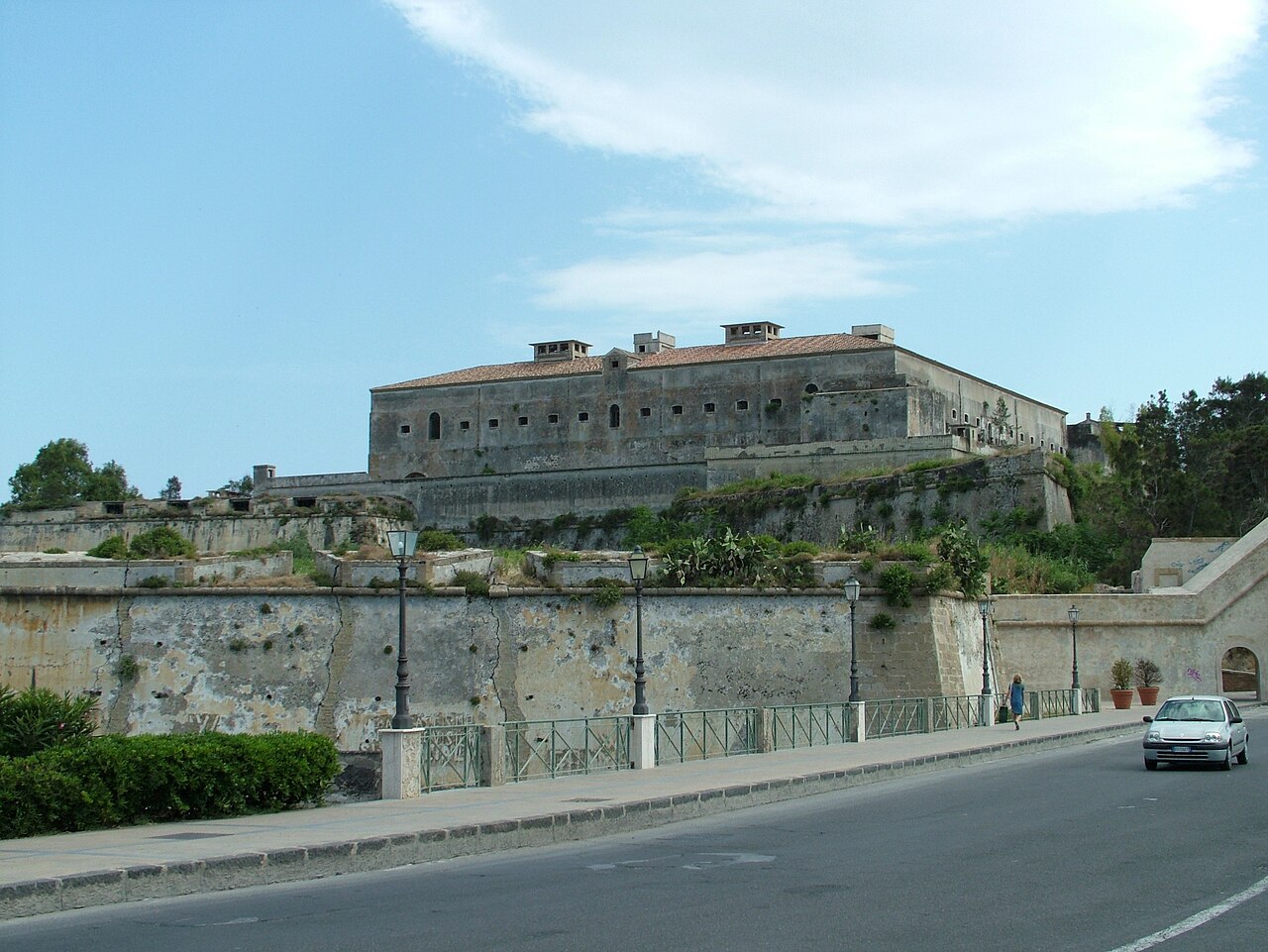
Castello Maniace is a monumental medieval fortress located at the southernmost tip of the Ortygia island promontory, the historic heart of Syracuse, Sicily. This imposing Hohenstaufen castle was constructed between 1232 and 1240 under the direction of Emperor Frederick II, one of the most remarkable rulers of the High Medieval period. The castle's strategic location allowed it to dominate the entrance to the Great Harbor of Syracuse, playing a crucial role in the city's defense and maritime control throughout the centuries.
The castle's name honors George Maniakes, the Byzantine general who briefly recaptured Syracuse from the Arabs in 1038. Although the current structure dates primarily from the 13th century, the site had earlier fortifications likely initiated by Maniakes during his campaign. These earlier Byzantine and subsequent Arab fortifications have left no visible remains today, but the legacy of their military significance endures in the castle's name.
Historical context and construction
The present Castello Maniace was commissioned by Frederick II of the Hohenstaufen dynasty after his return from the Crusades, reflecting his interest in fortifying his Sicilian domains with advanced military architecture. The design was entrusted to Riccardo da Lentini, whose work incorporated features from other contemporary Hohenstaufen castles across Sicily and southern Italy. The castle's construction between 1232 and 1240 marked a significant development in Sicilian military architecture, combining robust defensive elements with refined aesthetic details.
Following the Hohenstaufen period, the castle passed to the Angevin rulers in 1266 and became a focal point during the Sicilian Vespers uprising of 1282, when rebellious Syracusans seized it. It later came under the control of the Aragonese dynasty, who used it as both a royal residence and a military fortress. Notably, King Peter III of Aragon resided here with his family in 1288, and the castle served as the seat of the Camera Reginale from 1305 to 1536, housing several queens of Sicily.
Architectural features and layout
Fortification and design
Castello Maniace is characterized by its massive square layout, measuring approximately 51 meters on each side, with walls originally about 18 meters high and 3.5 meters thick. The fortress is reinforced by four cylindrical corner towers with octagonal bases, providing strong defensive vantage points. These towers are integrated into the curtain walls, which were designed to withstand siege warfare and artillery assaults.
The castle's main entrance faces the city of Syracuse on Ortygia and is accessed via a courtyard and a masonry bridge. This bridge replaced the original wooden drawbridge that spanned a wide moat connecting the castle to the mainland. The moat, once a formidable defensive barrier, was filled in during the 16th century as military technology and tactics evolved.
Decorative elements
One of the castle's most striking features is its decorated marble portal, which showcases a blend of military strength and artistic refinement. The portal is adorned with small marble columns topped by hooked leaf capitals, and four zoomorphic figures—two lions and two hippogriffs—are carved into the stonework, symbolizing power and protection. Floral motifs embellish the lower arch and archivolt, adding a delicate contrast to the fortress's robust construction. Above the pointed ogival portal arch, a 17th-century imperial coat of arms commemorates the castle's Spanish rule.
Interior architecture
Inside, the castle features a grand main hall with 24 rib-vaulted bays supported by pointed arches. This vaulted ceiling is notable for its richly sculpted capitals, which are rare examples of medieval secular architecture in the Mediterranean region. The rib patterns show influence from Cistercian architectural traditions, particularly those associated with Clairvaux Abbey. A small niche on the eastern wall resembles an Islamic prayer niche, reflecting the cultural interactions in Sicily, though its exact function remains uncertain.
The castle originally had one or two upper floors, giving it a tall, tower-like silhouette. These upper levels were removed during the Spanish period to reduce vulnerability to cannon fire, resulting in the current broader and lower profile. Many stone blocks bear inscriptions indicating their quarry of origin or the names of workers, providing valuable insights into medieval construction practices.
Historical roles and transformations
Royal residence and prison
During the Aragonese period, Castello Maniace served as the residence of the Camera Reginale, hosting queens such as Costanza, Maria, Bianca d’Evreux, and Germana de Foix. The castle was also a center of political intrigue and baronial revolts, notably in 1448 when Alfonso the Magnanimous dispatched Giovanni Ventimiglia to suppress rebellious nobles. Ventimiglia was honored with two bronze rams, believed to have been brought from Constantinople and linked to Maniakes, which were later placed on his tomb.
By the 15th century, the castle's function shifted primarily to that of a prison. Its robust fortifications made it suitable for detaining important prisoners, and it continued to play a military role in defending Syracuse's harbor and city.
Military upgrades and damage
In the mid-16th century, military engineer Ferramolino da Bergamo was commissioned by Viceroy Ferdinando Gonzaga to strengthen the castle's defenses against artillery attacks. Stones from ancient monuments were repurposed in these renovations, reflecting the common practice of spolia in Renaissance military architecture. The castle hosted notable figures such as Admiral Andrea Doria during Emperor Charles V's campaign against Muslim forces in 1540.
The fortress sustained damage from earthquakes in 1542 and 1693, and suffered a catastrophic explosion in 1704 when lightning struck the powder magazine. This blast destroyed watchtowers, collapsed a floor, and caused the deaths of 33 Spanish soldiers, leaving the castle partly in ruins.
Spanish and bourbon periods
In the early 17th century, under the castellanship of Joan de Roca Maldonato, the castle was adorned with symbols of the Spanish Empire, including the imperial shield of Charles V, the columns of Hercules, and globes representing Iberian world dominion. The castle's four corner towers were renamed after saints: San Pedro, San Catalina, San Philipe, and Santa Lucia. The fortress's name was officially changed to "Jago de Maniace" (Saint James of Maniace).
Flemish military architect Carlos de Grunembergh added the diamond-shaped Forte della Vignazza at the promontory's tip during the 17th century, enhancing the castle's coastal defenses. Under Bourbon rule, the castle regained military importance, with further artillery installations and fortifications added in 1838 amid regional unrest.
Modern era and preservation
Castello Maniace remained a military installation through World War II. Around the year 2000, it was restored and demilitarized, transitioning from a fortress to a cultural venue. Today, it is open to the public as a significant tourist attraction in Syracuse, hosting cultural events and official gatherings.
In June 2018, a Staufer stele was installed near the castle entrance to commemorate Emperor Frederick II and highlight the castle's historical importance within the legacy of the Hohenstaufen dynasty.
The castle's strategic position, robust fortifications, and blend of military and artistic elements make it a prime example of High Medieval castle architecture in Sicily. Its layered history reflects the complex political and cultural transformations of the island from the Byzantine era through the Spanish and Bourbon periods.
Frequently asked questions (FAQ)
- How do I get to Castello Maniace?
- Castello Maniace is located at the southern tip of the island of Ortigia in Syracuse, Italy. You can easily reach it by walking from various points in the city or by using local public transport. There are also parking facilities nearby for those traveling by car.
- What is the historical significance of Castello Maniace?
- Castello Maniace was built in the 13th century by Emperor Frederick II as a defensive fortress and later served as a royal residence. Its strategic location allowed it to play a crucial role in the defense of Syracuse against invaders throughout history. The castle is a testament to medieval military architecture and has witnessed numerous historical events.
- When was Castello Maniace constructed?
- Construction of Castello Maniace began in 1232 and was completed in 1240. It was commissioned by Emperor Frederick II, who aimed to fortify the city of Syracuse. The castle has since undergone various renovations and restorations, preserving its historical essence.
- Can I visit Castello Maniace year-round?
- Yes, Castello Maniace is open for visitors year-round, although opening hours may vary depending on the season. It is advisable to check the official website or local tourism information for updated hours before your visit. Special events may also affect accessibility, so planning ahead is recommended.
- Why is the architecture of Castello Maniace unique?
- The architecture of Castello Maniace features a blend of Arab, Norman, and Gothic styles, showcasing the diverse cultural influences in Sicily. Its robust stone walls, towers, and moat are characteristic of medieval fortifications, designed to withstand sieges. The castle's design also reflects its dual purpose as both a defensive structure and a royal residence.
- Is it possible to access all areas of the castle during my visit?
- While many areas of Castello Maniace are open to the public, some sections may be restricted for preservation purposes. Guided tours are often available to provide insights into the castle's history and architecture, ensuring visitors experience the most significant parts of the site. Be sure to inquire about guided tours upon arrival for the best access.
- What are the ticket prices for visiting Castello Maniace?
- Ticket prices for Castello Maniace are generally affordable, with discounts available for students, seniors, and children. Admission fees contribute to the maintenance and preservation of the castle. Check the official website for the most current pricing and any special offers available during your visit.
- What is the best time to visit Castello Maniace?
- The best time to visit Castello Maniace is during the spring (April to June) and fall (September to October) months when the weather is mild and the tourist crowds are smaller. These seasons provide a comfortable climate for exploring the castle and its surroundings. Summer can be quite hot, while winter may have fewer visitors and some attractions may close temporarily.
- Are there any nearby attractions to explore after visiting Castello Maniace?
- Yes, after visiting Castello Maniace, you can explore several nearby attractions such as the Cathedral of Syracuse, the Fountain of Arethusa, and the archaeological park of Neapolis. The charming streets of Ortigia also offer delightful shops and restaurants to enjoy. This area is rich in history and culture, making it a perfect complement to your castle visit.
Information
Website
Visit websiteSources & official resources
Verify the information above using these authoritative references.
Loading map...
Visitor reviews
No reviews yet. Been here? Write the first review and help other travelers!
Write the first reviewVisited this castle? Share your experience
Your review helps other travelers and adds first-hand knowledge to our encyclopedia.