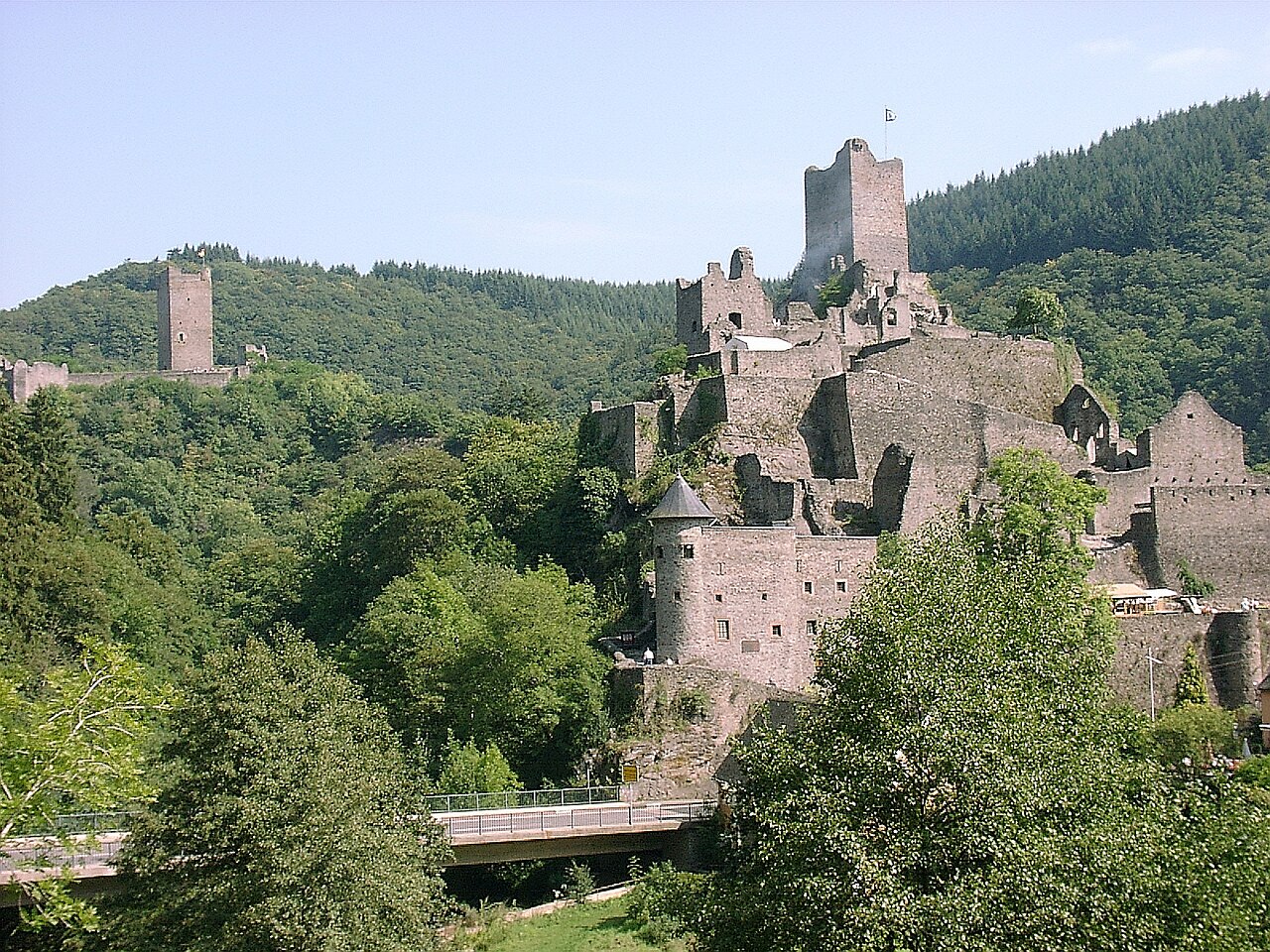
Manderscheid Upper Castle
Manderscheid Upper Castle, also known locally as the Oberburg of the Manderscheider Burgen, is a striking medieval fortress ruin situated near the town of Manderscheid in the Rhineland-Palatinate region of Germany. Perched on a prominent hilltop, the castle commands sweeping views of the Lieser valley and its twin counterpart, the Manderscheid Lower Castle, located just across the river on a rocky outcrop. This close proximity of two castles within 300 meters of each other is a rare and fascinating feature of the site, highlighting the strategic importance of the area during the medieval period.
The origins of Manderscheid Upper Castle trace back to the High Medieval period, with construction believed to have begun in the 12th century. While the exact date of its foundation remains uncertain, historical records indicate that the village of Manderscheid was first mentioned in 973, suggesting the castle may have existed or been planned around that time. The earliest documented individual associated with the castle is Richard von Manderscheid, first mentioned in 1133, who likely held the castle as a fief under Henry IV, Count of Luxembourg. At this time, the adjacent Lower Castle was also first referenced, initially serving as an outer bailey or subordinate fortification.
Strategic location and architectural layout
The Upper Castle occupies a levelled hilltop, a common medieval practice to create a defensible platform. Its ruins reveal an almost triangular enceinte, a defensive wall enclosing the core of the fortress. The centerpiece is a five-story bergfried or fighting tower, which has been restored and made accessible to visitors. From the top of this tower, one can enjoy panoramic views of the Lower Castle, the town of Manderscheid, and the surrounding Lieser valley countryside.
The bergfried served as a last refuge and lookout point, embodying the castle's military function. The enceinte walls, battlements, and gate structures, though largely in ruins, hint at the castle's robust fortifications designed to withstand sieges and attacks common in the medieval era.
Historical conflicts and ownership changes
The castle’s history is marked by a series of conflicts reflecting the turbulent political landscape of the region. Between 1141 and 1146, during a feud involving Count Henry the Blind of Namur-Luxembourg and Archbishop Albero of Trier, the castle changed hands multiple times. Albero besieged and captured the castle from Henry IV, and after peace negotiations, he retained control. The Lords of Manderscheid subsequently moved to the Lower Castle.
Following Albero's death in 1152, Henry IV and his vassal, Richard I von Manderscheid, reclaimed the Upper Castle. However, the new Archbishop, Hillin of Falmagne, besieged it again, and in 1160 the castle was largely demolished. Hillin then undertook a significant rebuilding effort, completed in 1166, reinforcing the castle’s strategic importance.
By the late 13th century, Manderscheid Upper Castle had become a seat of the Electorate of Trier, further cementing its role as a regional power center. The castle’s position served as a bridgehead into the surrounding sovereign territory of Luxembourg, underscoring its geopolitical significance.
Destruction and later history
The castle suffered extensive damage in 1673 when it was destroyed by the troops of Louis XIV of France during the wars that engulfed the Rhineland. Although there may have been attempts to rebuild, these were never fully realized, leaving the castle in a ruined state.
In 1794, the French revolutionary troops invaded the region, confiscating the castle ruins and ending the Archbishopric of Trier’s control. The castle was auctioned off in 1804, primarily for demolition purposes.
Ownership changed hands several times until 1870, when the ruin was acquired by the Count of Brühl, a descendant of the Manderscheid family. In 1921, the municipality of Manderscheid took ownership and undertook consolidation and restoration efforts to preserve the ruins.
Present-day condition and visitor experience
Today, Manderscheid Upper Castle stands as a well-preserved ruin open to the public. Visitors can explore the remains of the bergfried and the enceinte walls, gaining insight into medieval castle architecture and the region’s history. The castle’s elevated position offers spectacular views of the Lower Castle and the surrounding landscape, making it a favored destination for tourists and history enthusiasts alike.
The castle’s accessibility and the scenic combination with the nearby Lower Castle provide a unique experience, showcasing the medieval fortification system and the historical narrative of the Manderscheid family and the Electorate of Trier.
Architectural significance
The castle exemplifies typical High Medieval hill castle architecture with its bergfried, enceinte, and strategic hilltop placement. The five-story bergfried remains a dominant feature, illustrating the military and residential functions of such towers. The triangular layout of the enceinte is distinctive, adapted to the hill’s topography to maximize defense.
Historical importance in the region
Manderscheid Upper Castle played a crucial role in the power struggles of the Rhineland during the Middle Ages. Its association with the Electorate of Trier and the Luxembourg counts reflects the complex feudal relationships and territorial conflicts of the time. The castle’s repeated sieges and reconstructions attest to its strategic value.
Visiting information
The castle is freely accessible to visitors year-round, with no entrance fee. Its location near Niedermanderscheider Strasse 1 makes it easy to reach from the town of Manderscheid. Visitors are encouraged to explore both the Upper and Lower Castles to fully appreciate the historical landscape.
Guided tours and informational signage enhance the visitor experience, providing context about the castle’s architecture and history. The site’s preservation by the municipality ensures ongoing maintenance and public engagement.
Frequently asked questions (FAQ)
- How do I get to Manderscheid Upper Castle?
- Manderscheid Upper Castle is located near Niedermanderscheider Strasse 1 in Germany. It is accessible by car, with parking available nearby. Public transportation options may also be available, so check local schedules for buses or trains that stop close to the castle.
- What are the opening hours of Manderscheid Upper Castle?
- The castle is generally open to visitors from 10 AM to 5 PM daily, but hours may vary depending on the season or special events. It’s advisable to check the official website or contact the castle directly for the most current information before your visit.
- Can I enter the castle without a ticket?
- No, visitors must purchase a ticket to enter Manderscheid Upper Castle. Ticket prices are typically reasonable, allowing access to the castle grounds and various exhibitions. Discounts may be available for children, students, and seniors, so be sure to inquire at the ticket counter.
- When was Manderscheid Upper Castle built?
- Manderscheid Upper Castle was originally constructed in the 11th century and has undergone various modifications throughout its history. It played a crucial role in the region's defense and has significant historical value. The castle’s architecture reflects medieval styles and offers insight into its past.
- Is Manderscheid Upper Castle accessible for visitors with disabilities?
- While efforts have been made to accommodate visitors with disabilities, the castle’s historical architecture may present some challenges. Certain areas may not be fully accessible due to uneven terrain and steep staircases. It is recommended to contact the castle in advance for specific accessibility options and assistance.
- Why is Manderscheid Upper Castle considered historically significant?
- Manderscheid Upper Castle is historically significant as it reflects the feudal system and military architecture of the medieval period in Germany. The castle has witnessed numerous historical events and changes in power, making it an important site for understanding regional history. Its preservation allows visitors to explore and appreciate the rich heritage of the area.
- What is the best time to visit Manderscheid Upper Castle?
- The best time to visit Manderscheid Upper Castle is during the spring and fall when the weather is mild, and the surrounding scenery is particularly beautiful. Summer can be busy with tourists, while winter may limit access due to weather conditions. Planning your visit during weekdays may also help avoid crowds.
- Are there any nearby attractions to visit while at Manderscheid Upper Castle?
- Yes, there are several nearby attractions worth exploring, including the Manderscheid Lower Castle and the picturesque village of Manderscheid itself. The region is also known for its hiking trails and scenic landscapes, making it a great destination for outdoor enthusiasts. Consider spending a day exploring the area to fully appreciate its charm.
Loading map...
Visitor reviews
No reviews yet. Been here? Write the first review and help other travelers!
Write the first reviewVisited this castle? Share your experience
Your review helps other travelers and adds first-hand knowledge to our encyclopedia.