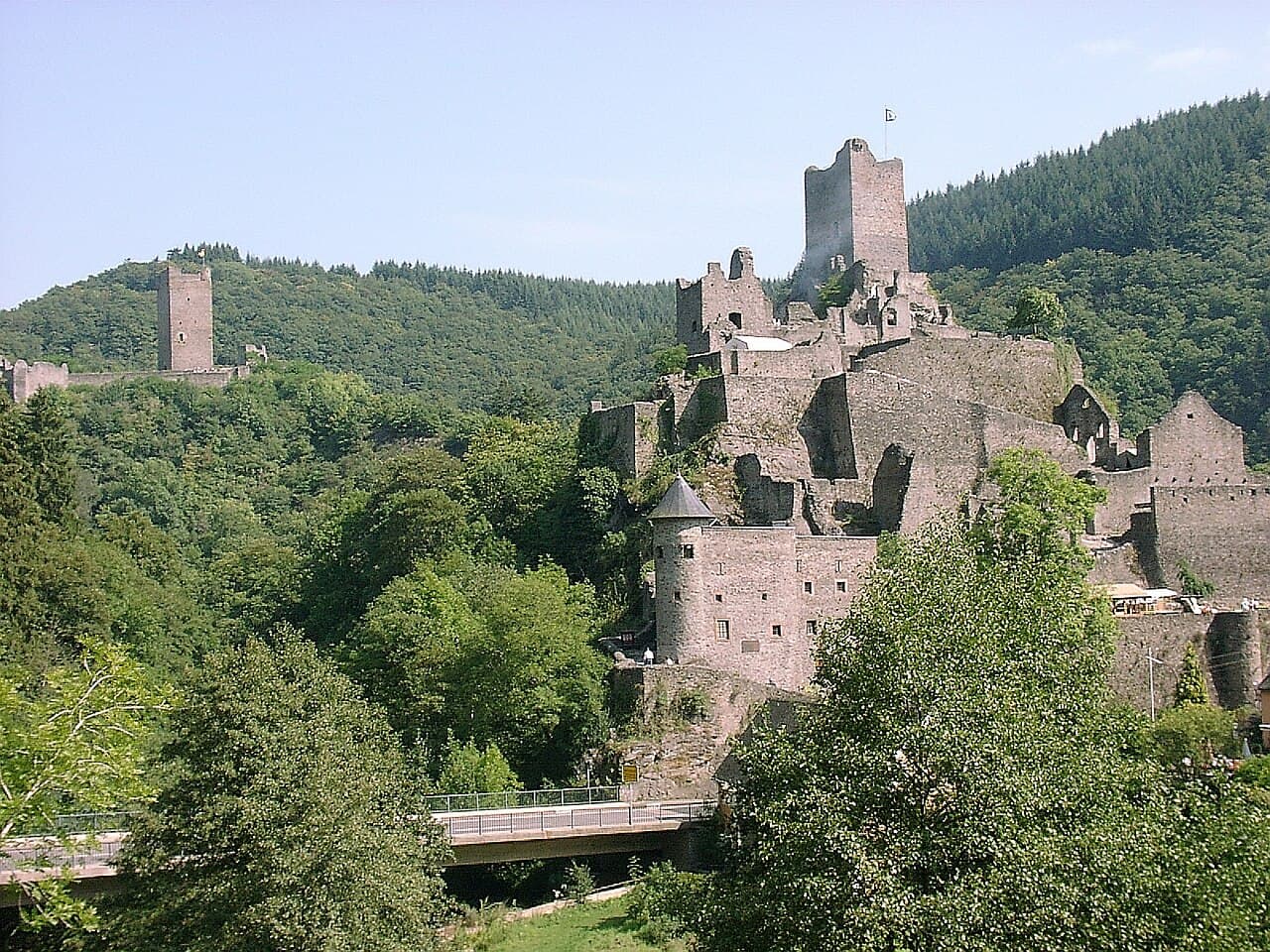
Manderscheid Lower Castle
Manderscheid Lower Castle, also known locally as the Niederburg, is a striking medieval fortress ruin located in Niedermanderscheid, near the town of Manderscheid in the Rhineland-Palatinate region of Germany. This castle complex, perched on a rocky outcrop overlooking the winding valley carved by the river Liesel, forms one half of the famous twin castles of Manderscheid, the other being the older and higher Manderscheid Upper Castle situated on the northern hill. Together, these castles dominate the landscape and provide a vivid glimpse into the region's turbulent medieval past.
First mentioned in 1133, Manderscheid Lower Castle began its life as an outer bailey to the Upper Castle, which was held by Richard von Manderscheid as a fief from Henry IV, Count of Luxembourg. The castle's early history is marked by conflict, notably a feud around 1146 between Henry IV and Albero de Montreuil, Archbishop of Trier. The Archbishop besieged and captured the Upper Castle, after which the Lords of Manderscheid relocated their residence to the Lower Castle, which was then developed into a fully independent fortress.
Architectural evolution and fortification
The Lower Castle underwent significant expansion and fortification during the 14th century. In 1332, the Archbishop of Trier granted city rights to the village of Manderscheid, prompting Wilhelm V von Manderscheid to substantially enlarge the Lower Castle. This expansion included enclosing the small hamlet beneath the castle within its defensive walls, reflecting the strategic importance of the site.
Between 1346 and 1348, the castle withstood an intense siege by Baldwin of Luxembourg, Archbishop-Elector of Trier, and William V, Duke of Jülich. Although the siege was unsuccessful, the castle sustained damage that required extensive rebuilding. This restoration was overseen by Dietrich I von Manderscheid and continued until 1427. The castle's fortifications from this period include robust curtain walls, defensive towers, and a fortified gatehouse, characteristic of high medieval military architecture.
Structural features
- The castle's location on a rocky outcrop provided natural defensive advantages, supplemented by thick stone walls.
- Its layout includes remnants of a keep, courtyards, and battlements designed for archers and artillery.
- The integration of the adjacent village into the castle's defenses is a notable feature, highlighting the castle's role as a center of local power and protection.
Historical significance and ownership
In 1457, the Manderscheid family was elevated to the rank of Counts by Holy Roman Emperor Frederick III, underscoring their growing influence. However, the county was divided in 1488 due to inheritance, leading to the Lower Castle becoming largely uninhabited except for caretakers.
The castle saw renewed occupation in 1606 when Countess Magdalena, niece of Dietrich IV von Manderscheid, and her husband, Count Steno von Löwenhaupt-Rasburg, took residence. This period was marked by religious conflict; the Count's attempt to introduce Lutheranism led to a siege in 1618 by troops of Archbishop Albrecht of Austria under orders from Emperor Ferdinand II. The Count was arrested, illustrating the castle's role in the religious and political struggles of the era.
Decline and restoration
The castle suffered severe damage in 1673 during military actions by the French troops of Louis XIV, marking the beginning of its long decline. Despite this, it remained inhabited until 1794, when the French Revolutionary troops invaded. The inhabitants had fled to Bohemia, and the castle was subsequently destroyed and auctioned off for demolition in the early 19th century.
Several private owners held the ruins until 1899, when the Eifelverein, a German rambling club, purchased the site. The club undertook consolidation and restoration efforts, preserving the ruins and making them accessible to the public. Today, the castle is a well-known tourist destination, open for visits with guided tours available. The site also hosts a popular medieval festival every August, attracting thousands of visitors and celebrating the castle's rich heritage.
Current condition and visitor experience
The ruins of Manderscheid Lower Castle are well-preserved thanks to ongoing restoration efforts. Visitors can explore the remains of the castle's defensive walls, towers, and courtyards, gaining insight into medieval fortification techniques. The castle's dramatic setting and historical ambiance make it a favored location for events such as weddings and cultural festivals.
Combined with the nearby Upper Castle, the Lower Castle offers a comprehensive experience of medieval castle architecture and history in the Eifel region. Its accessibility and rich programming ensure its continued importance as a cultural landmark.
Frequently asked questions (FAQ)
- When was Manderscheid Lower Castle originally built?
- Manderscheid Lower Castle was first mentioned in 1133 and began as an outer bailey to the Upper Castle before becoming a full castle in its own right.
- What architectural style characterizes Manderscheid Lower Castle?
- The castle primarily exhibits Gothic architectural features typical of high medieval fortifications, including curtain walls, battlements, and defensive towers.
- Can visitors tour Manderscheid Lower Castle?
- Yes, the castle ruins are open to visitors daily during the summer months, with guided tours and private event bookings available by arrangement.
- What historical events affected Manderscheid Lower Castle?
- The castle endured several sieges, notably in the mid-14th century and during the religious conflicts of the early 17th century, as well as damage from French troops in 1673.
- Who currently owns Manderscheid Lower Castle?
- The castle is owned and maintained by the Eifelverein, a German rambling club that has restored and preserved the ruins since 1899.
Photo gallery

Information
Opening hours
Daily during summer months
Ticket prices
Fee required
Current owner
Eifelverein
Loading map...
Visitor reviews
No reviews yet. Been here? Write the first review and help other travelers!
Write the first reviewVisited this castle? Share your experience
Your review helps other travelers and adds first-hand knowledge to our encyclopedia.


