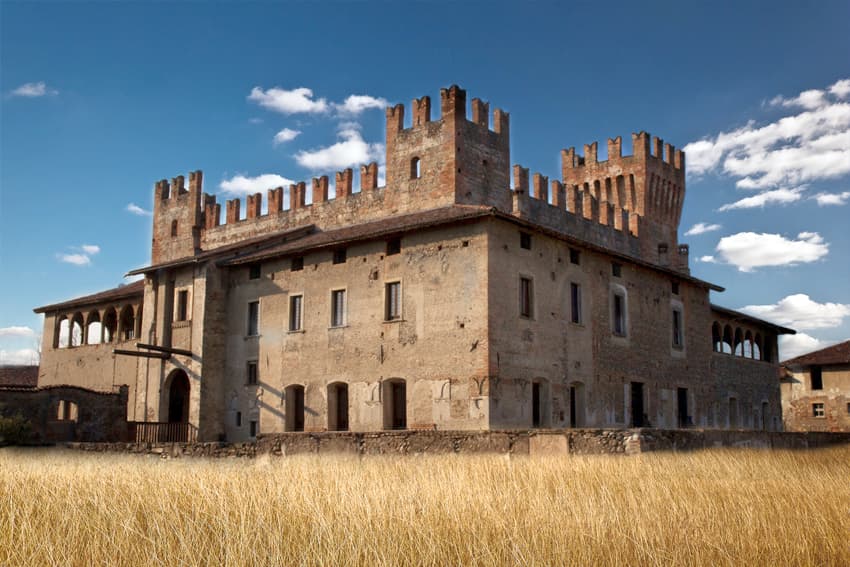
Malpaga Castle
Malpaga Castle, also known as Castello di Malpaga, is a remarkable example of a fortified residence that blends medieval military architecture with Renaissance artistic and cultural refinement. Situated in Cavernago, near the town of Ghisalba in the province of Bergamo, Lombardy, Italy, this castle stands as a testament to the turbulent history and evolving architectural styles of northern Italy from the 14th century onward.
Originally constructed in the mid-14th century by a member of the Ghibelline faction during the intense conflicts between the Guelphs and Ghibellines—supporters respectively of the Pope and the Holy Roman Emperor—Malpaga Castle was designed primarily as a defensive stronghold. Its square layout is enclosed by two lines of merlon-topped walls and a surrounding moat, features typical of late medieval hill castles. The outer wall, now lost, originally contained stables and barracks, supporting the castle’s military function.
The castle’s evolution under Bartolomeo Colleoni
By the mid-15th century, the castle had fallen into disrepair after a destructive raid in the 1440s and was abandoned under the ownership of the city of Bergamo. In 1456, Bartolomeo Colleoni, a renowned condottiero and Captain General of the Republic of Venice, purchased the castle. Recognizing the obsolescence of traditional fortifications in the age of gunpowder, Colleoni undertook extensive renovations to both restore and modernize the fortress.
Colleoni’s restoration transformed Malpaga from a purely military installation into a seigneurial residence that reflected the ideals of the Italian Renaissance. He raised the walls, added a second moat, and built housing for troops, stables, and fortified gates, turning the complex into a highly inaccessible citadel. Despite its defensive upgrades, the castle was designed to serve as a luxurious home and a center of power, hosting grand events and distinguished visitors.
Architectural features and artistic heritage
The castle’s interior is renowned for its extensive fresco decorations, many attributed to the celebrated Renaissance painter Il Romanino. These frescoes, commissioned by Colleoni’s heirs around 1520–1530, celebrate the life and achievements of Bartolomeo Colleoni and depict significant historical events, including the 1474 visit of King Christian I of Denmark.
The frescoes vividly illustrate the royal visit with scenes of the king’s procession, banquets, hunting expeditions, and tournaments, featuring idealized portraits of both Colleoni and Christian I. In the courtyard, a large outdoor fresco portrays the Battle of Molinella (1467), a notable conflict led by Colleoni near Bologna. This battle scene remains one of the most impressive visual records of 15th-century military engagements in Italy.
Other frescoes include allegorical images such as Silence, symbolizing the secrecy expected within the castle’s personnel, and religious works like a small 15th-century depiction of the Madonna and Child in Colleoni’s private studio, reflecting the spiritual dimensions of the castle’s life.
Defensive and residential design
The castle’s defensive architecture is characterized by its crenellated walls, moats, and a commanding tower that dominates the surrounding plain. The private chambers of Colleoni were designed with security in mind; for example, his bedroom lacked a fireplace to prevent enemy access through the chimney and featured barred windows.
The fortress’s military exterior contrasts with the richly decorated interiors, which served to impress guests and reflect the status of its owner. The castle hosted numerous high-profile visitors, including Borso d’Este, the sons of Francesco Sforza, and Charles the Bold, Duke of Burgundy, underscoring its importance as a cultural and political hub in Renaissance Italy.
Historical significance and legacy
Malpaga Castle is a prime example of the transition from medieval fortress to Renaissance noble residence. Its history is closely tied to the figure of Bartolomeo Colleoni (1395–1475), whose military prowess and political influence shaped much of northern Italy’s history during the 15th century.
After Colleoni’s death, the castle passed to his nephews, the Martinengo-Colleoni family, who maintained and embellished the property for centuries. The castle remained in their possession until the late 19th century, when it was sold to the Roncalli family in 1880 and later to the Crespi family in 1924.
Today, Malpaga Castle is owned by the Malpaga Spa and functions as a museum open to the public. Visitors can explore its well-preserved halls, admire the extensive frescoes, and appreciate the castle’s unique blend of military architecture and Renaissance art. Its location amidst cultivated fields and near the Serio River and Orobie Prealps adds to its picturesque setting and cultural value.
Visiting Malpaga Castle
The castle welcomes visitors who wish to experience a significant piece of Italian history and architecture. The frescoes by Il Romanino are among the highlights, offering insight into 15th-century life, art, and politics. The castle’s fortifications and residential quarters provide a tangible connection to the era of condottieri and Renaissance nobility.
Malpaga Castle’s combination of military and residential architecture, along with its rich artistic heritage, makes it a compelling destination for historians, art lovers, and tourists interested in the cultural legacy of Lombardy.
Frequently asked questions (FAQ)
- What is the historical significance of Malpaga Castle?
- Malpaga Castle, dating back to the 15th century, is a remarkable example of medieval military architecture in Italy. It served as a stronghold for the Visconti family and later became a residence for famous figures such as Bartolomeo Colleoni, a renowned condottiero.
- When was Malpaga Castle built?
- Construction of Malpaga Castle began in the late 15th century, around the year 1450. It was completed in the subsequent decades and has since remained a significant landmark in the region.
- What are the opening hours for Malpaga Castle?
- Malpaga Castle is typically open to visitors from 10 AM to 6 PM from April to October. During the winter months, the hours may vary, so it is advisable to check the official website before planning your visit.
- Can I take guided tours of Malpaga Castle?
- Yes, guided tours are available and highly recommended for an enriched experience. Knowledgeable guides provide insights into the castle's history, architecture, and the lives of its notable inhabitants.
- Is it possible to access Malpaga Castle by public transport?
- Yes, Malpaga Castle can be accessed via public transport, with local buses connecting it to nearby towns. However, check local schedules for the most convenient routes and times.
- What is the best time to visit Malpaga Castle?
- The best time to visit is during the spring and early autumn when the weather is mild, and the gardens surrounding the castle are in full bloom. Visiting during these seasons also allows you to enjoy special events and guided tours offered by the castle.
- Are there any nearby attractions to explore while visiting Malpaga Castle?
- Absolutely! Nearby attractions include the charming town of Bergamo, known for its historical architecture and scenic views. The area also has several parks and other historical sites that enhance your visit.
- How much do tickets cost to enter Malpaga Castle?
- Tickets to Malpaga Castle are reasonably priced, usually around €8 for adults and discounts available for children and seniors. Group rates may also be offered, making it an affordable option for families and school trips.
Photo gallery

Information
Sources & official resources
Verify the information above using these authoritative references.
Loading map...
Visitor reviews
No reviews yet. Been here? Write the first review and help other travelers!
Write the first reviewVisited this castle? Share your experience
Your review helps other travelers and adds first-hand knowledge to our encyclopedia.



