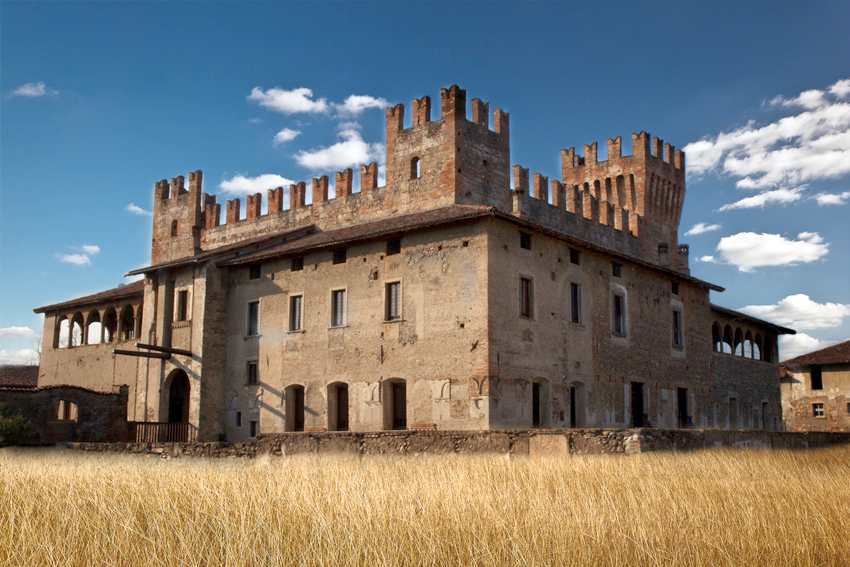
Castello di Cavernago
Castello di Cavernago stands prominently in the municipality of Cavernago, located in northern Italy, at a strategic junction where the historical territories of Milan, Bergamo, and Brescia once converged. This castle's origins date back to 1243, when the canons of the Bergamo cathedral acquired an existing fortified building on this site. The early ownership by ecclesiastical authorities underscores the castle's initial role as both a defensive stronghold and an administrative center in a region of considerable political and military importance.
Medieval origins and strategic importance
The castle's location on a hill provided natural defensive advantages, characteristic of a hill castle. During the High Medieval period, such elevated sites were chosen to monitor and control surrounding lands, trade routes, and borders. The early structure likely featured typical medieval defensive elements, although specific architectural details from this phase are scarce. The castle's role was primarily military and administrative, reflecting the turbulent and fragmented political landscape of northern Italy during the Middle Ages.
Bartolomeo Colleoni and Renaissance transformation
In 1470, the castle entered a new chapter when it was acquired by Bartolomeo Colleoni, a renowned condottiero or mercenary captain. Colleoni was a significant military figure in 15th-century Italy, serving various city-states and leaving a lasting legacy. His ownership marked a turning point for the castle, as he initiated modifications to suit his status and military needs. These alterations likely included strengthening fortifications and adapting residential quarters to the lifestyle of a prominent noble and military leader.
Following Bartolomeo Colleoni's death, the castle was inherited by Gherardo Martinengo-Colleoni, married to Colleoni's daughter Ursina, ensuring the property remained within the extended family. Their son, Alessandro Martinengo Colleoni, continued the lineage, reflecting the castle's sustained importance as a noble residence.
Baroque rebuilding and architectural features
A major rebuilding campaign was undertaken in 1597 by Francesco Martinengo, which significantly reshaped the castle's appearance and function. This renovation transitioned the castle from a primarily defensive fortress into a refined aristocratic residence, embracing the Baroque architectural style that was gaining prominence in Italy during the late 16th and early 17th centuries.
The castle's layout is organized around a square plan enclosing a large central courtyard. This courtyard is distinguished by a double loggia, consisting of two levels of open galleries supported by elegant columns and arches. These loggias provide sheltered walkways with views over the courtyard, enhancing both the aesthetic appeal and social functionality of the space.
Unlike typical medieval castles, Castello di Cavernago lacks battlements and wall-walks, signaling a shift away from military defense towards comfort and status display. However, some defensive features remain, such as the presence of a drawbridge that once spanned a now dry moat encircling the castle grounds. The moat, though no longer filled with water, remains visible in the landscape and was historically complemented by a central well, ensuring a water supply during sieges.
Interior decoration and gardens
The interiors of the castle are richly decorated with frescoes painted directly onto walls and ceilings. These artworks reflect the cultural tastes and artistic trends of the Baroque period, adding significant artistic and historical value to the residence. The frescoes likely depict religious, mythological, or heraldic themes, common in noble residences of the era.
Surrounding the castle is an extensive garden that enhances the estate's residential character and aesthetic appeal. The garden would have served both as a leisure space and a symbol of wealth and refinement, consistent with Baroque ideals of harmony between architecture and nature.
Ownership and heritage significance
Over the centuries, ownership of the castle passed through several prominent families, including the Giovanelli counts and Count Mazzotti Biancinelli. Today, the castle remains privately owned by a descendant of the Prince Gonzaga of Vescovato, linking it to one of Italy's notable noble lineages. This continuity of ownership highlights the castle's enduring status as a symbol of aristocratic heritage.
Architectural and historical importance
Castello di Cavernago exemplifies the architectural evolution from a medieval fortress to a Baroque aristocratic residence. Its transformation reflects broader historical trends in northern Italy, where military fortifications gradually gave way to stately homes designed for comfort and display. The castle's combination of defensive remnants, such as the moat and drawbridge, with elegant architectural features like the double loggia and frescoed interiors, offers valuable insights into the changing functions and aesthetics of noble residences from the Middle Ages through the early modern period.
Today, the castle stands as a well-preserved example of Baroque architecture adapted from medieval foundations, contributing to the cultural and historical landscape of the Lombardy region. Its location, design, and artistic embellishments make it a significant site for understanding the interplay between military necessity and aristocratic lifestyle in Italian history.
Frequently asked questions (FAQ)
- What is the historical significance of Castello di Cavernago?
- Castello di Cavernago is an important example of medieval architecture in Italy, dating back to the 13th century. It played a crucial role in the defense of the region and reflects the rich history of noble families in Lombardy.
- When was Castello di Cavernago built?
- The construction of Castello di Cavernago began in the early 1200s, with significant modifications and expansions occurring in subsequent centuries. Its enduring structure showcases the evolution of architectural styles over the years.
- What are the opening hours for visiting Castello di Cavernago?
- Castello di Cavernago is typically open to visitors from Tuesday to Sunday, with specific hours varying by season. It is advisable to check the castle's official website for the most up-to-date information on opening times and any holiday closures.
- Is it possible to take guided tours of the castle?
- Yes, guided tours are available at Castello di Cavernago, providing visitors with in-depth insights into its history and architecture. These tours are often conducted in multiple languages and can be booked in advance for a more personalized experience.
- Can I take photographs inside Castello di Cavernago?
- Photography is generally permitted in most areas of Castello di Cavernago, but some restrictions may apply in certain exhibitions or private events. Be sure to respect the guidelines provided by the staff during your visit.
- What are the ticket prices for visiting Castello di Cavernago?
- Ticket prices for Castello di Cavernago vary depending on age and group size, with discounts often available for students and seniors. Children under a certain age may enter free, making it an affordable destination for families.
- When is the best time to visit Castello di Cavernago?
- The best time to visit Castello di Cavernago is during the spring and early autumn months when the weather is mild and pleasant. These seasons also offer beautiful views of the surrounding landscape, enhancing your overall experience.
- Are there any nearby attractions to visit alongside Castello di Cavernago?
- Yes, there are several nearby attractions, including the charming town of Bergamo and its historic Città Alta. Additionally, visitors can explore local vineyards and enjoy the picturesque countryside that surrounds the castle.
- How do I get to Castello di Cavernago from the nearest airport?
- To reach Castello di Cavernago from the nearest airport, Orio al Serio International Airport, you can take a taxi or use public transportation. The journey typically takes about 30 minutes, making it a convenient option for travelers.
Information
Website
Visit websiteSources & official resources
Verify the information above using these authoritative references.
Loading map...
Visitor reviews
No reviews yet. Been here? Write the first review and help other travelers!
Write the first reviewVisited this castle? Share your experience
Your review helps other travelers and adds first-hand knowledge to our encyclopedia.