Mackworth Castle
Mackworth Castle is a medieval hill castle located in the village of Mackworth, Derbyshire, England. Established by the noble Mackworth family in the 13th century, the castle served as their residence and estate administrative centre for several centuries. The origins of the family trace back to Henry du Mackworth, recorded in the Pipe Rolls of 1254, marking the family's long-standing presence in the region.
Construction of the castle spanned from the early 14th century through the late 15th century, reflecting architectural developments over more than a century. Unlike large-scale fortresses, Mackworth Castle was likely intended as a practical noble residence rather than a heavily fortified military stronghold. The castle's layout centered around a courtyard, with timber-framed walls resting on low rubble foundations, a common construction method in the region during the medieval period.
Architectural features and construction details
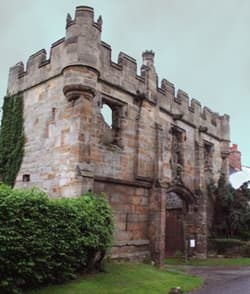
The most prominent surviving feature of Mackworth Castle is its Tudor gatehouse, a substantial square structure dating to shortly before 1500. This gatehouse was built with heavy battlements, designed as a self-contained fortified entrance that contrasts with the lighter timber elements of the other buildings. Its robust masonry construction has earned it a Grade I listing, highlighting its exceptional architectural and historic significance.
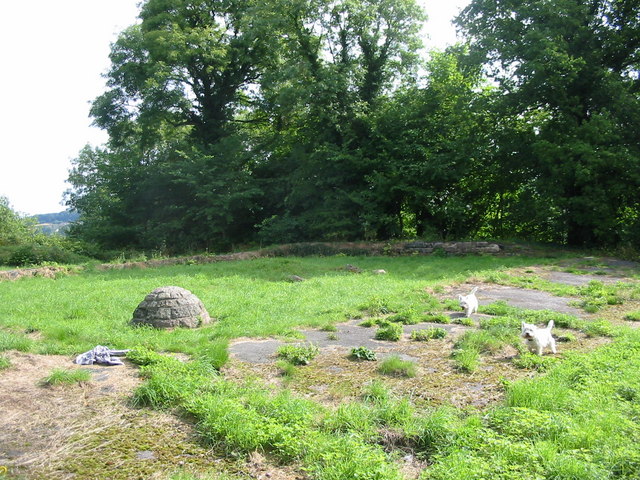
Archaeological investigations reveal that the castle's courtyards were enclosed by timber-framed walls on rubble bases, similar in style to the nearby 14th-century Tuchet family house. The Mackworths' role as stewards to the Tuchets may have influenced this shared architectural tradition. The castle's overall modest scale and construction suggest it was tailored to the needs and status of a middle-ranking noble family rather than a high-status fortress.
Historical context and ownership
The Mackworth family maintained ownership of the castle until the mid-17th century. By the late 16th century, the castle's condition had declined, as evidenced in 1584 when Sir Ralph Sadler declined to house Mary, Queen of Scots, there due to inadequate accommodations. This indicates the castle was no longer suitable for hosting high-profile guests.
In 1655 or 1656, Sir Thomas Mackworth, 3rd Baronet, sold the estate to Sir John Curzon, 1st Baronet, after relocating to Normanton in Rutland. Local tradition holds that the castle suffered damage during the English Civil War from artillery fire on a nearby hill. However, historical research by Rev. Charles Kerry suggests the castle was already in a state of decay before the war, casting doubt on the story of wartime destruction.
Present-day remains and heritage status
Today, the remains of Mackworth Castle provide valuable insight into medieval domestic architecture. The surviving gatehouse stands as a testament to Tudor military architectural design, while the foundations and timber wall bases reveal the castle's original layout. The site is protected as a Scheduled Ancient Monument, ensuring its preservation for future study and public interest.
The castle's remains are modest but significant, illustrating the lifestyle of a regional noble family rather than a royal fortress. The gatehouse's survival as a Grade I listed building underscores its importance as an architectural and historical landmark within Derbyshire.
Cultural significance and popular culture
Despite its relatively modest historical profile, Mackworth Castle gained wider recognition as a filming location for the 1954 movie The Black Shield of Falworth, based on Howard Pyle's 19th-century novel Men of Iron. This association has contributed to public awareness of the site beyond its local heritage context.
Frequently asked questions (FAQ)
- When was Mackworth Castle built and by whom?
- Mackworth Castle was constructed between the early 14th century and late 15th century by the Mackworth family, a noble lineage established in Derbyshire since at least the mid-13th century.
- What remains of Mackworth Castle can visitors see today?
- Visitors can see the substantial Tudor gatehouse, which is Grade I listed, along with foundations and timber-framed wall bases that reveal the castle's original courtyard layout.
- Why is Mackworth Castle considered more of a noble residence than a fortress?
- The castle's modest scale, timber-framed walls, and lack of extensive fortifications indicate it was designed as a practical noble residence rather than a large military stronghold.
- Is Mackworth Castle open to the public and are there any visitor facilities?
- Mackworth Castle is a Scheduled Ancient Monument with no specific visitor facilities or regular opening hours. Visitors should check local heritage resources for access information before planning a visit.
- What historical events affected Mackworth Castle?
- The castle declined in condition by the late 16th century and was sold in the mid-17th century. Local tradition suggests damage during the English Civil War, although evidence points to prior decay.
Photo gallery

Information
Loading map...
Visitor reviews
No reviews yet. Been here? Write the first review and help other travelers!
Write the first reviewVisited this castle? Share your experience
Your review helps other travelers and adds first-hand knowledge to our encyclopedia.