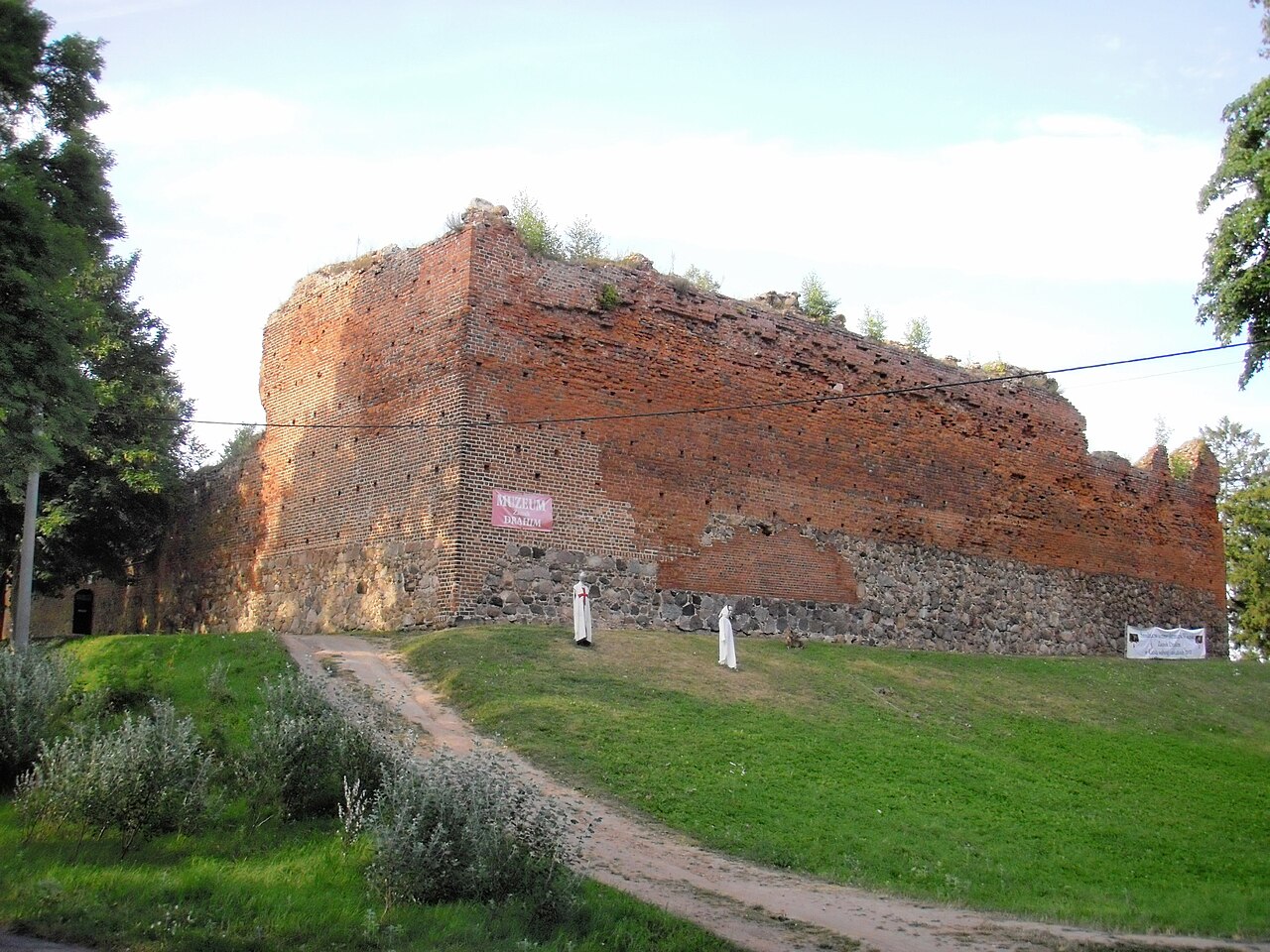
Machliny

Machliny Castle: late medieval hill fortress in Poland
Machliny, Poland
Late Medieval (14th–15th c.)
Restored

Machliny Castle stands as a testament to the turbulent history of the Late Medieval period in the region of Pomerania, Poland. Originally constructed in 1312 following the dissolution of the Knights Templar, this hill castle was strategically positioned on an island amidst the wetlands of the Dobrzyca River. Its location was chosen to guard the southern boundaries of the Commandery of Tempelborch, a key territorial possession of the Order of Saint John (Joannites) after they inherited the Templar estates in Pomerania.

After the Templars were disbanded, their properties in the region, including the commandery with its seat in Czaplinek, were transferred to the Joannites in 1345. The first commander of the Tempelborch commandery was Gebhard von Bortfelde. While Czaplinek remained the main seat, the Joannites sought to strengthen their control over the newly acquired lands by erecting two castles: one at Drahim and another at Machliny.

The strategic significance and location of Machliny Castle

Machliny Castle was built to protect the southern borders of the commandery. Its unique placement on an island surrounded by the river's floodplains provided natural defense advantages. The castle was connected to the mainland by a causeway, allowing controlled access while maintaining a defensive moat-like barrier formed by the surrounding waters.

Although detailed architectural records of the castle are scarce, archaeological investigations conducted in the 1960s uncovered fragments of Gothic bricks, suggesting that at least part of the structure was built or later reinforced with masonry. This indicates the castle may have evolved from a simple wooden fortification to a more robust stone or brick-built stronghold.

Architecture and construction features

Historical sources and archaeological evidence imply that the original castle was likely a small timber-framed fortress encircled by a palisade. Such construction was typical for frontier castles of the period, designed for rapid defense rather than grand residential purposes.

After 1361, the castle was granted in fief to the brothers Ludek and Jerzy Golc, possibly prompting enhancements or expansions. The presence of Gothic brick fragments supports the theory of a later phase of construction that included masonry elements, which would have improved the castle's durability and defensive capabilities.

Historical events and decline

In 1378, the castle's fate was sealed during a conflict involving the Pomeranian dukes Świętobór III of Szczecin and Warcisław VII of Szczecinek. Their forces launched a raid against the lands of the voivode Czarnkowski of Człopa, and on their return, they attacked the holdings of the Joannites, who were vassals of the Kingdom of Poland.

While the castle at Czaplinek fell to the invaders and the fortress at Drahim managed to hold out, Machliny Castle was unable to withstand the assault. It was not rebuilt after this devastation, leading to its eventual ruin.

Present-day remains and archaeological significance

Today, Machliny Castle exists only as a small elevation on the left bank of the Dobrzyca River, approximately 3 kilometers south of the village of Machliny. This site is an important archaeological location that offers insights into the military and religious history of the region during the Late Middle Ages.

Despite its modest remains, the castle's history reflects the complex dynamics of medieval Pomerania, including the transition of power from the Templars to the Joannites, the role of feudal lords, and the impact of regional conflicts on border fortifications.

Legacy and cultural importance

Machliny Castle serves as a symbol of the medieval military architecture typical of small frontier strongholds. Its story contributes to understanding the network of castles that protected the Teutonic and Joannite orders' territories in northern Poland.

While the castle itself no longer stands, its historical footprint enriches the cultural heritage of the West Pomeranian region and remains a point of interest for historians and archaeologists studying the medieval orders and their fortifications.

Frequently asked questions (FAQ)

How do I get to Machliny Castle?
You can reach Machliny Castle by taking a train to the nearby town of Machliny and then using local transportation options such as buses or taxis. If you are driving, the castle is accessible via the main roads from major cities in Poland. Make sure to check local traffic updates for the best route.
What is the historical significance of Machliny Castle?
Machliny Castle dates back to the 14th century and is known for its strategic importance in defending the region against invasions. It has witnessed numerous historical events and has been a key location for local governance throughout the ages. The castle reflects Poland's rich medieval history and architectural evolution.
When was Machliny Castle last renovated?
The last major renovation of Machliny Castle took place in the early 2000s, aimed at preserving its historical features while making it safe for visitors. Ongoing maintenance is conducted to ensure the structural integrity and aesthetic beauty of the castle. These efforts help maintain its status as a historical landmark.
Can I take guided tours of Machliny Castle?
Yes, guided tours are available for visitors who wish to learn more about the castle's history and architecture. These tours are typically offered in multiple languages and provide in-depth insights into the castle's past. It's recommended to book your tour in advance, especially during peak tourist seasons.
Why is Machliny Castle considered an architectural gem?
Machliny Castle is regarded as an architectural gem due to its blend of Gothic and Renaissance styles, showcasing intricate stonework and beautiful towers. The design reflects the historical context of its construction and the artistic influences of the period. Visitors often admire the castle's unique features and stunning views from its walls.
Is it possible to host events at Machliny Castle?
Yes, Machliny Castle offers facilities for hosting various events, including weddings, corporate meetings, and cultural events. The picturesque setting and historical ambiance provide a unique backdrop for any occasion. Interested parties should contact the castle's administration for availability and arrangements.
What are the opening hours for Machliny Castle?
Machliny Castle is open to visitors from 9 AM to 5 PM daily, with extended hours during the summer months. It's advisable to check the official website or contact the castle directly for any seasonal variations in opening hours. Planning your visit around these times ensures a more enjoyable experience.
What are the ticket prices for visiting Machliny Castle?
Ticket prices for Machliny Castle are generally affordable, with discounts available for students and seniors. Adult tickets cost around 15 PLN, while children and students can enter for 10 PLN. Special group rates may apply, so it's best to inquire beforehand if you're planning a large visit.
When is the best time to visit Machliny Castle?
The best time to visit Machliny Castle is during the spring and early autumn months when the weather is mild and pleasant for outdoor exploration. Additionally, these seasons typically see fewer crowds compared to the height of summer. Events and festivals may also be held during these times, adding to the experience.
Are there any nearby attractions to visit while at Machliny Castle?
Yes, there are several nearby attractions, including local museums and parks that showcase the region's natural beauty and history. Visitors often explore the charming town of Machliny, which offers quaint cafes and shops. Additionally, nearby historical sites provide further opportunities for exploration.

Information

Hill Castle

Loading map...

Visitor reviews

No reviews yet. Been here? Write the first review and help other travelers!

Write the first review

Visited this castle? Share your experience

Your review helps other travelers and adds first-hand knowledge to our encyclopedia.

Write a review

(5/5)

0/2000 characters

Your review will be visible after admin approval

Nearby castles

15.1 km

Czaplinek

Czaplinek, Poland

Czaplinek Castle stands as a significant medieval fortress located in Czaplinek, Poland. Founded in the late 13th century, it was originally established by the Order of the Knights Templar under the auspices of Prince Przemysław II. On 21 November 1290, Przemysław II granted the Templars lands around Drawsko Lake with the strategic intention that they would defend the borders of Greater Poland against incursions by the Pomeranian dukes. This military and religious order established the Tempelborch commandery with its seat in Czaplinek, marking the beginning of the castle's history. The origins and early construction The exact location of the original Templar castle remains uncertain. Two main hypotheses exist: one places the castle on the south-east shore of Drawsko Lake, while the other, considered more probable, locates it at the site of the present-day Church of the Holy Trinity. The absence of surviving remains from the initial Templar fortress suggests it was likely a wooden structure fortified with an earthen rampart and palisade, typical of early medieval fortifications. The impact of political turmoil and the Templar dissolution Following the assassination of King Przemysław II in 1296, the Margraviate of Brandenburg seized parts of Greater Poland, including the Tempelborch commandery. The Templars' growing influence and reputed wealth made them targets of political and religious conflict, culminating in their suppression by King Philip IV of France and the Papal bull of Clement V in 1312, which officially disbanded the order. Their holdings in Pomerania were transferred to the Order of Saint John (the Johannites). Transition to Johannite control and Brandenburg resistance Despite the papal decree, the Brandenburg Ascanian dynasty resisted relinquishing the Czaplinek lands. Only after the death of the last Ascanian ruler in 1313 did the territory pass to the Bishops of Kamień, who subsequently granted it as a fief to knights Herman Roden and Wyszkin von Verbecke. The official takeover by the Johannites occurred in 1345, with Gebhard von Bortfelde appointed as the first commander of the Tempelborch commandery. Czaplinek remained the primary seat of the order in the region. Military conflicts and castle destruction In 1354, during the Pomeranian-Brandenburg war, the castle suffered substantial damage during a siege by Pomeranian forces. An agreement between the Johannites and the Brandenburg margrave Louis obligated Brandenburg to assist in the castle's reconstruction. The political landscape shifted again under the reign of King Casimir III the Great, who aimed to reclaim lost Polish territories. By 1365, Polish forces had captured Drezdenko and Santok, and the 1368 Drawsko agreement saw Brandenburg's margrave Otto cede the Tempelborch commandery to Poland, with the Johannites becoming vassals to the Polish crown. Further conflicts and decline In 1378, Pomeranian dukes Świętobór III of Szczecin and Warcisław VII of Szczecinek launched raids that devastated the lands of the Polish voivode Czarnkowski. Returning from this campaign, Pomeranian troops attacked the Johannite estates, capturing Czaplinek and Machliny, while only the castle at Drahim resisted successfully. Following these events, the castle at Czaplinek was not rebuilt. Later history and legacy After King Władysław Jagiełło captured the castle at Drahim in 1407, the Johannites finally abandoned the Czaplinek lands. The former commandery territory was reorganized into a non-fortified starosty with its seat at Drahim Castle. Today, Czaplinek Castle is recognized as a restored hill castle that reflects the complex medieval history of the region, marked by religious military orders, territorial disputes, and shifting sovereignties. Architectural features and significance Though the original Templar castle was likely a simple wooden fortification, the later Johannite presence would have introduced more substantial stone constructions typical of high medieval military architecture. The castle's strategic location on a hill provided natural defensive advantages, complemented by fortifications adapted over time to withstand sieges and conflicts. The castle's ruins and restored sections offer valuable insights into the military and religious architecture of the period. Visiting Czaplinek Castle today Visitors to Czaplinek Castle can explore its restored structures and learn about its rich history through onsite displays and guided tours. The castle's setting near Drawsko Lake also offers scenic views and opportunities for cultural tourism. The site serves as a testament to the medieval military orders' role in shaping the borderlands of Poland and the enduring legacy of their fortifications.

High Medieval (11th–13th c.)
Details
19.6 km
Stare Drawsko — Poland castle

Stare Drawsko

Stare Drawsko, Poland

Stare Drawsko Castle, also known historically as Burg Draheim, stands as a significant medieval fortress ruin nestled on a narrow isthmus between the lakes Drawsko and Żerdno in Poland. This hill castle was constructed in the 14th century by the Knights Hospitaller and represents a remarkable example of Gothic military architecture adapted to natural defensive advantages. Its strategic location and robust fortifications played a crucial role in the turbulent history of the region, reflecting the complex political and military struggles between the Polish Kingdom, the Margraviate of Brandenburg, and neighboring powers. Early history and site significance The castle site originally hosted a Slavic stronghold belonging to the Drawian tribe from the 7th century until the mid-12th century. This early fortification was positioned on an important salt trade route connecting Greater Poland to Pomerania. It was destroyed during the military campaigns of Bolesław III Wrymouth in the early 12th century, marking the beginning of a new era of regional control and fortification development. In the late 13th century, Duke Przemysł II granted the lands around the Drawa River and Drawsko Lake to the Knights Templar in 1290. The Templars established a commandery at nearby Czaplinek, but following their suppression by Pope Clement V in 1312 under pressure from King Philip IV of France, their properties were transferred to the Knights Hospitaller by 1345. This transition marked the beginning of the construction of the current stone fortress. Construction and architectural features Construction of the castle began around 1360 and was completed by 1366. The fortress was built on an artificially raised mound approximately 6 meters high and roughly 50 by 50 meters in area, forming a near-square plan. The castle’s quadrangular layout measures approximately 41.5 by 46.5 meters. The walls, made of brick on a foundation of granite boulders, reach heights of over 7 meters and are about 2.5 meters thick, crowned with battlements providing defensive positions. Unlike many medieval castles, Stare Drawsko lacks a central tower, a feature possibly omitted due to the site's natural defensive advantages or financial constraints. Instead, the castle relied on its thick curtain walls, wooden defensive galleries (hoardings), and strategically placed arrow slits for defense. The main entrance was located on the northern wall, protected by a gatehouse and preceded by a drawbridge over the moat. The southern wing is the largest building within the castle, extending along the southern curtain wall. It likely had three stories: the ground floor served economic functions, the middle floor housed residential chambers and a chapel, and the upper floor was used for storage and included arrow slits for defense. The absence of exterior windows and the lack of cellars—except for a deep, stone-lined dungeon discovered in the southwest corner—reflect the castle’s defensive priorities and the marshy terrain on which it was built. The courtyard was paved with stone, featuring a centrally located well essential for water supply during sieges. Defensive moats approximately 3 meters wide surrounded the castle on the north and south, fed by lake waters. The slopes and moat banks were reinforced with stone and wooden beams to prevent erosion. A northern outer bailey, accessible via a wooden bridge, provided additional defense and operational space. Medieval military and political history Throughout the 14th and 15th centuries, Stare Drawsko Castle was a focal point in the ongoing conflicts between Poland and Brandenburg. After the castle's transfer to the Knights Hospitaller, it served as a commandery seat and a military stronghold under Brandenburg's influence. Despite lacking a central tower, the fortress proved resilient, successfully withstanding attacks during regional skirmishes and maintaining control even when nearby fortresses fell. In 1368, the Treaty of Drawsko resulted in the Margrave of Brandenburg renouncing claims to the castle in favor of Poland, with the Hospitallers becoming Polish vassals. However, the castle's allegiance and ownership fluctuated amid the complex political landscape, including the rise of the Teutonic Order and the Thirteen Years' War. The castle was briefly seized by Polish forces in 1407 during campaigns against Brandenburg and the Teutonic Knights, forcing the Hospitallers to abandon their holdings. Following the Second Peace of Toruń in 1466, the castle's military importance diminished, transitioning to a primarily administrative role as the seat of a starosty. It remained a significant local center until the 17th century, when it underwent renovations and expansions under various starosts, including the addition of timber-framed buildings and defensive bastions. Early modern period and decline The castle suffered damage during the Swedish Deluge (1655-1660), after which it was pledged to Brandenburg in 1657. Subsequent owners, including the Hohenzollern family, undertook repairs and fortification enhancements, such as wooden corner turrets and bastioned earthworks, reflecting evolving military architectural trends designed to counter artillery. During the Seven Years’ War in 1758, the castle was defended by a small Prussian garrison but was ultimately captured, looted, and set on fire by Russian Cossacks. This event marked the beginning of its permanent decline. By the late 18th century, parts of the castle were dismantled to provide materials for local construction, including an evangelical church. In 1818, the ruins and surrounding lands were sold to private owners, and minor conservation efforts occurred in the early 20th century. Archaeological excavations in the 1960s uncovered important features such as a 15th-century illegal mint, providing unique insights into the castle's economic and military history. Architectural remains and heritage significance Today, the ruins of Stare Drawsko Castle preserve substantial sections of the curtain walls, the southern wing remains, and earthworks stabilized with stone revetments. The site offers a valuable glimpse into Gothic military architecture and the adaptations of a medieval hill castle to its natural environment. The absence of a central tower distinguishes it from many contemporaneous fortresses, highlighting its unique defensive strategy. The castle's historical role as a border fortress guarding the Polish realm and its later function as an administrative center underscore its cultural and heritage importance. Since 1994, the site has been privately owned and partially restored, with wooden buildings reconstructed in the courtyard to evoke the castle's former layout and support visitor engagement. Stare Drawsko Castle remains a poignant monument to the region's medieval past, reflecting centuries of military, political, and architectural evolution. Its ruins continue to attract visitors interested in Gothic fortifications, the history of the Knights Hospitaller, and the complex history of Pomerania and Poland.

High Medieval (11th–13th c.)
Details
23.4 km

Mirosławiec

Mirosławiec, Poland

Mirosławiec Castle, located in the town of Mirosławiec in Poland, stands as a testament to the region's complex medieval and early modern history. Founded in the early 14th century by the noble von Wedel family, the castle was an important strategic fortress guarding key trade routes and consolidating territorial control during the Late Medieval period. The castle's origins trace back to the year 1314, when the settlement of Mirosławiec, also known as New Friedland, was granted town rights. This was part of a broader effort by the Margraves of Brandenburg to secure newly acquired lands in the New March region through colonization and fortification. The castle itself was erected east of the town amidst marshy meadows, constructed in the Gothic architectural style typical of fortified buildings of that era, though no detailed descriptions or illustrations of its original form survive. The medieval fortress and its strategic importance Historical records from 1375 list Mirosławiec Castle among the twelve strongest fortifications held by the von Wedel family east of the Oder River. Its location was critical, positioned along the "via regis", a salt trade route leading to the Baltic port of Kołobrzeg, and the "via marchionis", a march road connecting the Teutonic Order's lands with Brandenburg. This gave the castle significant military and economic importance in the borderlands of medieval Central Europe. Ownership passed through noble families, notably to Henryk von Blankenburg by marriage in 1576, linking the castle to the Blankenburg lineage. However, during internal family conflicts in 1594, the castle was captured and plundered, indicating turbulent times and the vulnerability of even strong fortresses to siege and strife. Destruction and abandonment The castle's decline was marked by a catastrophic fire in 1719 that ravaged the town and destroyed the medieval fortress. Following this disaster, the castle was abandoned and never rebuilt, reflecting a shift in the region's political and military landscape, as well as changing architectural and residential preferences. The baroque palace: a new chapter In 1731, Colonel Dionizy Jerzy Joachim von Blankenburg, serving in the Prussian army, initiated the construction of a new residence, a Baroque-style palace built on a fortified island surrounded by a water-filled moat. This palace marked a departure from medieval defensive architecture, focusing instead on residential comfort and aesthetic grandeur. The rectangular brick-and-stone building measured approximately 20 by 40 meters and had two floors. Between 1743 and 1745, two wings were added to the palace, expanding its footprint and enhancing its status as a noble residence. Despite these improvements, the palace was not designed for defense and symbolized the transition from fortress to stately home in the 18th century. Later history and current state The last owner of the estate, Baron von Blankenburg, died in 1836. The palace remained inhabited until 1877, after which it fell into disuse. A devastating fire in 1890 destroyed the building completely, leaving only ruins. Today, the site consists of a water-surrounded island with remnants of the palace's foundations. Archaeological excavations conducted between 2015 and 2016 have helped clarify the site's layout, though it remains uncertain whether the Baroque palace was built directly atop the medieval castle ruins or on an adjacent location. Architectural and historical significance The remains of Mirosławiec Castle and the later Baroque palace provide valuable insights into the evolution of noble residences and military architecture from the Late Medieval period through the early modern era in Poland. The castle's strategic placement and Gothic construction reflect the defensive priorities of the 14th century, while the Baroque palace exemplifies 18th-century aristocratic tastes and the diminished role of fortifications in residential architecture. Despite its ruinous condition, the site is an important cultural heritage location, offering a tangible connection to the region's feudal past and the noble families who shaped its history. The archaeological findings contribute to ongoing research and public understanding of medieval fortifications and their transformation over time. Preservation and visitor information Currently, visitors to Mirosławiec can view the ruins from the surrounding areas, with the remains accessible as an open-air archaeological site. While no extensive structures remain, the foundational walls and moat outline the historical footprint of both the castle and the palace. Interpretive signage and local guides provide context for the site's significance. The castle's condition is classified as ruins, with limited structural preservation. Efforts continue to protect and study the site to prevent further deterioration and to enhance its educational value.

Late Medieval (14th–15th c.)
Details