Macenas Tower
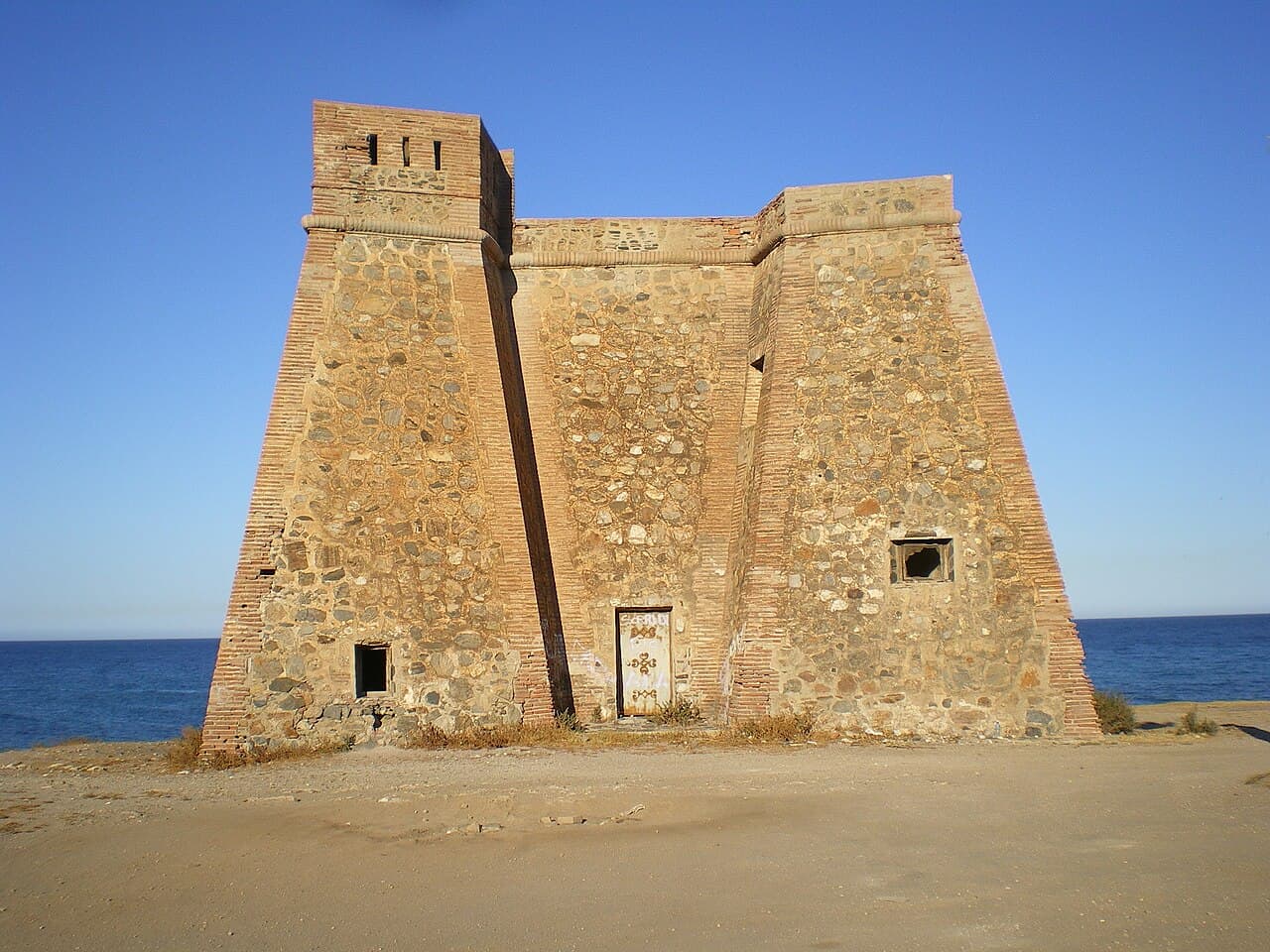
Macenas Tower, locally known as Castillo de Macenas, is a remarkable example of 18th-century Spanish coastal military architecture located on the beach south of the village of Ventanicas-el-Cantal in the province of Almería, Spain. This horseshoe-shaped artillery tower was constructed in the second half of the 18th century, during the reign of King Charles III of Spain, as part of a network of coastal defenses designed to protect the vulnerable Mediterranean shoreline from seaborne threats such as piracy and foreign invasions.
The tower's strategic position on a slightly elevated terrain about 27 meters above sea level provided a commanding view of the sea, enabling early detection of approaching vessels. Its architectural design, known locally as torre de pezuña or torre de herradura, features a semicircular plan with a diameter between 10.7 and 12.5 meters, not including the sloped base, and a height of approximately 11.7 meters. This horseshoe-type design was typical for coastal artillery towers in the region, including its counterparts like the Mesa Roldán and Cristal towers in Almería, allowing for effective artillery coverage over the surrounding waters.
Architectural features and military function
The tower was originally accessed via a doorway located on the first floor, reachable only by a rope ladder, a defensive feature that minimized the risk of enemy intrusion. Internally, the tower is divided into three vaulted floors. The lowest level served as a secure storage area for gunpowder and other munitions, critical for sustained defense operations. The middle floor contained living quarters and a kitchen, accommodating the garrison stationed there. The roof was designed as a gun platform, equipped with artillery pieces mounted on a raised barbette, enabling the cannons to fire over the parapet.
In 1803, records by Felipe de Paz indicate that Macenas Tower was armed with two 24-pounder cannons, a substantial artillery complement for a coastal watchtower of its size. The parapet was tall and included narrow loopholes, which allowed defenders to use rifles aimed inland while remaining protected, thus providing a layered defense system against both naval and land-based threats.
Historical usage and modifications
By 1830, the tower was reported to be in disrepair but remained manned by a corporal and three guards, reflecting its ongoing role in coastal surveillance despite reduced artillery capability. In 1873, the adjacent presence of a customs house (house-barracks) indicated the tower's involvement in monitoring maritime trade and preventing smuggling along this stretch of the Spanish coast.
During the 20th century, particularly around the time of the Spanish Civil War, the tower was used by the Guardia Civil, who made significant modifications including the insertion of a ground floor entrance to improve access. This alteration remains visible today and marks the tower's adaptation to modern military needs while preserving its historic fabric.
Preservation and cultural significance
Today, Macenas Tower stands as a well-preserved monument, cataloged under the official code AL-CAS-140. It is recognized as a Bien de Interés Cultural monument under Spanish heritage laws, with formal conservation measures dating back to a 1949 decree and reinforced by the Historical Heritage Law of 1985. The regional government of Andalucía granted special acknowledgment in 1993, underscoring the tower's cultural and historical importance.
The tower's preservation offers valuable insight into 18th-century coastal defense strategies and architectural techniques in Spain. Its robust masonry construction, vaulted interiors, and strategic design exemplify military engineering adapted to the challenges of maritime defense during the post-Renaissance period.
Visiting Macenas Tower today
The exterior of Macenas Tower is freely accessible to visitors, providing an opportunity to appreciate its imposing silhouette against the coastal landscape. Although the interior is not regularly open to the public, the tower remains an evocative landmark for those interested in military history and coastal fortifications. Nearby, visitors can also explore the Pirulico Tower, another historic fortification contributing to the rich heritage of Almería's coastline.
Macenas Tower serves as a tangible connection to Spain's efforts to secure its Mediterranean shores during a turbulent era marked by geopolitical conflicts and maritime threats. Its enduring presence continues to inspire appreciation for historical military architecture and the legacy of coastal defense.
Frequently asked questions (FAQ)
- How do I visit Macenas Tower?
- The exterior of Macenas Tower is freely accessible to visitors year-round. However, the interior is generally not open to the public, so visitors can enjoy viewing the tower from outside and exploring the surrounding area.
- What is the historical significance of Macenas Tower?
- Macenas Tower was built in the 18th century as a coastal artillery defense tower during the reign of Charles III of Spain. It played a key role in protecting the Almería coastline from maritime threats and is recognized as a cultural heritage monument today.
- What architectural features make Macenas Tower unique?
- The tower's horseshoe-shaped design, vaulted interior floors, elevated first-floor entrance accessed by rope ladder, and rooftop artillery platform with loopholes are distinctive features reflecting 18th-century coastal military architecture.
- When was Macenas Tower built and by whom?
- Macenas Tower was constructed in the second half of the 18th century during the reign of King Charles III of Spain as part of a coastal defense network.
- Is Macenas Tower accessible for people with mobility issues?
- Due to its historic design, including an elevated entrance originally accessed by rope ladder and uneven terrain, Macenas Tower may present challenges for visitors with mobility issues. The exterior area is more accessible.

Information
Sources & official resources
Verify the information above using these authoritative references.
Loading map...
Visitor reviews
No reviews yet. Been here? Write the first review and help other travelers!
Write the first reviewVisited this castle? Share your experience
Your review helps other travelers and adds first-hand knowledge to our encyclopedia.