Lviv High Castle
Lviv High Castle stands as a monumental symbol of medieval fortification atop Castle Hill in the historic city of Lviv, Ukraine. Its origins trace back to the 13th century, when it was first established by the rulers of the Kingdom of Rus’. This strategic hilltop location provided a commanding view of the surrounding area, making it an ideal site for defense and governance. The castle's earliest incarnation was a wooden and earthwork fortress constructed under the reign of King Leo I of Halych (Lev Danilovich). It served not only as a military stronghold but also as the primary treasury and seat of royal authority, safeguarding invaluable insignia such as crowns, thrones, and crosses believed to contain fragments of the True Cross.
Early history and medieval origins
The castle's initial fortifications were typical of Rus’ defensive architecture, combining wooden palisades with earthen ramparts. In 1259, the fortress was dismantled by order of the Mongol commander Boroldai following Mongol incursions into the region. However, by 1270, the castle was rebuilt and successfully withstood a siege in 1287 led by Khan Telebuga, demonstrating its strategic importance in the volatile borderlands of Eastern Europe.
Despite this resilience, the wooden structure was destroyed in 1340 during the conquest of Lviv by King Casimir III of Poland. The castle suffered further damage during a Lithuanian assault in 1353. These events marked a turning point, as the region came under Polish control and the castle's role evolved accordingly.
Transformation into a stone fortress under polish rule
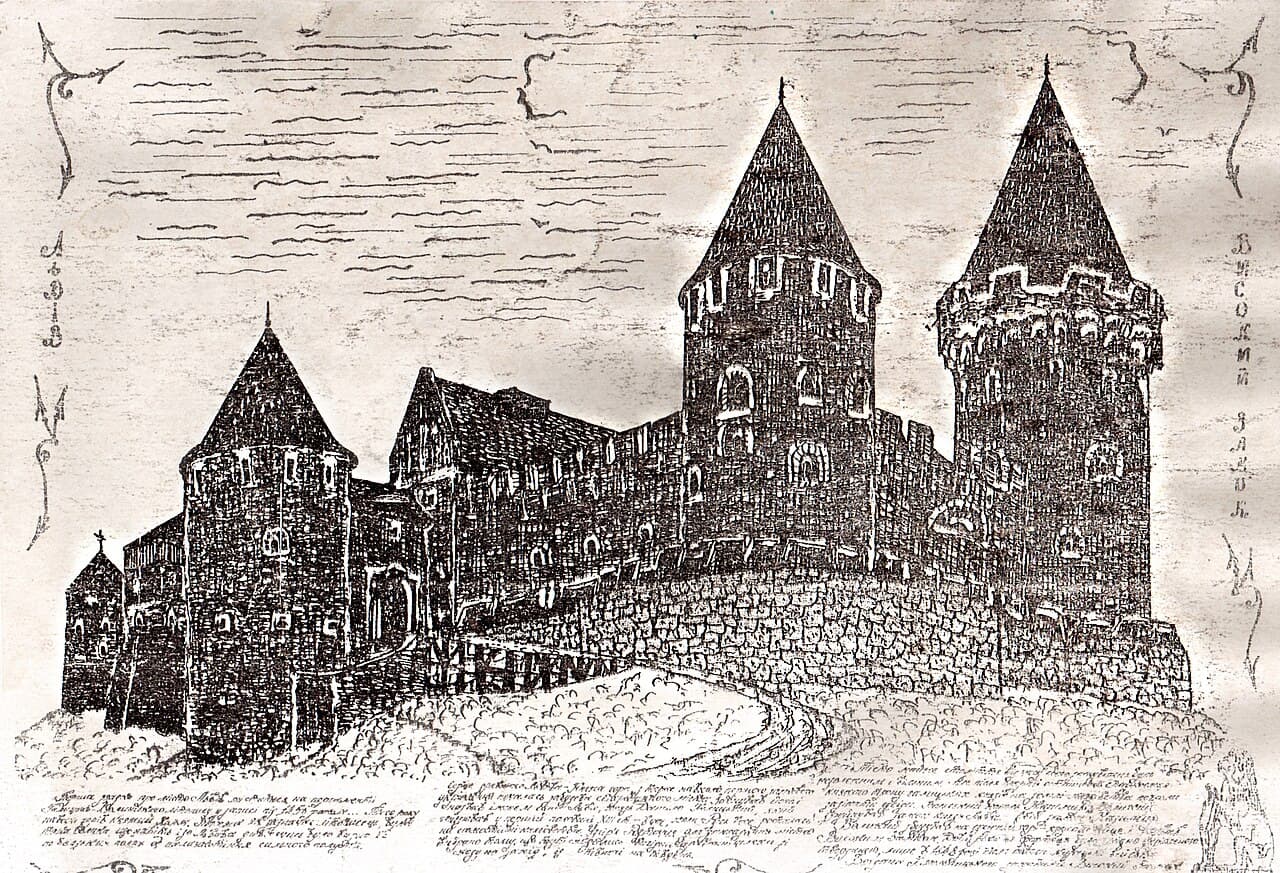
Following the incorporation of the region into the Kingdom of Poland and the establishment of the Ruthenian Voivodeship in 1387, King Casimir III commissioned the construction of a new stone castle in 1362. This marked a significant architectural and military upgrade from the earlier wooden fortifications. The stone fortress was designed as an elongated rectangular complex adapted to the contours of Castle Hill, featuring four corner towers with the tallest on the western side serving as a watchtower.
The castle's interior was divided into two courtyards separated by the princely palace. Within the fortified walls were essential support buildings including barracks, ammunition depots, and a deep well carved into the rock to ensure a reliable water supply during sieges. The fortress housed a permanent garrison and served as the residence of the royal starosta, the Polish royal official overseeing the region.
Military capabilities and architectural features
By the mid-16th century, the castle was a well-maintained military complex. It contained a chapel for religious services, vaulted guardrooms designed for defense, and an arsenal of ten cannons alongside various siege implements. The storage of large quantities of gunpowder and cannonballs attests to its preparedness for prolonged military engagements.
The residential quarters included arcaded galleries or krużganek, which are covered walkways supported by arches, adding architectural elegance to the fortress. The defensive walls were pierced with embrasures, allowing artillery fire while protecting defenders. This combination of robust military architecture and royal residential amenities reflects the dual function of the castle as both a fortress and a seat of governance.
Conflicts and decline
The castle witnessed numerous military conflicts over the centuries. In 1648, it fell to Cossack and peasant forces under Colonel Maksym Kryvonis during the Khmelnytsky Uprising. Later, in 1672, it was occupied by Turkish troops, and in 1704, Swedish forces inflicted heavy damage during the Great Northern War. These repeated assaults gradually weakened the fortress.
After the First Partition of Poland in 1772, the castle came under Austrian control. The Austrian administration began dismantling the fortifications, and throughout the 19th century, most of the stone structure was removed. Between 1868 and 1869, the remaining walls were demolished to construct the Union of Lublin Mound, a landscaped park commemorating the historic union between Poland and Lithuania.
Archaeological remains and modern legacy
Archaeological investigations have uncovered remnants of the original 13th-century wooden and stone fortifications, including a round tower and deposits of local stone. Scholars debate the interpretation of "tramy," which may refer to wooden beams or stone blocks used in the defensive structures.
The stone castle's footprint is still discernible, with a fragment of the southern defensive wall featuring characteristic embrasures surviving today. Much of the castle's stone was repurposed for building projects across Lviv, such as the tenement house at 3 Lychakivska Street. The rocky base of Castle Hill was also extensively quarried in the 19th century.
In 1869, the Union of Lublin Mound was erected atop the former castle site, symbolizing a new chapter in the hill's history. Later, in 1957, a 141-meter television tower was constructed on the ridge, dominating the modern skyline where the fortress once stood.
Although proposals to reconstruct the stone castle emerged in the early 21st century, they were never realized. Today, the site serves as a public park and historical landmark, offering visitors panoramic views of Lviv and a tangible connection to the region's rich medieval heritage.
Cultural significance and tourism
Lviv High Castle remains a powerful cultural symbol for the city and Ukraine at large. Its layered history reflects the complex political and military struggles that shaped Eastern Europe. The castle hill is a popular destination for both tourists and locals, providing scenic viewpoints, walking trails, and a place for reflection on the area's past.
The site offers educational opportunities through archaeological findings and preserved remnants, contributing to the understanding of medieval fortification techniques and regional history. Its integration into the urban fabric of Lviv highlights the ongoing dialogue between heritage conservation and modern urban development.
Frequently asked questions (FAQ)
- How do I get to Lviv High Castle?
- Lviv High Castle is located on Castle Hill in the center of Lviv and is accessible by foot from the city center via several walking paths.
- What remains can I see at Lviv High Castle today?
- Visitors can see fragments of the southern defensive wall with embrasures, the Union of Lublin Mound, and a television tower on the site.
- Is there an entrance fee to visit Lviv High Castle?
- No, visiting Lviv High Castle and the surrounding park is free of charge.
- When is the best time to visit Lviv High Castle?
- The best time to visit is during spring through autumn when the weather is pleasant and the panoramic views of Lviv are most enjoyable.
- Can I learn about the castle's history on site?
- Yes, informational plaques and guided tours are available to provide historical context and details about the castle's past.

Information
Opening hours
Open daily, daylight hours
Ticket prices
Free
Current owner
Municipality
Loading map...
Visitor reviews
No reviews yet. Been here? Write the first review and help other travelers!
Write the first reviewVisited this castle? Share your experience
Your review helps other travelers and adds first-hand knowledge to our encyclopedia.