Petit-Arnsberg Castle
Petit-Arnsberg Castle, known locally as Château du Petit-Arnsberg, is a notable medieval ruin perched above the village of Obersteinbach in the Bas-Rhin department of the Alsace region, also called Northern Alsace or the Northern Vosges. This hill castle is a significant example of late medieval fortifications in the area and offers insight into the turbulent feudal history of the region.
Historical background and ownership
The exact date of the castle's construction remains unknown, but it was first documented in 1316, indicating its establishment by the early 14th century. Initially, the castle was under the control of the Wasigenstein family who held it on behalf of the Abbey of Wissembourg. During this period, the castle served both as a defensive stronghold and a symbol of feudal power.
By the early 14th century, the lords of Petit-Arnsberg had gained a reputation as robber knights, engaging in banditry that threatened the surrounding region. This led to a military response, and in 1335, the castle was besieged successfully. Following the siege, Frédéric de Wasigenstein was compelled to sign a peace treaty with the city of Strasbourg, resulting in the confiscation of the castle from him.
After the Wasigenstein tenure, the castle passed into the hands of the Ochsenstein family around 1360. Later, in 1400, ownership transferred to Frédéric de Than, who mortgaged half the property to Louis de Lichtenberg in 1420. Towards the end of the 15th century, the castle came under the control of the Counts of Zweibrücken-Bitsch, who undertook restoration efforts in 1494.
During the 16th century, the castle was owned by the Counts of Hanau-Lichtenberg. However, its strategic importance diminished over time. The castle suffered significant damage during the Thirty Years' War in 1635 when it was destroyed and subsequently abandoned, never to be rebuilt.
Architectural features and layout
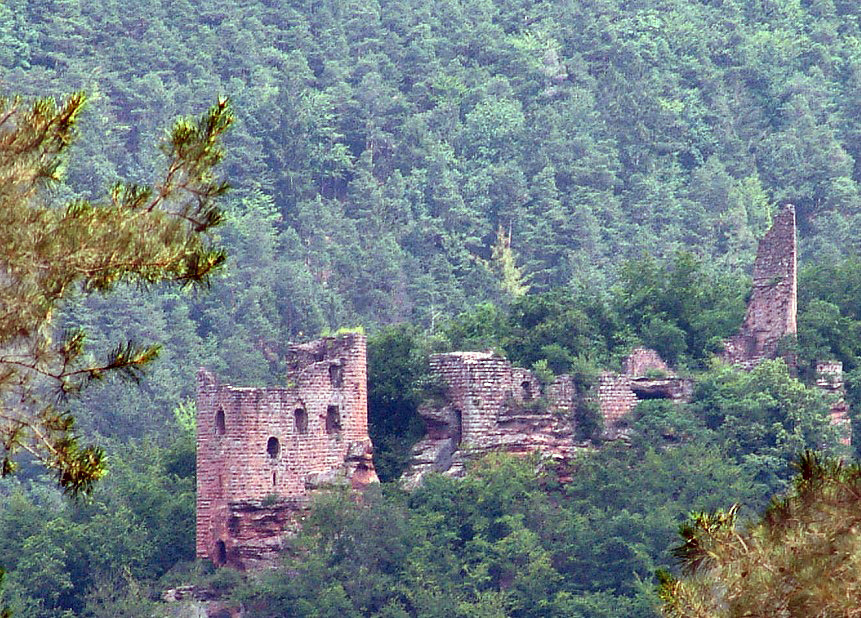
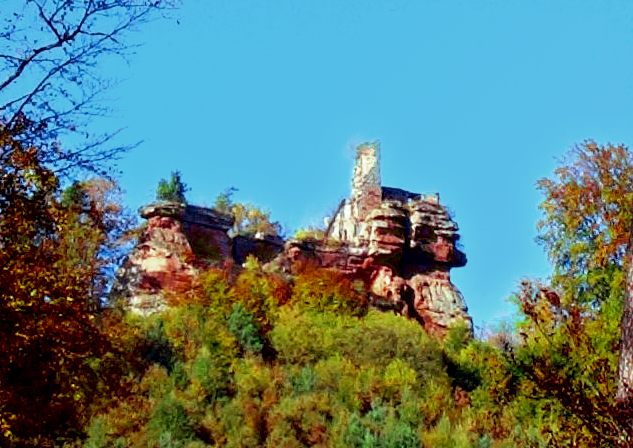
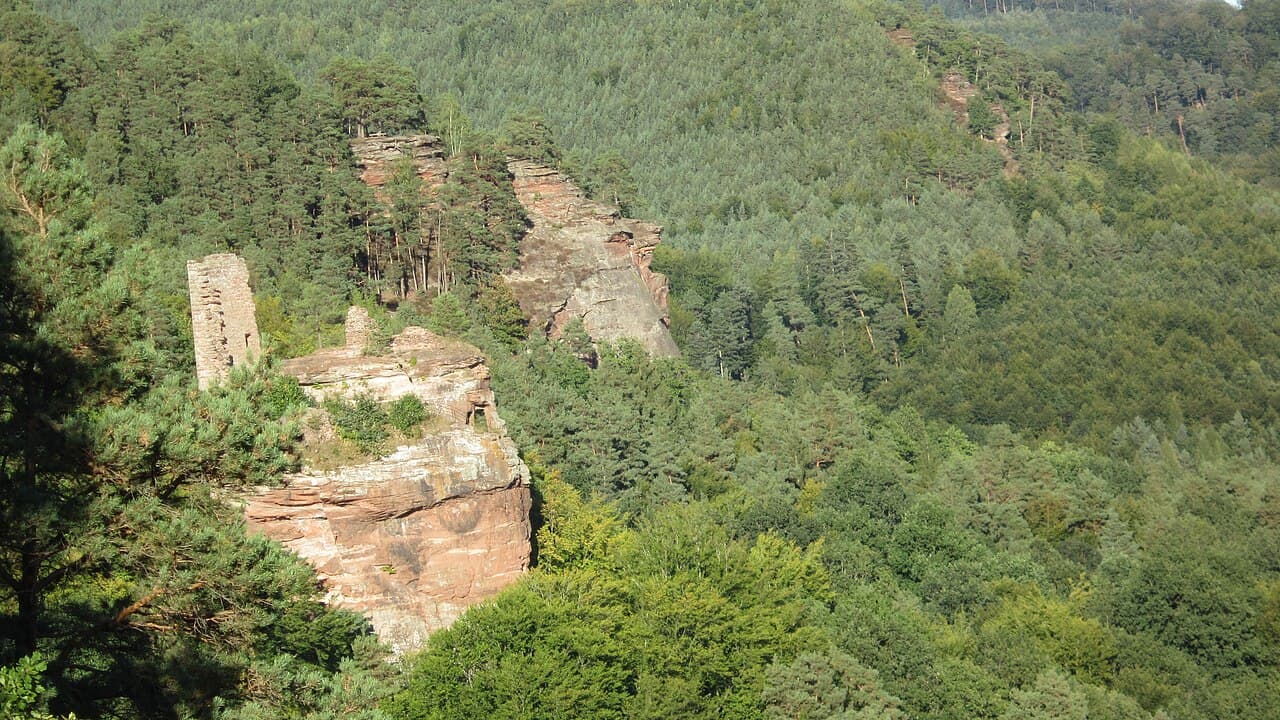
Petit-Arnsberg Castle is uniquely constructed on two sandstone rock formations separated by a deep crevice. This natural feature was incorporated into the castle's defensive design, creating a formidable barrier against attackers. The castle's layout adapts to the rocky terrain, with several rooms and chambers carved directly out of the sandstone, a characteristic feature of many castles in the Vosges region.
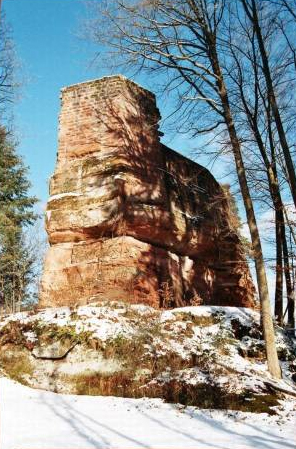
The ruins include the remains of a keep situated on the southern rock, which would have served as the last line of defense and the lord's residence. The castle walls and other fortifications are partially preserved, allowing visitors to appreciate the medieval construction techniques and the integration of natural rock formations into the castle's defenses.
The castle's elevated position on a hill provided commanding views of the surrounding landscape, essential for early warning and defense. The combination of natural rock formations with man-made structures exemplifies the strategic use of terrain in medieval castle construction.
Current condition and visitor information
Today, Petit-Arnsberg Castle stands as a well-preserved ruin that is freely accessible to the public. The site offers a compact but evocative glimpse into medieval fortification architecture. Visitors can explore the rock-carved rooms and the remains of the keep, walking along the rugged terrain that once formed the castle's defenses.
The castle has been officially recognized for its cultural and historical importance, having been listed as a monument historique by the French Ministry of Culture since 1898. This designation helps protect the site and promotes its preservation for future generations.
Due to its location in the scenic Northern Vosges, the castle is a popular destination for hikers and history enthusiasts. The surrounding area provides additional opportunities for exploring other medieval sites and enjoying the natural beauty of Alsace.
Historical significance and legacy
The history of Petit-Arnsberg Castle reflects the complex feudal dynamics of the Alsace region during the Middle Ages. Its association with prominent noble families such as the Wasigenstein, Ochsenstein, Zweibrücken-Bitsch, and Hanau-Lichtenberg highlights the castle's role in regional power struggles.
The castle's downfall during the Thirty Years' War illustrates the widespread destruction experienced throughout Europe during this period. Its abandonment and ruin stand as a testament to the changing nature of warfare and the decline of feudal fortresses in the face of new military technologies and political shifts.
Today, the ruins of Petit-Arnsberg offer valuable insights into medieval castle construction, feudal history, and the adaptation of architecture to natural landscapes. The site continues to attract scholars, tourists, and locals interested in the rich heritage of Alsace.
Frequently asked questions (FAQ)
- How do I get to Petit-Arnsberg Castle?
- Petit-Arnsberg Castle is located north of Obersteinbach in the Bas-Rhin department of Alsace, France. It is accessible by hiking trails from the village, with signposted paths suitable for visitors.
- What is the historical significance of Petit-Arnsberg Castle?
- The castle played a key role in regional feudal conflicts and was associated with notable noble families such as the Wasigenstein and Ochsenstein. It was besieged in 1335 due to the lords' activities as robber knights.
- Can I explore the castle ruins freely?
- Yes, the ruins of Petit-Arnsberg Castle are freely accessible to the public. Visitors can explore the rock-carved rooms and the remains of the keep without restrictions.
- When was Petit-Arnsberg Castle destroyed?
- The castle was destroyed in 1635 during the Thirty Years' War and was never rebuilt afterwards.
- Is there an entrance fee to visit Petit-Arnsberg Castle?
- There is no entrance fee to visit the castle ruins; access is free to all visitors.
Photo gallery

Information
Current owner
French Ministry of Culture
Loading map...
Visitor reviews
No reviews yet. Been here? Write the first review and help other travelers!
Write the first reviewVisited this castle? Share your experience
Your review helps other travelers and adds first-hand knowledge to our encyclopedia.