Lumley Castle
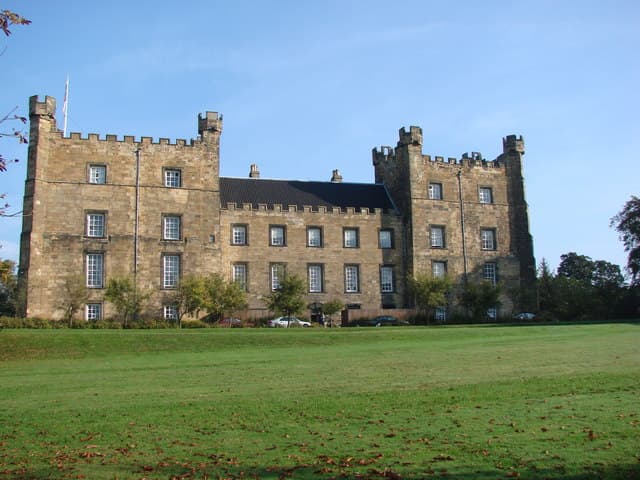
Lumley Castle stands as a remarkable example of a 14th-century quadrangular hill castle located in Chester-le-Street, United Kingdom. Constructed in 1389 by Sir Ralph Lumley, the castle evolved from a manor house into a fortified residence that reflects the architectural and social transformations of medieval England. Its strategic location atop a hill, elevated 41 meters above sea level, provided defensive advantages and oversight of the surrounding valley and terrain.
Medieval origins and early history
The castle’s foundation is rooted in the late 14th century during a period marked by political unrest and border conflicts between England and Scotland. Sir Ralph Lumley, a nobleman and military figure, initiated the transformation of his family manor into a quadrangular stone fortress. This design featured four ranges of buildings enclosing a central courtyard, a common layout for fortified residences aiming to balance defense with domestic needs.
Following its construction, Lumley Castle experienced a turbulent history tied closely to the fortunes of the Lumley family. Sir Ralph Lumley was implicated in a conspiracy against King Henry IV, resulting in his execution and the temporary confiscation of the castle by the Earl of Somerset. Control returned to the Lumleys in 1421 under Thomas Lumley, Sir Ralph's grandson, restoring the family’s influence and stewardship.
Architectural evolution and adaptations
Early 17th-century renovations
In the early 1600s, the castle underwent significant modifications under John Lumley, 1st Baron Lumley. These renovations reflected a shift from purely defensive architecture to enhancing residential comfort. Enlarged windows were installed to admit more natural light, a key feature indicating the castle’s adaptation to Renaissance influences and changing lifestyles.
The great hall, a focal point of medieval castles, was updated with a large fireplace, emblematic of the period’s architectural trends toward warmth and domesticity. Within the castle’s interiors, a distinctive lavabo crafted from black and white marble bears the pelican emblem of the Lumley family crest, symbolizing piety and family identity.
Georgian period influences
During the Georgian era, Lumley Castle saw further architectural enhancements. Tradition attributes some of these changes to Sir John Vanbrugh, a renowned architect of the period, though documentary evidence for his direct involvement is absent. The creation of a library space during this time, now functioning as the Black Knight Restaurant, exemplifies the castle’s ongoing evolution and adaptation to contemporary tastes and functions.
Historical significance and notable events
One of the castle’s most historically significant moments occurred in April 1603, when King James VI of Scotland stayed at Lumley Castle en route to London to assume the English throne as King James I. The former chapel where he lodged has been preserved and converted into a hotel suite named the King James Suite, commemorating this royal visit and linking the castle to the broader narrative of British monarchy.
In the 19th century, the castle transitioned into the residence of the Bishop of Durham. This change followed Bishop William Van Mildert’s decision to transfer Durham Castle to the newly founded University of Durham. Subsequently, Lumley Castle was adapted to serve as student accommodation for University College, Durham, housing first-year undergraduates known as "Castlemen" until the 1960s. This period highlights the castle’s versatility and continued relevance through centuries.
Modern use and cultural heritage
Since 1976, Lumley Castle has operated as a hotel managed by No Ordinary Hotels, with ownership retained by the Earl of Scarbrough. Its scenic grounds provide a picturesque backdrop to the Durham County Cricket Club’s Riverside Ground, integrating the castle into contemporary sporting culture.
In recent years, the castle has embraced cultural tourism by introducing an escape room experience in its old beer cellar themed around the local legend of Lily of Lumley. This attraction connects visitors with the castle’s folklore and medieval past in an engaging, interactive format.
Architectural features and preservation
Lumley Castle retains much of its original quadrangular plan, with stone walls enclosing a central courtyard surrounded by residential and service buildings. The castle’s great hall remains a highlight, showcasing the early 17th-century fireplace and the marble lavabo with the family crest, illustrating the blend of defensive and domestic architectural elements.
The chapel, once central to the castle’s spiritual life, has been sensitively converted into a hotel suite, preserving historical associations while adapting to modern hospitality needs. The library space from the Georgian period now serves as the Black Knight Restaurant, a testament to the castle’s layered architectural history.
The subterranean beer cellar reflects the castle’s medieval utility spaces and has been repurposed for contemporary cultural use. The castle’s Grade I listing underscores its architectural and historic importance, ensuring careful preservation of its fabric and features.
Legends and ghost stories
Lumley Castle is enveloped in rich folklore, most notably the ghost story of Lily Lumley. According to local legend, Lily was murdered and cast down a well by priests as punishment for rejecting Catholicism. While this tale lacks documentary support, it remains a popular narrative among visitors and local communities, adding a layer of mystique to the castle’s history.
These ghost stories have been recounted by many, including members of the cricket community and visiting teams, contributing to Lumley Castle’s reputation as one of England’s haunted historic sites.
Location and strategic importance
Situated in Chester-le-Street, Lumley Castle occupies a commanding position in the landscape. Its elevation above the valley floor allowed for surveillance and defense against potential invaders, a critical consideration during the turbulent border conflicts of the medieval period. The surrounding terrain, with flat lands to the southeast and rising hills to the northwest, enhanced its strategic value.
This location also facilitated the castle’s role as a noble residence and later as an institutional building, benefiting from accessibility and prominence within the region.
Frequently asked questions (FAQ)
- When was Lumley Castle originally built?
- Lumley Castle was originally constructed in 1389 by Sir Ralph Lumley, transforming a manor house into a fortified quadrangular castle.
- What architectural style characterizes Lumley Castle?
- Lumley Castle features a mixed architectural style reflecting its medieval origins and later Georgian and early modern modifications.
- Can visitors stay overnight at Lumley Castle?
- Yes, Lumley Castle operates as a hotel offering accommodation in historic suites, including the King James Suite, which commemorates King James I's stay.
- Is Lumley Castle accessible to visitors with mobility issues?
- The castle has some accessibility adaptations, but as a historic building with multiple floors and uneven surfaces, visitors with mobility issues should contact the hotel in advance for assistance.
- What is the legend of Lily Lumley associated with the castle?
- The legend tells of Lily Lumley, who was allegedly murdered and thrown down a well by priests for rejecting Catholicism. This ghost story is popular locally but lacks historical documentation.
- Are there any special events or activities at Lumley Castle?
- Lumley Castle hosts various events and offers an escape room experience themed around the Lily Lumley legend, providing interactive cultural engagement for visitors.
- How can visitors reach Lumley Castle from nearby cities?
- Lumley Castle is located in Chester-le-Street, accessible by road and public transport from Durham and Newcastle, with parking available on site.
Photo gallery

Information
Opening hours
Hotel and event hours vary; advance booking recommended
Ticket prices
Varies by event and hotel stay
Current owner
Earl of Scarbrough
Website
Visit websiteSources & official resources
Verify the information above using these authoritative references.
Loading map...
Visitor reviews
No reviews yet. Been here? Write the first review and help other travelers!
Write the first reviewVisited this castle? Share your experience
Your review helps other travelers and adds first-hand knowledge to our encyclopedia.