Durham Castle
Durham Castle is a remarkable example of Norman military architecture located in the historic city of Durham, England. Perched on a strategic hill above the River Wear, the castle has been continuously occupied since its construction in the 11th century. Since 1840, it has served as the home of University College, Durham, blending centuries of medieval history with academic life. This enduring use makes Durham Castle one of the most significant Norman fortresses in England, both architecturally and historically.
The castle's commanding position on a peninsula opposite the iconic Durham Cathedral highlights its historical role in securing Norman control over northern England. Together, the castle and cathedral form a UNESCO World Heritage Site, celebrated for their exemplary Romanesque (Norman) architectural style and their importance in medieval ecclesiastical and secular power. The castle was originally built by order of William the Conqueror beginning in 1072 as a motte-and-bailey fortress to establish Norman dominance and defend against Scottish incursions.
Historical significance and development
The origins of Durham Castle lie in the turbulent aftermath of the Norman Conquest. Constructed on a 35-meter high hill, the castle's initial wooden structures were soon replaced by robust stone fortifications by the end of the 11th century. Its early history is marked by conflict, including the notable siege of 1080 when Bishop Walcher was killed during a local uprising. The castle served as the residence of the Prince Bishops of Durham, who wielded both spiritual and temporal power, effectively ruling the region with authority to raise armies, collect taxes, and administer justice.
Throughout the 12th and 13th centuries, successive bishops such as Hugh de Puiset and Thomas Hatfield expanded and fortified the castle, adapting it to the evolving needs of defense and governance. The castle was a key stronghold during the Anglo-Scottish conflicts, reflecting its strategic importance on England's northern frontier. By the late medieval period, its military role diminished as it became more a symbol of the prince-bishops' authority and residence.
The abolition of the prince-bishopric in 1836 marked a major transition for the castle. Shortly afterward, Bishop William Van Mildert donated the castle to Durham University, initiating its current role as an academic institution. This transition preserved the castle's continuous occupation, making it a living monument bridging medieval history and modern education.
Architectural features and layout
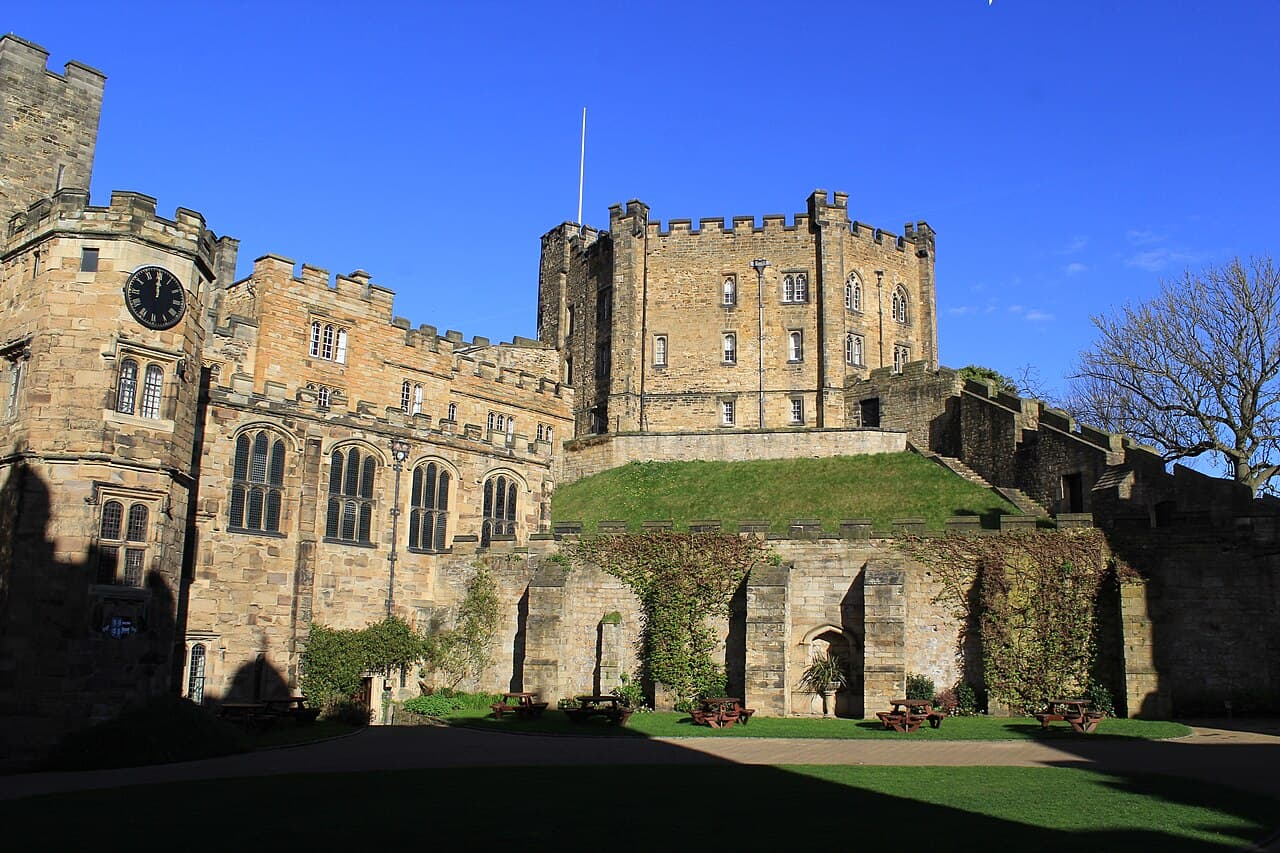
Durham Castle is laid out around an irregularly shaped central courtyard, enclosed by a series of buildings and defensive walls. The complex retains elements from its Norman origins through to later medieval and post-medieval modifications. The castle includes inner and outer baileys, a keep, curtain walls, and a gatehouse, all reflecting its development from a motte-and-bailey fortress to a fortified residence.
The keep and defensive structures
The keep is an irregular octagonal stone tower approximately 23 meters long and 20 meters wide, built atop a 14-meter high motte. Originally constructed in wood, it was replaced with stone under Bishop Ranulf Flambard and later rebuilt in the 14th century by Bishop Hatfield. The keep's current form includes significant 19th-century alterations, including the removal of upper floors to accommodate its use as student accommodation.
The castle's defenses include a gatehouse with a bastion, known as the gate bastion, remodeled in the 18th century by architect James Wyatt in a Gothic style. The gatehouse features a vaulted Norman archway and served as the main entrance. The Black Staircase, a stair tower built in the 17th century, is notable for its inward-tilted steps and carved wooden paneling, with structural reinforcements added in the 20th century to address deterioration.
Residential and ceremonial spaces
The Great Hall, constructed in the early 14th century by Bishop Antony Bek, was originally the castle's main dining hall. Measuring approximately 14 meters high, 11 meters wide, and 31 meters long, the hall remains a prominent feature, despite later reductions in size. Adjacent to it is the Tunstall Gallery, which connects the Great Hall to the chapel and houses the castle's museum collections.
The bishop's apartments and dining rooms were extensively remodeled in the 18th and 19th centuries, featuring richly decorated interiors with 17th-century Flemish tapestries, 16th-century carved misericords, and period furniture including a notable four-poster bed. These spaces reflect the castle's evolution from a fortress to a palatial residence.
Chapels and religious significance
Durham Castle contains two surviving chapels, underscoring its religious importance. The Norman Chapel, dating from around 1078, is distinguished by its Anglian architectural style and features three vaulted bays supported by decorated columns carved with grotesque and animal figures. The columns show signs of subsidence, leaning due to ground movement beneath the structure.
The Tunstall Chapel, built in the 16th century on the site of an earlier Norman chapel, continues to serve as a place of worship within the college. These chapels highlight the castle's dual role as both a defensive fortress and a religious center for the prince-bishops.
Archaeological findings and preservation
Archaeological excavations in the 1970s uncovered a well beneath the courtyard, dating to earlier phases of occupation. The western wall facing the River Wear required underpinning in the late 19th century due to subsidence, a challenge that continues to affect the castle's fabric. Despite these issues, the castle remains largely intact and well-preserved, thanks to ongoing restorations.
The castle houses a museum with over 200 paintings, primarily portraits of bishops and views of Durham, alongside silverware, tapestries, furniture, and medieval arms and armor displayed in the Great Hall and Tunstall Gallery. These collections enrich the visitor experience and provide insight into the castle's history and the lives of its inhabitants.
Visiting durham castle today
Today, Durham Castle is a vibrant part of Durham University, housing over 100 students. Public access is available only through guided tours, which offer visitors a chance to explore the castle's historic interiors, including the Great Hall, chapels, and museum collections. The castle's unique combination of medieval architecture and academic life makes it a compelling destination for history enthusiasts and tourists alike.
Its designation as a UNESCO World Heritage Site alongside Durham Cathedral underscores its global cultural and architectural significance. Visitors are encouraged to appreciate the castle not only as a monument of Norman military engineering but also as a living institution that continues to shape the heritage of northern England.
Frequently asked questions (FAQ)
- How do I get to Durham Castle?
- Durham Castle is easily accessible by public transport, with regular train services to Durham Station, which is approximately a 15-minute walk from the castle. If you're driving, there are several parking options nearby, but please note that parking may be limited in the city center.
- What is the historical significance of Durham Castle?
- Durham Castle, a UNESCO World Heritage Site, has a rich history dating back to the 11th century when it was built by the Normans. It served as a fortress and later became the residence of the Bishop of Durham, playing a crucial role in the region's governance and defense.
- When was Durham Castle built?
- Durham Castle was constructed in 1072 and has undergone various modifications and restorations over the centuries. Its architectural evolution reflects the changing styles and functions of the building, making it an important example of Norman military architecture.
- Can I visit Durham Castle?
- Yes, Durham Castle is open to the public, and guided tours are available to provide visitors with insights into its history and architecture. It is advisable to book tickets in advance, especially during peak tourist seasons, to ensure a spot on the tour.
- Why is Durham Castle a popular tourist attraction?
- Durham Castle attracts visitors due to its stunning architecture, rich history, and its status as part of the wider UNESCO World Heritage Site that includes Durham Cathedral. The castle's picturesque setting and fascinating stories make it a must-visit for history enthusiasts and tourists alike.
- Is it possible to access all areas of Durham Castle?
- While some areas of Durham Castle are accessible to visitors, certain parts may have restricted access due to their historical significance or ongoing preservation efforts. The guided tours typically cover the main areas of interest, ensuring that visitors can experience the highlights of the castle.
- What are the opening hours for Durham Castle?
- Durham Castle is generally open for tours from 10:00 AM to 5:00 PM, with varying hours during different seasons. It is recommended to check the official website for the most current opening hours and any special events that may affect access.
- What is the ticket price for visiting Durham Castle?
- Ticket prices for Durham Castle vary, with concessions available for children, students, and seniors. As prices may change, it is best to consult the official website before your visit for the most up-to-date information on ticketing and any special offers.
- When is the best time to visit Durham Castle?
- The best time to visit Durham Castle is during the spring and early autumn months when the weather is milder, and the gardens are in full bloom. Additionally, visiting during weekdays may help you avoid larger crowds, allowing for a more enjoyable experience.
- Are there any nearby attractions to visit after Durham Castle?
- Yes, after exploring Durham Castle, visitors can also enjoy the magnificent Durham Cathedral, another UNESCO World Heritage Site located nearby. The charming streets of Durham city, along with the River Wear, offer plenty of opportunities for scenic walks and additional attractions.
Photo gallery

Information
Website
Visit websiteSources & official resources
Verify the information above using these authoritative references.
Loading map...
Visitor reviews
No reviews yet. Been here? Write the first review and help other travelers!
Write the first reviewVisited this castle? Share your experience
Your review helps other travelers and adds first-hand knowledge to our encyclopedia.