Ludlow Castle
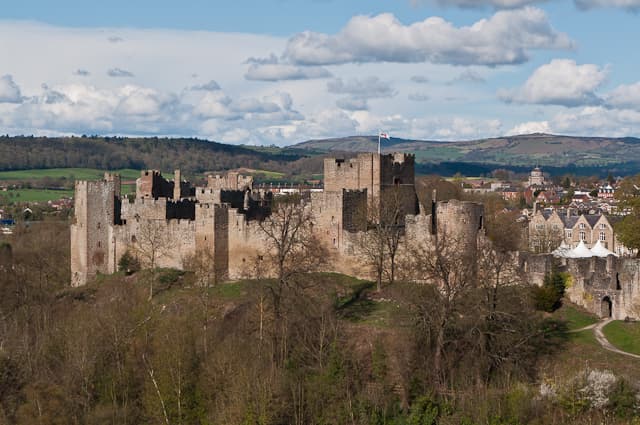
Ludlow Castle stands as a remarkable example of a medieval hill castle in the historic market town of Ludlow, located in the English county of Shropshire. Perched on a commanding rocky promontory overlooking the River Teme, the castle's strategic position offered both natural defense and control over the surrounding landscape. Founded shortly after the Norman Conquest around 1075 by Walter de Lacy, Ludlow Castle is among the earliest stone castles constructed in England, marking a significant development in Norman military architecture.
The castle's long and varied history reflects the turbulent political and military landscape of medieval and early modern England and Wales. Throughout the centuries, Ludlow Castle witnessed numerous sieges, ownership changes, and architectural adaptations that illustrate the evolution of castle design from the late 11th century through the 17th century. It played a pivotal role in regional governance as the seat of the Council of Wales and the Marches, effectively serving as the administrative capital of Wales for several centuries.
The origins and early medieval fortifications
Initially known as Dinham Castle, Ludlow was established as a Norman stronghold to secure the de Lacy family's extensive estates in the Welsh Marches. The castle's earliest phase featured typical Norman defensive elements including a Great Tower (donjon) and robust curtain walls built primarily from greenish-grey siltstone rubble with red sandstone detailing. The location on a high rocky ridge provided natural defenses, complemented by a deep rock-cut ditch on the south and west sides.
During the 12th century, Ludlow Castle became a focal point during the civil war known as The Anarchy, a contest for the English throne between King Stephen and Empress Matilda. The castle changed hands multiple times between the de Lacy family and rival claimants such as Roger FitzMiles and Josce de Dinan. To bolster its defenses, a large outer courtyard or outer bailey was added, along with a fortified gatehouse and additional towers.
13th and 14th century expansions and architectural developments
In the mid-13th century, Ludlow Castle passed to Geoffrey de Geneville, who undertook significant rebuilding projects. He reconstructed parts of the inner bailey, enhancing the castle's residential and defensive capabilities. Key structures from this period include the Great Hall, which served as a venue for courtly assemblies, and the Solar block, providing private living quarters. Geoffrey's tenure coincided with the Second Barons’ War, during which the castle's strategic importance was affirmed.
At the dawn of the 14th century, ownership transferred to Roger Mortimer, a powerful Marcher lord. Mortimer expanded the castle's internal complex, adding the Great Chamber block around 1320, a grand residential building featuring carved corbel heads possibly depicting King Edward II and Queen Isabella. He also commissioned the construction of a chapel dedicated to Saint Peter in the outer bailey, reflecting the castle's dual role as a fortress and noble residence.
Architectural features of the Mortimer period
The Mortimer renovations emphasized Norman architectural traditions with robust masonry and symbolic decoration. The castle's curtain walls were reinforced, and Mortimer’s Tower, a D-shaped gatehouse tower, was adapted into a multi-story defensive tower. The chapel and other additions also showcased the evolving Gothic style while maintaining Norman structural elements.
Ludlow Castle in the Wars of the Roses and Tudor period
In 1425, Richard, Duke of York, inherited Ludlow Castle, linking it to the Yorkist cause during the Wars of the Roses. The castle served as a symbol of Yorkist authority in the region and a key administrative center. Upon his son Edward IV's accession to the throne in 1461, Ludlow became Crown property.
During the 16th century, Ludlow Castle was extensively renovated to accommodate its new role as the seat of the Council of Wales and the Marches. This council held judicial and administrative authority over Wales and the bordering English counties. The castle's interiors were upgraded with Tudor architectural features, including the construction of the porter’s lodge and prison buildings in the outer bailey, both exemplifying finely cut ashlar stonework.
The castle's circular Romanesque chapel of Saint Mary Magdalene, dating from the 12th century and modeled after the Church of the Holy Sepulchre in Jerusalem, was heavily altered during this period but remains a rare example of such a structure in England.
Cultural significance and the English Civil War
By the early 17th century, Ludlow Castle was not only a military and administrative center but also a cultural venue. It hosted events such as the 1634 premiere of John Milton’s masque Comus, reflecting the castle's role in the artistic life of the period.
During the English Civil War, Ludlow was held by Royalist forces until it was besieged and captured by Parliamentarian troops in 1646. The castle's furnishings were sold off, and it served as a garrison during the subsequent Interregnum. Although the monarchy was restored in 1660 and the Council of Wales re-established, Ludlow Castle never regained its former prominence.
Decline, restoration, and modern preservation
Following the abolition of the Council of Wales in 1689, Ludlow Castle entered a period of decline. In 1772, Henry Herbert, 1st Earl of Powis, leased the site from the Crown and began landscaping and basic repairs. Later, Edward Clive purchased the castle outright in 1811 and constructed Castle House within the outer bailey, converting former tennis courts and inns into a mansion that remains in use today.
The 19th century saw growing public interest in Ludlow Castle, aided by improved transport links such as the railway. Artists and visitors were drawn to its picturesque ruins, which were used for various purposes including grazing and militia storage.
Archaeological investigations in the early 20th century uncovered important insights into the castle's complex history. Ludlow Castle was designated as a protected ancient monument in 1915. During World War II, the site served military functions, and post-war conservation efforts have stabilized and preserved the ruins.
Today, Ludlow Castle remains under the ownership of the Earl of Powis and is managed as a historic site attracting tourists and hosting cultural events. Its extensive ruins, including the Great Tower, solar block, Great Hall, and the rare circular chapel, represent an extraordinarily complete multiphase castle complex. English Heritage regards Ludlow as one of the most beautiful and historically significant castles in England.
Architectural layout and key structures
The castle's defensive design
Ludlow Castle covers approximately 2 hectares (5 acres) on a roughly rectangular plateau measuring about 152 by 133 meters (500 by 435 feet). The castle is divided into three main baileys: the outer bailey, the inner bailey, and the innermost bailey, each enclosed by thick curtain walls and connected by fortified gatehouses.
The outer bailey includes the 19th-century Castle House and the Beacon Tower, which overlooks the town. It also contains the 16th-century porter’s lodge, prison, and stable block, as well as the remains of St Peter’s Chapel, later converted into a courthouse. The outer bailey's defenses were enhanced by Mortimer’s Tower, a D-shaped gatehouse tower adapted into a multi-story defensive structure.
Inner and innermost baileys
The inner bailey is surrounded by curtain walls up to 1.8 meters thick and protected by a deep rock-cut ditch on the south and west sides. The gatehouse, built in 1581, features coats of arms of Sir Henry Sidney and Queen Elizabeth I and originally served as lodging for judges attending the council court.
The innermost bailey contains the castle's most significant medieval buildings, including the Great Tower or donjon, a four-story Norman keep with thick walls and vaulted Norman arcading in the basement. The Great Hall, Solar block, and Great Chamber block form the core residential and ceremonial spaces. Two Norman towers, the North-West and North-East (Pendover) towers, flank the northern side, while the Closet Tower, West (Postern) Tower, and South-West (Oven) Tower complete the defensive circuit.
Unique features
The circular Romanesque chapel of Saint Mary Magdalene, modeled on the Church of the Holy Sepulchre in Jerusalem, is a rare architectural feature in England. Its 12th-century origins and arcaded bays make it a significant example of Norman religious architecture. The castle also contains Tudor lodgings that were adapted over time to serve as offices and private apartments for council officials.
Frequently asked questions (FAQ)
- How do I get to Ludlow Castle?
- Ludlow Castle is located in the town of Ludlow, Shropshire, accessible by car via the A49 road and by train to Ludlow railway station. The castle is a short walk from the town center.
- What are the opening hours of Ludlow Castle?
- Ludlow Castle is typically open to visitors from 10:00 to 16:00 daily, though hours may vary seasonally. It is advisable to check ahead for any special closures or events.
- Is there an admission fee to visit Ludlow Castle?
- Admission fees apply, with prices around £7 for adults and discounts for children and seniors. Family tickets and annual passes may also be available.
- What architectural styles are present at Ludlow Castle?
- Ludlow Castle features a mix of Norman Romanesque, Gothic, and Tudor architectural styles, reflecting its long history and multiple phases of construction and renovation.
- Can I explore the interior of Ludlow Castle?
- Visitors can explore much of the castle's ruins, including the Great Tower, Great Hall, and chapel. Some areas may be restricted for safety reasons, but guided tours are often available.
- Why is Ludlow Castle historically significant?
- Ludlow Castle played a key role in the Norman consolidation of the Welsh Marches, the Wars of the Roses, and as the seat of the Council of Wales and the Marches, making it a vital political and military site.
Photo gallery

Information
Sources & official resources
Verify the information above using these authoritative references.
Loading map...
Visitor reviews
No reviews yet. Been here? Write the first review and help other travelers!
Write the first reviewVisited this castle? Share your experience
Your review helps other travelers and adds first-hand knowledge to our encyclopedia.