Löwenburg and Philippsburg Castles
Situated on a prominent hill spur above the picturesque village of Monreal in Germany's Elzbach valley, the Löwenburg and Philippsburg castles stand as evocative ruins that offer insight into medieval fortification and noble family dynamics during the high medieval period. These two neighboring hill castles are remarkable for their intertwined history and strategic placement within the Rhineland region.
Historical background and origins
The Löwenburg castle was first documented in 1229, marking its establishment in the early 13th century. It was constructed by Count Hermann III of Virneburg, who controversially built it on land belonging to his brother, Philip, following a partition agreement that divided their inherited territories. This act sparked a fraternal feud that was ultimately resolved through legal means, with Philip relinquishing his rights over the area to Hermann. The Philippsburg, built during the same century, is notably smaller and earned the local nickname "Rech," meaning "deer," in contrast to the "lion" (Löwenburg). Its purpose is debated; some historians view it as an advanced outwork of the Löwenburg, while local tradition holds that it was Philip's response to Hermann's unauthorized construction.
Strategic importance and political affiliations
Monreal was located within the territory of the Electorate of Trier, yet the counts of Virneburg maintained strong ties with the Electorate of Cologne. Their primary objective was securing ecclesiastical benefices for their numerous descendants, which was a common strategy among noble families to consolidate power and influence. A prominent figure was Henry II of Virneburg, born around 1244 or 1246, who served as cathedral dean in Cologne before being elected Archbishop of Cologne in 1306. His 26-year tenure was marked by efforts to strengthen the Cologne archbishopric following the Battle of Worringen in 1288, which had diminished its authority.
Henry II's aggressive actions against the nearby town of Mayen, under Trier's control, led to a feud between the Archbishop of Trier and the Virneburg family. Mediated by the Archbishop of Cologne, an agreement was reached whereby Henry II would hold the Monreal castle as a fief of Trier after the death of his father, Robert III of Virneburg. This arrangement reflected the complex political landscape of the Rhineland, where ecclesiastical and secular powers intersected.
Architectural features and castle layout
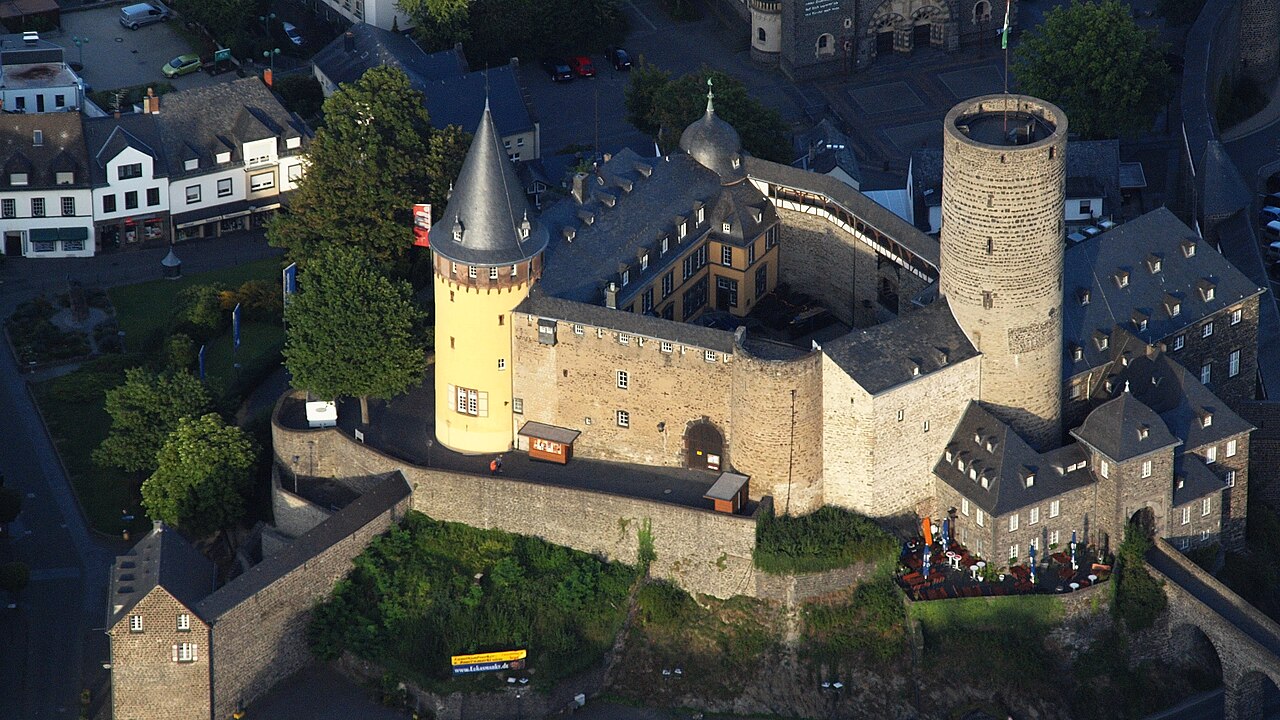
The Löwenburg castle exhibits characteristics typical of high medieval hill castles. Its most prominent feature is the bergfried, a tall defensive tower standing approximately 25 meters high with walls over 3 meters thick. The tower's elevated entrance faces the valley, deliberately oriented away from potential attackers. In the 15th century, a pointed shield wall was added to protect the bergfried against the emerging threat of firearms, demonstrating adaptations to evolving military technology.
The castle's inner bailey is secured by two neck ditches: one arched ditch protects it from the higher hillside to the northwest, while another separates it from the eastern outer bailey, of which only limited remains survive today. The early Gothic castle chapel once featured outer walls reinforced by an enceinte, though its vaults have collapsed, leaving the structure barely recognizable.
Philippsburg castle's role and structure
The Philippsburg castle, smaller and less fortified than the Löwenburg, likely served as either a defensive outpost or a symbol of Philip's claim to power in the area. Its nickname, "Rech," reflects its modest scale compared to the "lion" of Löwenburg. While much of its structure has not survived, its proximity to the Löwenburg indicates a strategic relationship between the two castles, whether cooperative or adversarial.
Later history and decline
By the late 14th and early 15th centuries, under Robert IV of Virneburg, the estate saw further development and was occasionally used as a dower house for the comital family. By the 16th century, Monreal had effectively replaced the ancestral castle of Virneburg as the family's primary residence.
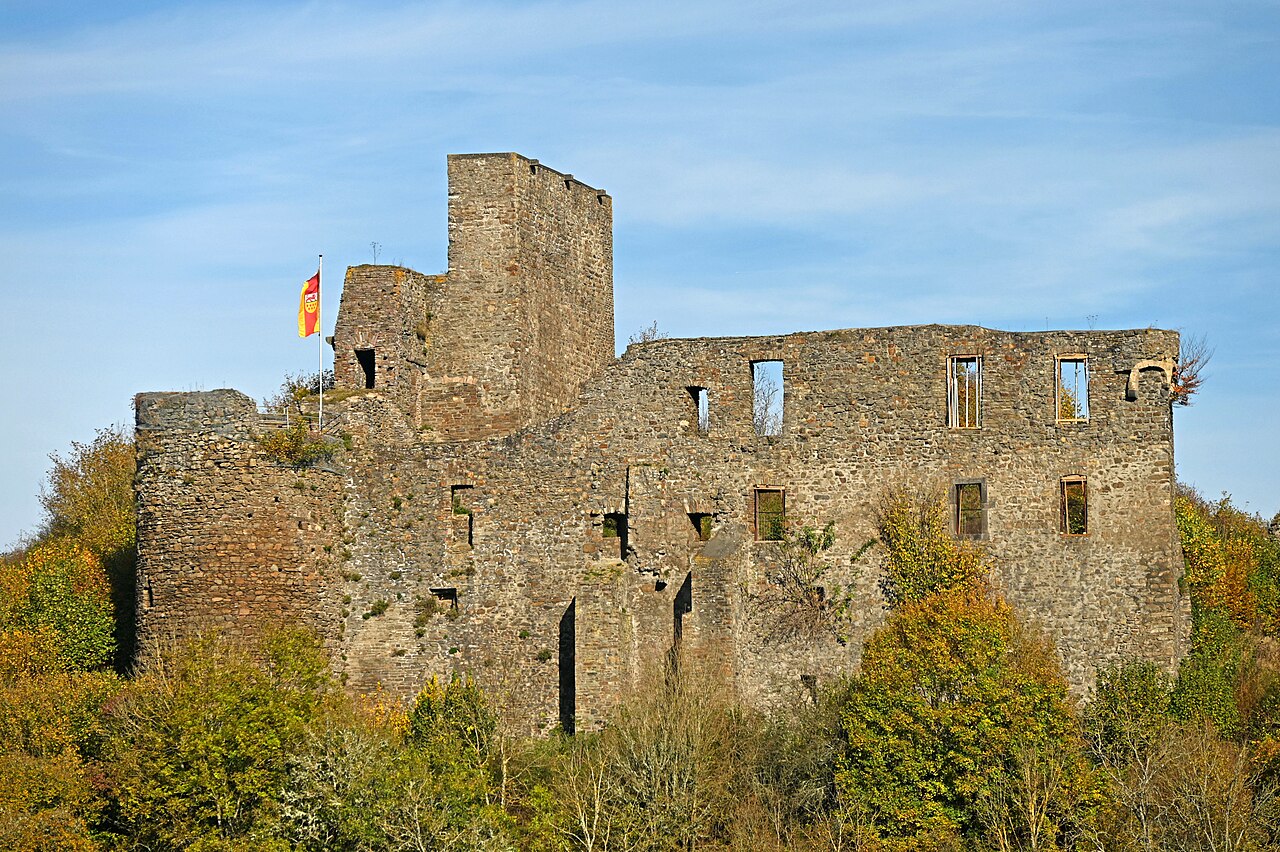
The extinction of the House of Virneburg in 1545 led to the transfer of the fief to Henry of Leiningen, although the Elector of Trier eventually took direct control by installing his own Amtmann after 1555. The castle's fortifications suffered significant damage in 1632 during an unsuccessful defense against Swedish troops in the Thirty Years' War. Later, in 1689, during the War of the Palatine Succession, French forces destroyed the castles, leaving them in ruins.
Preservation and current status
Following the secularisation of 1815, the ruins were granted to Prussia and remained under its ownership until the state's castle administration took over the inner bailey. Starting in 1970, various conservation and safety measures were implemented, allowing visitors to freely explore the ruins today.
The remains of the Löwenburg bergfried remain a striking landmark visible from afar, now accessible as a viewing tower. The surviving neck ditches and remnants of the outer bailey provide a tangible sense of the castle's original defensive complexity. Although the castle chapel is largely in ruins, the site offers valuable insight into medieval ecclesiastical architecture and noble residence design.
Visiting the ruins
Visitors today can explore the extensive ruins of Löwenburg and the surrounding landscape of the Elzbach valley. The site offers a glimpse into the medieval fortifications and the turbulent history of noble families in the Rhineland. The accessible bergfried tower provides panoramic views of the valley and the village of Monreal, making it a popular destination for history enthusiasts and hikers alike.
Frequently asked questions (FAQ)
- How do I get to Löwenburg and Philippsburg Castles?
- Löwenburg and Philippsburg Castles are located in Monreal, Germany, and can be accessed by car or public transport. If you are traveling by train, the nearest station is in the town of Monreal, from where you can take a short walk to the castles.
- What is the historical significance of Löwenburg and Philippsburg Castles?
- Both Löwenburg and Philippsburg Castles date back to the medieval period and are significant examples of German castle architecture. They played important roles in the regional defense strategies and reflect the feudal history of the area.
- When was Löwenburg and Philippsburg Castles built?
- Löwenburg Castle was constructed in the early 14th century, while Philippsburg Castle was built in the late 12th century. Each castle has undergone various renovations over the centuries, showcasing different architectural styles.
- Can I take guided tours of the castles?
- Yes, guided tours are available for both Löwenburg and Philippsburg Castles. These tours provide visitors with in-depth historical insights and architectural details, making your visit more enriching.
- Why is it important to visit Löwenburg and Philippsburg Castles?
- Visiting these castles offers a unique glimpse into the medieval history of Germany and the architectural innovations of the time. The stunning views from the castles and the surrounding landscapes also make for a memorable experience.
- Is it possible to visit both castles in one day?
- Yes, it is quite feasible to visit both Löwenburg and Philippsburg Castles in a single day. They are located relatively close to each other, allowing for a convenient itinerary that includes time for exploration and photography.
- What are the opening hours for Löwenburg and Philippsburg Castles?
- The opening hours vary by season, but typically, the castles are open from 9 AM to 5 PM. It is advisable to check the official website before your visit for any updates on hours or special events.
- What are the ticket prices for visiting the castles?
- Ticket prices for Löwenburg and Philippsburg Castles are generally affordable, with discounts available for students and seniors. Admission usually includes access to the grounds and guided tours, providing great value for visitors.
- When is the best time to visit the castles?
- The best time to visit Löwenburg and Philippsburg Castles is during the spring and early autumn months when the weather is mild and the landscapes are at their most beautiful. Additionally, these times tend to have fewer crowds, allowing for a more pleasant experience.
- Are there any nearby attractions to explore?
- Yes, the area surrounding Monreal is rich with attractions, including scenic hiking trails, charming villages, and other historical sites. Visitors can also enjoy local cuisine in nearby restaurants, enhancing their overall experience in the region.
Loading map...
Visitor reviews
No reviews yet. Been here? Write the first review and help other travelers!
Write the first reviewVisited this castle? Share your experience
Your review helps other travelers and adds first-hand knowledge to our encyclopedia.