Genovevaburg
Genovevaburg Castle stands as a prominent symbol of Mayen in the German state of Rhineland-Palatinate. This hill castle boasts a rich history dating back to the late 13th century, with its origins around 1280 under the auspices of the Electorate of Trier. The castle’s strategic location on the southwestern side of Mayen allowed it to serve as a vital fortress guarding territorial claims during the medieval period. Over the centuries, Genovevaburg has undergone numerous transformations, reflecting the changing tides of history and architectural styles.
The castle’s name is derived from a local legend involving Count Palatine Siegfried and his wife, Genevieve of Brabant (German: Genoveva), who were said to have their seats on the same hill above Mayen. Although the fortress itself dates from the medieval era, the association with this legend was first documented in the 17th century, adding a layer of cultural significance to the site.
Medieval origins and strategic importance
Genovevaburg was constructed around 1280 by Heinrich II von Finstingen, the Elector of Trier, to assert and protect the Electorate’s territorial interests against rival powers such as the Archbishopric of Cologne. The castle was first officially mentioned in records from 1281. Shortly after, in 1291, Bohemond von Warnesberg succeeded Heinrich II and secured town rights for Mayen from King Rudolf I of Habsburg, highlighting the castle’s role in the political development of the region.
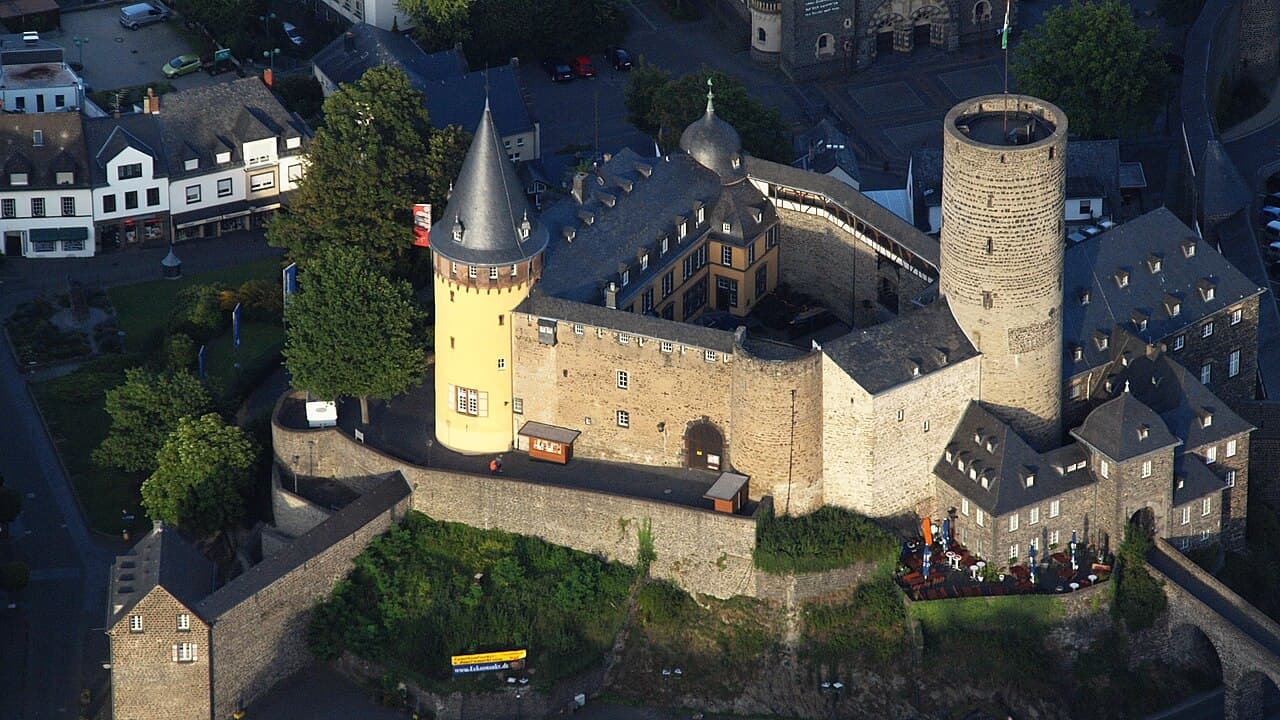
The fortress was designed as a medieval hill castle with a roughly six- to seven-sided citadel layout, adapting to the natural topography. It was surrounded by a moat and an outer defensive courtyard known as a zwinger, along with robust stone walls facing outward to defend against attacks. The castle’s primary defensive feature was its bergfried, the main tower called the Goloturm, which stands 34 meters tall with walls 3.7 meters thick. This tower served as a last refuge during sieges and included a vaulted basement dungeon with prison cells used historically for criminals, political prisoners, and accused witches during the 16th century.
Destruction and baroque reconstruction
Genovevaburg remained structurally intact for nearly four centuries until it was almost completely destroyed by fire in 1689 during the War of the Palatine Succession. French forces led by General François d’Escoubleau deliberately burned the castle as part of their military campaign. This event marked a significant turning point, necessitating extensive rebuilding efforts.
The reconstruction began swiftly in 1690 under Archbishop Johann Hugo von Orsbeck, Elector of Trier, with architect Philipp Honorius von Ravensteyn overseeing the project. The rebuilding introduced Baroque architectural elements, replacing original Gothic windows with ornate Baroque double windows and adding curved roofs to corner towers. In 1707, the construction of the lower castle (Unterburg) expanded the complex using local basalt lava stone. This addition included stables, service buildings, and a ceremonial gate adorned with the Elector’s carved coat of arms, marking the formal entrance to Mayen from the castle.
19th-century decline and varied uses
In the early 19th century, under French rule, the castle’s fortunes declined. Confiscated and auctioned in 1803, it was acquired by Philipp Hartung who dismantled much of the upper castle for building materials, leaving it largely in ruins by 1815. Despite this, the lower castle found new life as Mayen’s first Protestant prayer room in 1821. Attempts by the Protestant community to acquire the entire castle in 1830 were unsuccessful, leading to its sale to Justice Cadenbach, who initiated restoration efforts.
Throughout the mid-1800s, Genovevaburg’s buildings served commercial purposes such as a brewery and inn. The bergfried was repurposed for grain storage, and parts of the castle were adapted for storage and other uses. In 1880, local bank shareholders purchased the complex, and in 1893 the upper castle was sold to a merchant who renovated it in a neo-Renaissance style. However, a devastating fire in 1902 destroyed much of this revival work.
20th-century restoration and cultural significance
The castle changed ownership again in 1910 when Arend Scholten acquired it. Scholten’s restoration efforts from 1918 onward removed many 19th-century additions, restoring the fortress closer to its earlier historical appearance. In 1921, he opened the Eifel Museum within the former stable buildings, making the castle accessible to the public.
Mayen’s city government took ownership in 1938, though the castle was requisitioned by the Nazi regime in 1939 for military use, suffering further damage during World War II due to Allied bombings. Post-war, the castle was repurposed as an agricultural school. Restoration efforts continued through the latter half of the 20th century, culminating in a full reopening to visitors in 1984. Today, Genovevaburg serves as a cultural and educational center, housing museums and collections that celebrate the region’s heritage.
Architectural features and castle grounds
Genovevaburg’s layout is irregular, shaped by the terrain, and originally fortified with a moat and stone walls. The moat, once water-filled, is now crossed by a main road but retains its historic position. Access to the castle was originally via a Gothic stone arch bridge spanning about 20 meters, later replaced by a permanent stone arched bridge at the main entrance.
The bergfried Goloturm remains a dominant feature, with its thick walls and height providing panoramic views from a platform accessible by stairs or an elevator inside the museum. This tower’s basement includes a vaulted dungeon used historically for imprisonment and trials.
The main residential wing, located on the northern side of the inner castle, likely served as the primary living quarters and administrative center. Supplementary buildings to the south housed economic and service functions. The earliest mention of a castle chapel dates to 1362, indicating the presence of a religious space within the fortress complex.
Roofs throughout the castle are covered with slate from local quarries, reflecting regional building traditions. Beneath the castle lies a network of tunnels and mines historically used for slate extraction, now incorporated into museum exhibitions showcasing the area’s industrial history.
The castle courtyard remains an open space used for cultural events during summer, highlighting Genovevaburg’s ongoing role as a vibrant community landmark. Its layered history as a military stronghold, administrative center, residential complex, and cultural site makes it a fascinating destination for visitors interested in medieval and early modern European history.
Frequently asked questions (FAQ)
- How do I get to Genovevaburg?
- Genovevaburg is located in Mayen, Germany, and can be easily accessed by car or public transportation. If you are traveling by train, the nearest station is in Mayen, from where you can take a short bus ride or walk to the castle.
- What is the historical significance of Genovevaburg?
- Genovevaburg dates back to the 13th century and is a significant example of medieval architecture in the region. It has served various purposes over the centuries, including a fortress and a residence, playing a key role in the history of Mayen and its surroundings.
- When was Genovevaburg built?
- The construction of Genovevaburg began around 1240, with various modifications and expansions taking place in the following centuries. Its strategic location and impressive fortifications made it an important stronghold during its time.
- Can I visit Genovevaburg year-round?
- Yes, Genovevaburg is open to visitors year-round, although opening hours may vary by season. It is advisable to check the official website for the most current visiting hours and any special events that may be taking place.
- Why is Genovevaburg a popular tourist attraction?
- Genovevaburg attracts visitors due to its rich history, stunning architecture, and picturesque views of the surrounding area. The castle also hosts various cultural events and exhibitions throughout the year, making it a vibrant part of the local heritage.
- Is it possible to take guided tours of Genovevaburg?
- Yes, guided tours are available at Genovevaburg, providing visitors with in-depth knowledge about the castle's history and architecture. These tours are a great way to enhance your experience and learn more about this fascinating landmark.
- What are the ticket prices for Genovevaburg?
- Ticket prices for Genovevaburg are generally affordable, with discounts available for students and seniors. Children under a certain age may enter for free, making it an excellent destination for families.
- What are the best times to visit Genovevaburg?
- The best times to visit Genovevaburg are during the spring and fall when the weather is mild and the surrounding landscape is particularly beautiful. Summer is also popular, but be prepared for larger crowds and warmer temperatures during this peak season.
- What nearby attractions should I consider visiting?
- While visiting Genovevaburg, you can also explore the charming town of Mayen, known for its historic buildings and local museums. Additionally, consider visiting the nearby Eifel National Park for stunning natural scenery and outdoor activities.
Photo gallery

Information
Website
Visit websiteSources & official resources
Verify the information above using these authoritative references.
Loading map...
Visitor reviews
No reviews yet. Been here? Write the first review and help other travelers!
Write the first reviewVisited this castle? Share your experience
Your review helps other travelers and adds first-hand knowledge to our encyclopedia.