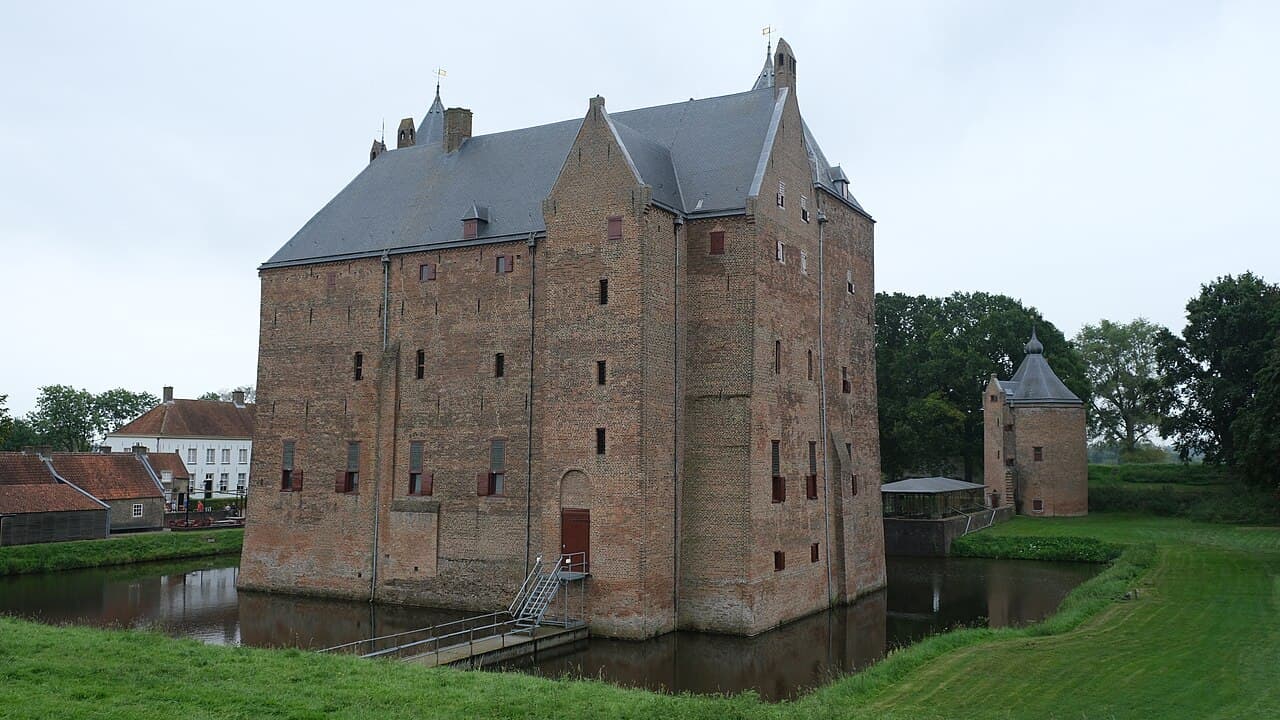
Loevestein Castle
Loevestein Castle, locally known as Slot Loevestein, stands as a remarkable example of a medieval fortress in the province of Gelderland, Netherlands. Situated strategically at the confluence of the Maas and Waal rivers, the castle was originally constructed between 1357 and 1368 by the knight Dirk Loef van Horne, whose name likely inspired the castle's name, meaning "Loef's stone house". The castle was initially a simple square brick building designed to control and charge tolls on passing trading vessels navigating these vital waterways.
Over the centuries, Loevestein Castle evolved from a toll-collecting stronghold into a significant military fortress and state prison. Its location made it a key defensive site, particularly during the tumultuous political landscape of the Late Middle Ages and the Eighty Years' War. The castle's fortifications were expanded and modernized in the 16th century, especially under the orders of William the Silent, who transformed it into a bastioned fortress integrated into the Dutch Waterline, a sophisticated system of defensive flooding protecting the Republic of the Seven United Netherlands.
Medieval origins and early history
Loevestein Castle was founded by Dirk Loef van Horne, Lord of Altena, as a stone stronghold to assert control over the surrounding river trade routes and the nearby Munnikenland area. The castle's original structure was a compact square building with thick brick walls, designed for defense and toll collection. By 1372, the castle had passed into the possession of the Counts of Holland, serving as a border fortress against the Duchy of Gelre.
The castle's strategic importance led to several expansions and fortifications during the 14th and 15th centuries. Notably, the Riddertoren (knight's tower) was heightened around 1375, enhancing its defensive capabilities. The castle's walls, constructed of heavy brick between 1.6 and 2.2 meters thick, rest on wooden piles and oak beams, showcasing medieval engineering adapted to the floodplain environment.
Role in regional conflicts and political turmoil
Throughout the 14th and 15th centuries, Loevestein Castle was embroiled in regional power struggles. In 1385, it came under the control of Albert I, Duke of Bavaria, who appointed his trustee as castle keeper. However, internal conflicts led to a siege in which part of the castle's curtain wall and a corner tower were destroyed. The castle later became a prison for political detainees under Jacqueline, Countess of Hainaut in the early 15th century.
Siege and capture during the Dutch revolt
The castle's military significance peaked during the Eighty Years' War (1568–1648), when it changed hands multiple times between Spanish forces and Dutch rebels known as the Geuzen. In 1570, a daring assault by Calvinist rebels disguised as monks enabled them to capture the castle briefly. Despite a swift Spanish counterattack, the castle was permanently seized by the Dutch in 1572.
Following this, Loevestein Castle was modernized with the addition of bastions, earthworks, and moats, transforming it into a formidable fortress integrated into the Nieuwe Hollandse Waterlinie (New Dutch Waterline). This defensive system utilized controlled flooding to protect the western provinces from invasion.
State prison and notable inmates
From 1614 onward, Loevestein Castle served as a state prison, primarily for political prisoners. Its most famous inmate was the Dutch jurist and philosopher Hugo Grotius (Hugo de Groot), often regarded as the father of modern international law. Imprisoned in 1619 for his political and religious views, Grotius famously escaped in 1621 by hiding in a large wooden book chest, a plan orchestrated by his wife, Maria van Reigersberch.
Other notable prisoners included English Vice-Admiral George Ayscue, detained in 1666, and various Dutch political figures who surrendered towns during conflicts with the French in the 18th century. The castle also held prisoners of war during the French occupation and other European conflicts until the early 19th century.
Architectural evolution and fortifications
The castle's architecture reflects its adaptation to evolving military technologies and political needs. The original medieval hall tower castle features a U-shaped layout with a main hall building, two square corner towers—the Riddertoren to the north and the Keuckentoren to the south—and a gate tower enclosing a small inner courtyard.
The fortifications expanded in the late 16th century included an irregular five-sided earthwork fort with five bastions, replacing medieval walls and towers. The northern side of the fortress retains stone walls and towers, including a large artillery tower nearly 30 meters in diameter, constructed in the late 15th century.
Additional military structures were added over time, such as stone barracks replacing wooden huts, officers' quarters, a schoolhouse, and storage buildings. The Kruittoren, originally the Barbarye tower, was rebuilt as a round tower and adapted for gunpowder storage. The Nieuwe Arsenaal, built in 1780, served as a weapons and ammunition depot.
In the 19th century, the castle was integrated into an enlarged earthwork fortress as part of the New Dutch Waterline, enhancing its strategic role. A bombproof concrete shelter was added in 1883, though it soon became obsolete due to advances in artillery.
Preservation, museum status, and visitor experience
After losing its military function in 1952, Loevestein Castle underwent extensive restoration beginning in the early 20th century, culminating in the preservation of its medieval character and fortifications. Today, it is recognized as a Rijksmonument, a protected national heritage site.
The castle operates as a medieval museum and cultural center, offering guided tours that showcase its rich history, architectural features, and famous prison cells, including the room where Hugo Grotius was held. The surrounding fortress grounds with moats, bastions, and earthworks are freely accessible during daytime, providing visitors with a comprehensive experience of Dutch military architecture and history.
Loevestein's location in a floodplain without dikes means it is periodically inaccessible by land during high water, surrounded by diverse wetlands that contribute to the area's ecological significance.
With its blend of medieval architecture, Renaissance fortifications, and storied past as a prison and military stronghold, Loevestein Castle remains a captivating destination for history enthusiasts, scholars, and tourists alike.
Frequently asked questions (FAQ)
- How do I get to Loevestein Castle?
- Loevestein Castle is located in Poederoijen, Gelderland. It is accessible by car and public transport; parking is available nearby. The castle is well-signposted from major roads.
- What are the opening hours of Loevestein Castle?
- The castle is open daily from 10:00 to 17:00. Guided tours are available during these hours, offering detailed insights into the castle's history and architecture.
- Can I visit the interior of Loevestein Castle?
- Yes, visitors can explore the castle's interior on guided tours. These tours include the medieval halls, prison cells, and the famous room where Hugo Grotius was imprisoned.
- Why is Loevestein Castle historically significant?
- Loevestein Castle played a key role in Dutch history as a toll fortress, military stronghold, and state prison. It is renowned for the daring escape of Hugo Grotius and its involvement in the Eighty Years' War.
- Is Loevestein Castle wheelchair accessible?
- The castle's medieval architecture includes uneven floors and narrow passages, which may limit accessibility. However, the surrounding grounds are more accessible, and staff can provide assistance upon request.
- What is the best time to visit Loevestein Castle?
- Spring through early autumn offers the best weather for visiting, with the castle grounds and surrounding wetlands at their most picturesque. The castle is open year-round except for major holidays.
- Are there facilities for families and children at Loevestein Castle?
- Yes, the castle offers educational programs and activities tailored for children and school groups, making it a popular destination for family visits.
Photo gallery

Information
Opening hours
10:00-17:00, daily
Ticket prices
€10 adult, €5 child
Current owner
State museum
Website
Visit websiteAddress
Loevestein 1, Poederoijen, Netherlands
Sources & official resources
Verify the information above using these authoritative references.
Loading map...
Visitor reviews
No reviews yet. Been here? Write the first review and help other travelers!
Write the first reviewVisited this castle? Share your experience
Your review helps other travelers and adds first-hand knowledge to our encyclopedia.



