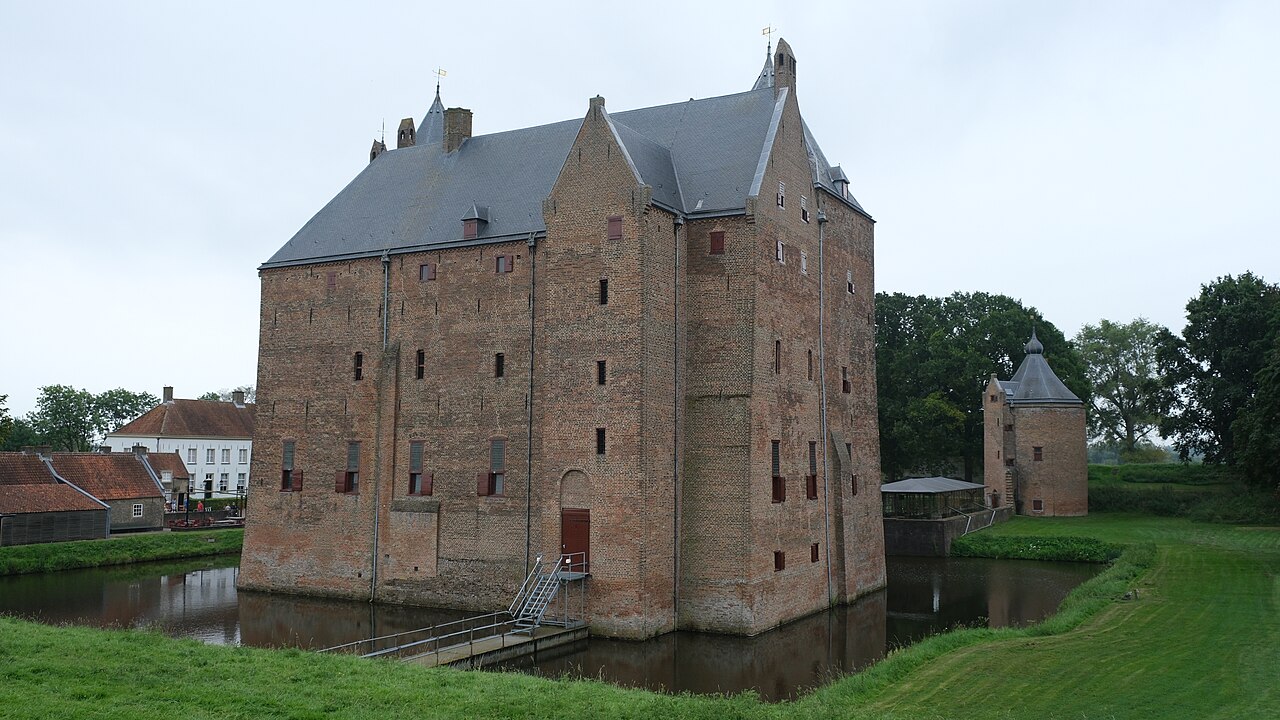
Fort Vuren
Fort Vuren is a historic military fortification located west of the village of Vuren in the province of Gelderland, Netherlands. Constructed in 1844, it was strategically positioned on the dike along the north bank of the Waal river, a vital waterway in the region. The fort was part of the New Dutch Waterline, a defensive system designed to protect the country by controlling flooding and halting enemy advances from east to west along the river.
Early construction and strategic purpose
Initially, Fort Vuren consisted of an earthen redoubt and a lunette, basic fortifications that provided a defensive position overlooking the river. Its primary role was to work in tandem with Loevestein Castle, located across the river, to form a barrier against invading forces. The fort’s location on the dike allowed defenders to utilize the surrounding water as a natural obstacle.
Architectural enhancements in the mid-19th century
Between 1847 and 1851, the fort was significantly reinforced with the addition of a bombproof round tower. This imposing structure measured approximately 40 meters in diameter and featured three floors: a cellar, ground level, and first floor. The tower was surrounded by a moat and accessed via a drawbridge on its west side, enhancing its defensibility against assault.
Tower design and defensive features
The round tower’s robust construction was intended to withstand artillery bombardment, reflecting advances in military engineering during the period. Its circular shape helped deflect incoming fire, while the moat and drawbridge provided an additional layer of protection. The interior spaces were designed to accommodate troops and artillery, enabling the fort to serve as a stronghold in the event of conflict.
Modifications due to changing military technology
During the Franco-Prussian War of 1870-71, although the Netherlands remained neutral, Fort Vuren was mobilized as a precautionary measure. The rapid development of artillery technology soon rendered some of the fort’s original features obsolete. Between 1874 and 1879, the first floor of the tower was removed to reduce its profile and vulnerability to modern artillery fire.
To compensate for the loss of interior space, a bombproof barracks was constructed on the northern lunette, providing additional accommodation for the garrison. A counterscarp gallery was added east of the tower to strengthen the fort’s frontal defenses. The moat around the tower was largely filled in, and the northern lunette and the redoubt were merged, creating a more cohesive defensive layout.
The entrance to the tower was relocated from the west side to the north, with the original entrance sealed off and its drawbridge removed. A new bridge connected the tower to the interior of the fort, resulting in the configuration that remains visible today.
Military use and armament in the late 19th and early 20th centuries
By 1880, Fort Vuren was garrisoned by approximately 495 soldiers. Its armament included 6 howitzers, 16 cannons, 4 mortars, and 4 coehorn mortars, reflecting its role as a significant defensive position along the waterline.
Role during world wars and post-war period
During World War I, the fort was again mobilized despite the Netherlands’ neutral stance, serving as a precaution against potential incursions. In World War II, Fort Vuren was mobilized once more and suffered damage from a German air raid. Subsequently, it was occupied by German forces, who utilized the fort for their military purposes.
After the war, the fort was repurposed as a prison for collaborators and former members of the National Socialist Movement, marking a significant shift in its function from military defense to incarceration.
Current status and visitor experience
Today, Fort Vuren is open to the public free of charge. It has been adapted for modern uses, including serving as a bed and breakfast, a wedding venue, and housing a small inn. Visitors can explore the interior of the tower, which remains a highlight due to its historical architecture and defensive design.
The fort’s well-preserved structures offer insight into 19th-century military engineering and the evolution of defensive strategies in response to technological advancements. Its location along the Waal river and connection to the New Dutch Waterline make it an important cultural and historical site in the Gelderland region.
Frequently asked questions (FAQ)
- How do I get to Fort Vuren?
- Fort Vuren is located at Waaldijk 29 near the village of Vuren in Gelderland, Netherlands. It is accessible by car and local roads, with parking available nearby.
- What is the historical significance of Fort Vuren?
- Fort Vuren was built in 1844 as part of the New Dutch Waterline to defend the Netherlands against eastern invasions along the Waal river. It features a bombproof round tower and played roles in both World Wars.
- Can I visit the interior of the fort?
- Yes, visitors can explore the interior of Fort Vuren, including the bombproof tower. The fort is open to the public free of charge and also operates as a bed and breakfast and wedding venue.
- When was Fort Vuren last used for military purposes?
- Fort Vuren was last actively used during World War II when it was occupied by German forces and suffered damage from an air raid. After the war, it was repurposed as a prison.
- Is Fort Vuren suitable for family visits?
- Yes, Fort Vuren is suitable for families. It offers a safe environment with historical exhibits and outdoor spaces to explore. The small inn and B&B provide amenities for visitors.
Information
Address
Waaldijk 29, Netherlands
Loading map...
Visitor reviews
No reviews yet. Been here? Write the first review and help other travelers!
Write the first reviewVisited this castle? Share your experience
Your review helps other travelers and adds first-hand knowledge to our encyclopedia.