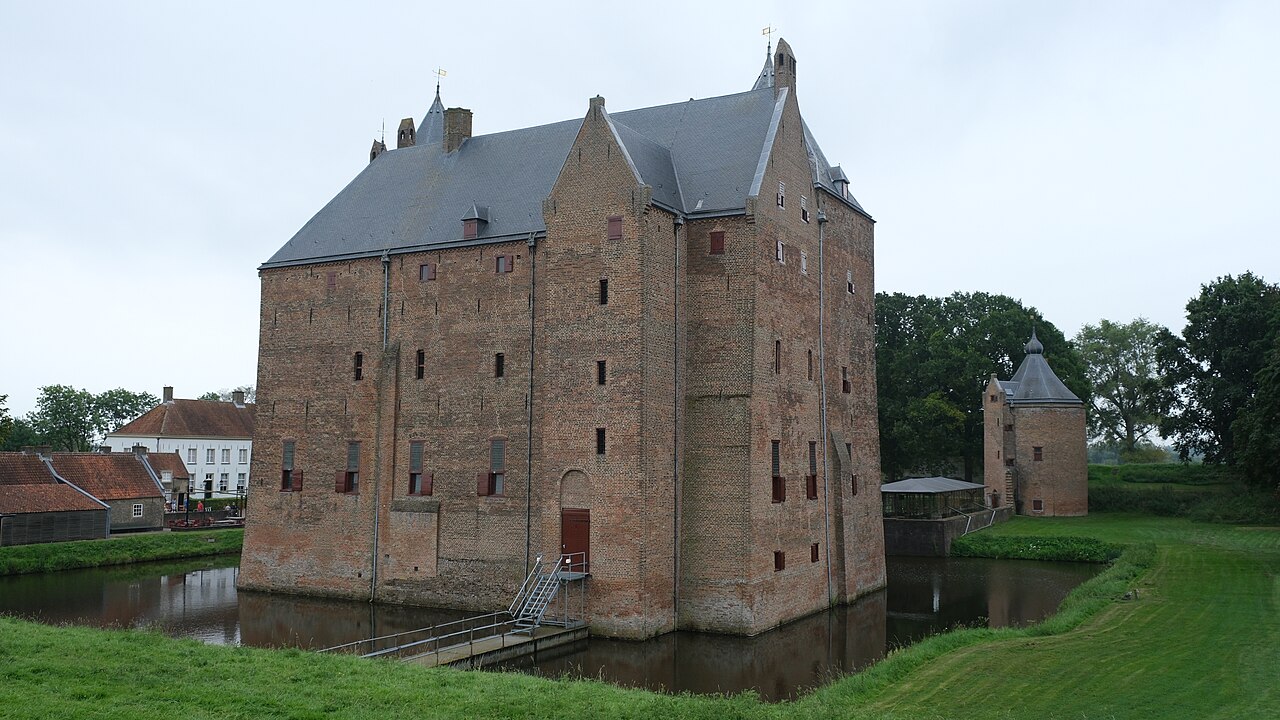
Loevestein Castle
Loevestein Castle, located in the village of Poederoijen in the Gelderland region of the Netherlands, stands as a remarkable example of medieval military architecture and Dutch history. Situated strategically near the confluence of the Waal and Meuse (Maas) rivers, the castle was originally constructed in 1361 by the Dutch knight Dirc Loef van Horne. Its name, meaning "Loef's stone house," reflects its founder's legacy and the castle’s early function as a fortified residence on the contested border between the counties of Holland and Geldern.
Initially, Loevestein began as a simple square blockhouse made of brick, designed to assert control over this critical river junction. Within a decade, van Horne expanded the structure into a larger castle complex, enhancing its defensive capabilities. The castle's position was so strategically important that in 1372, the powerful Count of Holland acquired the castle through bail after exerting political pressure and offering payment, transforming Loevestein from a knight’s home into a seat for the castellan appointed by the Count of Holland.
Medieval military architecture and strategic importance
The castle's architecture reflects the typical high medieval defensive design, with thick brick walls and a square keep that served as the core stronghold. Its location near the meeting point of two major rivers made Loevestein a vital military and trade control point, capable of overseeing river traffic and defending the borderlands. Over time, the castle was expanded and fortified, including the addition of bastions and moats to enhance its defensive posture.
Sieges and conflicts
Loevestein's history is marked by several significant sieges and conflicts. In 1397, the castle was besieged when the steward, Bruijsten van Herwijnen, resisted dismissal after accusations of abuse of power. He barricaded himself inside with 90 men, but after two weeks of bombardment with catapults and early cannons, the castle fell, though the steward had already fled. This event highlights the castle's military resilience and political importance during the late medieval period.
During the Dutch Revolt against Spanish rule, Loevestein again became a focal point. In 1568, Spanish troops captured the castle, recognizing its strategic value. However, in 1570, a dramatic event unfolded when a group of Sea Beggars—pirate-like rebels fighting for Dutch independence—attempted to seize the castle. Led by Herman de Ruijter, they initially gained shelter under false pretenses but were ultimately repelled, resulting in the death of the castle bailiff and the recapture of Loevestein by Spanish forces. The brutal aftermath included the display of de Ruijter’s head and body as a warning to others.
Renovation and transformation under Dutch control
In 1572, Dutch forces reclaimed Loevestein, and it remained under their control thereafter. Under the guidance of William of Orange, renovations began in 1575 to modernize the castle’s defenses. A pentagonal grassland fortification with three bastions was constructed, reflecting the evolving military architecture of the Renaissance period and adapting the castle to withstand artillery sieges.
Use as a state prison
From 1614, Loevestein was repurposed as a state prison, a role it would famously hold for centuries. One of its most notable prisoners was Hugo Grotius, a Dutch humanist, historian, and diplomat, who was imprisoned there in 1619 for political reasons. Grotius's daring escape in 1621 by hiding in a large wooden book chest remains one of the most famous prison escapes in history, symbolizing both the castle’s role in Dutch political struggles and its formidable security.
Architectural features and preservation
Loevestein Castle today retains much of its well-preserved medieval and Renaissance fortifications. The castle complex includes the original square brick keep, curtain walls, moats, and bastions added in the late 16th and mid-17th centuries. These features illustrate the transition in military architecture from high medieval stone fortifications to bastioned star forts designed to resist cannon fire.
The castle's grounds also include various outbuildings and a courtyard, which have been restored to reflect their historical appearance. Loevestein now operates as a medieval museum, offering visitors insight into its rich history, architecture, and role in Dutch heritage.
Cultural significance and visitor experience
Loevestein Castle is not only a prime example of medieval and Renaissance military architecture but also a symbol of Dutch resilience and independence. Its history encompasses feudal power struggles, the tumultuous Dutch Revolt, and the evolution of state authority through its use as a prison.
Visitors today can explore the castle’s extensive fortifications, prison cells, and exhibitions detailing its storied past. The site hosts educational programs and reenactments that bring to life the castle’s military and political history. Its picturesque setting at the river confluence adds to its appeal as a cultural landmark in Gelderland.
Frequently asked questions (FAQ)
- How do I get to Loevestein Castle?
- Loevestein Castle is located in Poederoijen, Gelderland, Netherlands. It is accessible by car and public transport from nearby cities like Rotterdam and Nijmegen. Visitors can follow local signs to the castle.
- What is the historical significance of Loevestein Castle?
- Loevestein Castle played a crucial role in medieval border defense and Dutch independence struggles. It was a strategic fortress, a state prison, and the site of notable events such as Hugo Grotius's escape.
- When was Loevestein Castle built?
- The castle was originally built in 1361 by the Dutch knight Dirc Loef van Horne as a square brick blockhouse, later expanded into a larger fortress.
- Can I visit the interior of Loevestein Castle?
- Yes, Loevestein Castle is open to the public as a museum. Visitors can explore the castle's interiors, including the keep, prison cells, and exhibition spaces detailing its history.
- What architectural styles are represented at Loevestein Castle?
- Loevestein Castle primarily features Gothic architecture from its original medieval construction, with Renaissance-era bastions added during later renovations.
- Is Loevestein Castle suitable for family visits?
- Absolutely. The castle offers educational programs, historical reenactments, and interactive exhibits suitable for visitors of all ages, making it a great family destination.
Information
Current owner
State museum
Loading map...
Visitor reviews
No reviews yet. Been here? Write the first review and help other travelers!
Write the first reviewVisited this castle? Share your experience
Your review helps other travelers and adds first-hand knowledge to our encyclopedia.