Lochranza Castle
Lochranza Castle is a striking medieval fortress located on the northern tip of the Isle of Arran in Scotland. Dating from the 13th century, the castle's origins are tied to the MacSweens, with ownership passing to the Stewarts of Menteith in the mid-1200s. This castle is a prime example of a Scottish tower house that evolved from an earlier hall house, reflecting centuries of architectural development and historical significance.
The castle's strategic position on a rocky promontory overlooking Loch Ranza bay provided natural defense and control over maritime routes. Its location also made it an important royal and military site, with ties to notable Scottish monarchs such as King Alexander III, Robert the Bruce, Robert II, and James IV. The castle served diverse roles including a royal hunting lodge, a military garrison, and a noble residence.
Historical background and royal connections
The earliest records associate Lochranza Castle with the MacSween family, who likely constructed the original hall house in the 13th century. In 1262, King Alexander III granted the castle and surrounding lands to Walter Stewart, Earl of Menteith, bringing it under Stewart control. This transfer marked the beginning of the castle's long association with the Scottish crown.
Legend holds that Robert the Bruce landed at Lochranza in 1306 upon returning from Ireland to claim the Scottish throne, underscoring the castle's role in Scotland's tumultuous early 14th-century history. By 1371, the castle was firmly in royal hands under Robert II and was reputedly used as a royal hunting lodge, a role that highlights its importance beyond mere military function.
During the late 15th century, King James IV utilized the castle strategically during his campaign against the Lord of the Isles and the powerful Clan MacDonald. The castle's military relevance continued into the 17th century, with James VI occupying it in 1614 and forces loyal to Oliver Cromwell using it in the 1650s.
Ownership transitions and decline
Following its royal phase, the castle passed through several noble families, including the Campbells of Locawe and the Montgomeries, who undertook significant architectural modifications in the late 16th century. These changes transformed the original hall house into a more fortified tower house, incorporating defensive features suited to the period's evolving warfare.
By the early 18th century, the castle was owned by the Hamilton family, having been acquired by the Duchess of Hamilton. The Hamiltons eventually sold it to the Blackwood-Davidson family, who used it as their principal seat on the island. However, by the mid-18th century, the castle was abandoned and fell into ruin. The loss of the roof in 1772 exposed the structure to the elements, accelerating its decay.
Architectural features and layout
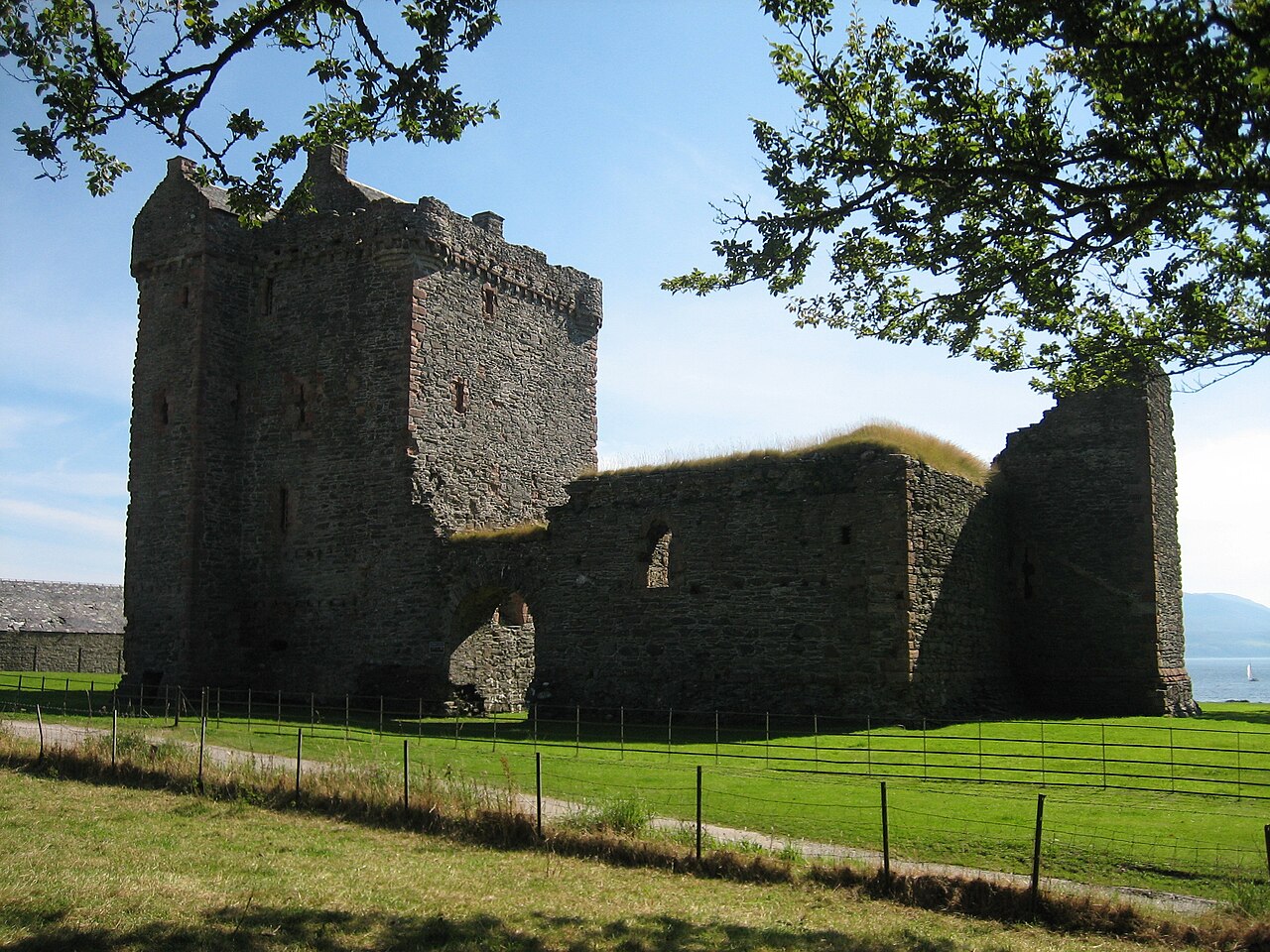
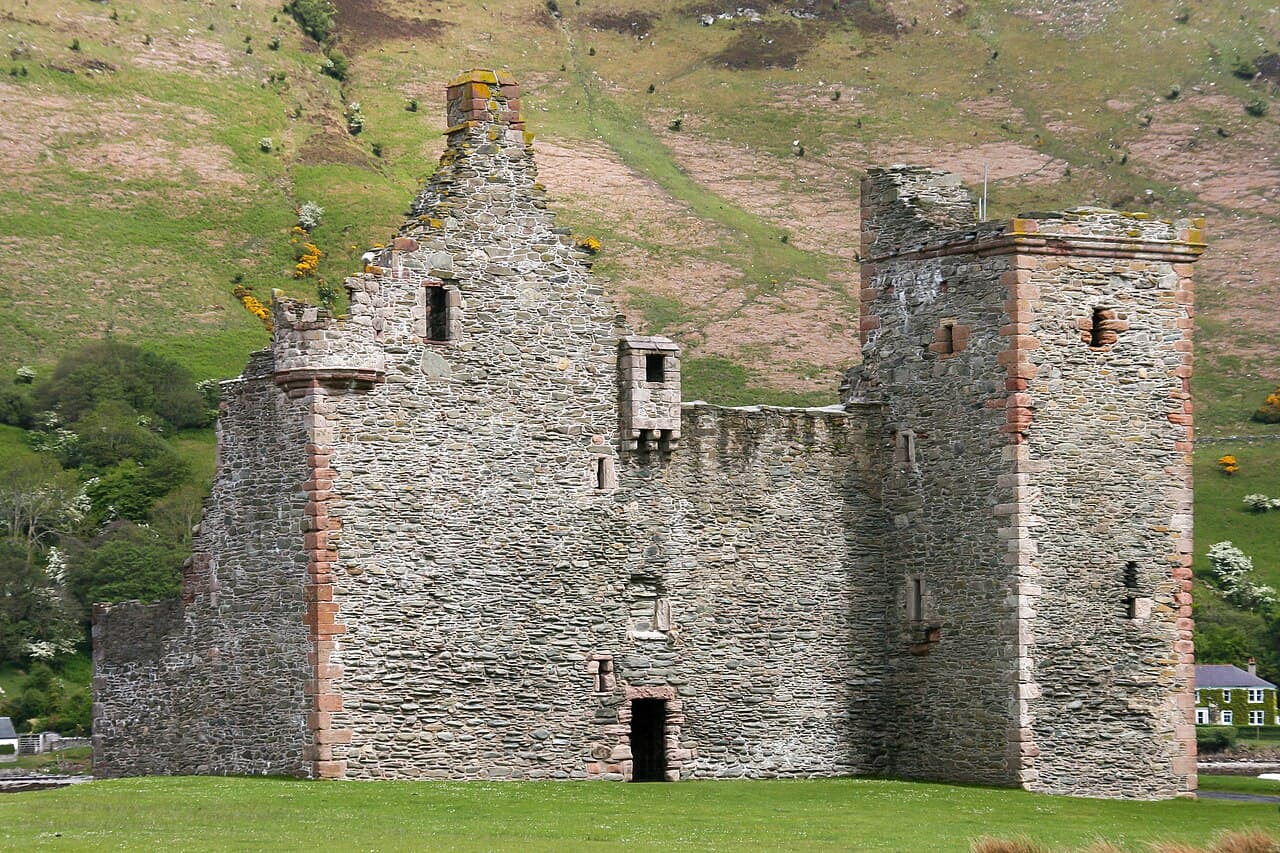
Lochranza Castle today stands as a well-preserved ruin of a classic Scottish tower house. The main structure is a rectangular four-storey building constructed of grey rubble stone, measuring approximately 66 by 35 feet (20 by 10.5 meters). This core reflects the medieval origins of the castle merged with later Renaissance-era enhancements.
Attached to the southern corner is a five-storey square tower, smaller in footprint (about 15.6 by 16.6 feet or 4.75 by 5 meters), featuring a battlemented parapet and a walkway that once served defensive and surveillance purposes. The tower's basement likely functioned as a dungeon, a common feature in Scottish tower houses for prisoner confinement.
The castle's corners are reinforced with distinctive red sandstone quoins, contrasting with the grey walls and adding structural strength. The principal entrance, located on the southwest side, dates from the 16th-century renovations and is protected by a projecting machicolated parapet. This defensive feature allowed defenders to drop objects or fire vertically on attackers, enhancing the castle's fortifications.
Originally, the entrance was on the first floor along the east wall, accessed by an external wooden stair—a typical medieval security measure. Internally, the ground floor featured vaulted ceilings for robust storage. Each upper floor was divided into a large southern chamber and smaller northern rooms. The first floor's southern room served as the great hall, measuring approximately 34.6 by 23 feet (10.5 by 7 meters), while the northern side housed the kitchen and service areas essential for daily life.
Vertical circulation was provided by a stone spiral staircase near the southwest entrance and a narrower stair in the northeast wall leading to the upper floors. On the fourth floor, remnants of a watchtower base supported by stone corbels indicate the castle's surveillance and defensive capabilities. The castle roof was lost in 1772, and coastal erosion caused further structural damage by the late 19th century.
Location and strategic importance
Perched on a rocky promontory extending into Loch Ranza bay, the castle's position offered commanding views of the surrounding waters and landscape. This location was critical for defense and monitoring maritime activity, underscoring the castle's military and administrative functions.
Today, Lochranza Castle is managed by Historic Environment Scotland and remains a significant cultural heritage site. Its ruins attract visitors interested in medieval Scottish history, architecture, and the dramatic coastal scenery of the Isle of Arran.
Preservation and visitor information
Since the late 20th century, conservation efforts have focused on stabilizing and preserving the castle ruins to prevent further deterioration. The castle is accessible to the public, offering a tangible connection to Scotland's medieval past and the complex history of the Highlands and Islands.
Visitors can explore the castle's remains, appreciate its architectural features, and learn about its role in Scotland's royal and military history. The site provides insight into the evolution of castle design from a simple hall house to a fortified tower house adapted to changing defensive needs.
Frequently asked questions (FAQ)
- When was Lochranza Castle built?
- Lochranza Castle was originally constructed in the 13th century, with significant modifications in the late 16th century transforming it into a tower house.
- What is the historical significance of Lochranza Castle?
- Lochranza Castle played important roles in Scottish history, including being a royal hunting lodge, a military stronghold during campaigns against the Lords of the Isles, and a residence for notable noble families.
- Can visitors explore the interior of Lochranza Castle?
- Visitors can explore the ruins of Lochranza Castle, including the remains of the tower house, great hall, and defensive features such as battlements and machicolations, offering insight into medieval Scottish architecture.
- Who owns Lochranza Castle today?
- Lochranza Castle is currently managed and preserved by Historic Environment Scotland, ensuring its protection as a cultural heritage site.
- Why is Lochranza Castle located on a promontory?
- The castle's position on a rocky promontory overlooking Loch Ranza bay provided natural defenses and strategic control over maritime routes and local territory.
Photo gallery

Information
Sources & official resources
Verify the information above using these authoritative references.
Loading map...
Visitor reviews
No reviews yet. Been here? Write the first review and help other travelers!
Write the first reviewVisited this castle? Share your experience
Your review helps other travelers and adds first-hand knowledge to our encyclopedia.