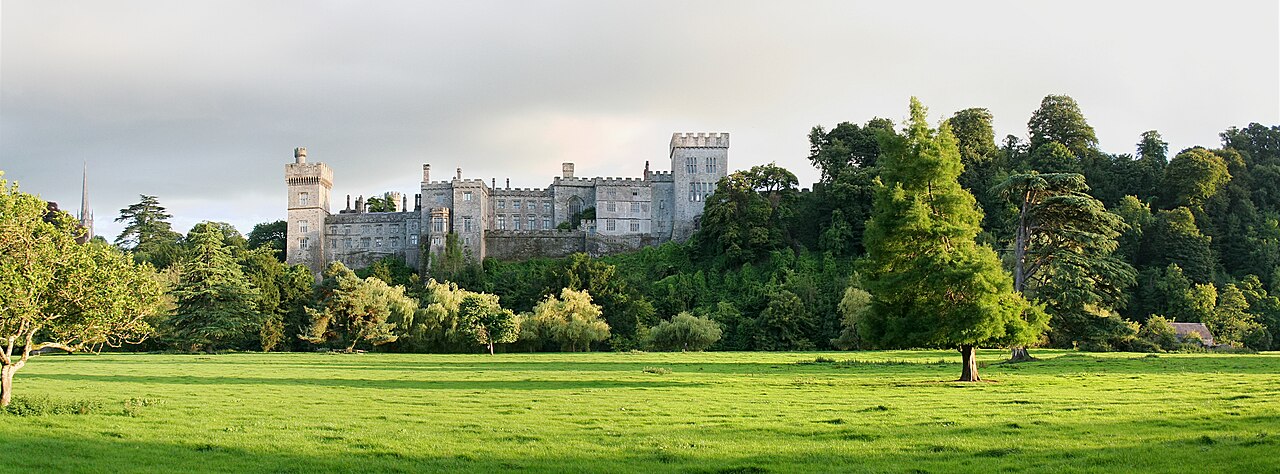
Lismore Castle
Lismore Castle stands as a remarkable historic fortress and noble residence located in the town of Lismore, on the south bank of the River Blackwater in County Waterford, Ireland. This castle's origins trace back to a 7th-century abbey that marked the site as a center of religious learning and ecclesiastical importance for centuries. The castle itself was first constructed in 1185 by Prince John of England, later King John, as a strategic stronghold to guard a vital river crossing. Over the centuries, Lismore Castle evolved through destruction, rebuilding, and extensive remodeling, reflecting Ireland's turbulent history and changing architectural tastes.
Early history and medieval origins
The site initially housed Lismore Abbey, an important religious institution founded in the early 7th century. This abbey was renowned for its scholarly activity and spiritual significance in medieval Ireland. In 1175, it was visited by Henry II of England, underscoring its prominence. Shortly thereafter, in 1185, Henry's son, Prince John, replaced the abbey with a fortified castle to secure the River Blackwater crossing, a critical defensive and administrative location.
The original castle was soon destroyed but was rebuilt to serve as the episcopal residence for the local bishop. During the Desmond Rebellion of 1579, the castle, then owned by the Earls of Desmond, sustained significant damage. Following the rebellion, the castle was granted to Sir Walter Raleigh, a key figure in English colonial ventures. However, by 1600, Lismore Castle was described as "broken and ruined" after Raleigh's imprisonment and eventual sale of the property.
The boyle family and restoration
Sir Richard Boyle, Earl of Cork, acquired Lismore Castle in 1602 and undertook a comprehensive rebuilding project in 1621. Boyle transformed the castle into a grand noble residence, marking a shift from its purely defensive origins. His son, Robert Boyle, the celebrated scientist known for Boyle's Law in physics, was born in the castle in 1627.
During the Irish Confederate Wars, the castle endured an eight-day siege in 1643 and was later captured and ransacked in 1645 by forces led by Lord Castlehaven. By 1650, the castle was again in a ruinous state. The 2nd Earl of Cork attempted restoration in the 1660s but did not reside there permanently.
Transition to the cavendish family and gothic revival remodeling
Ownership passed to the Cavendish family, the Dukes of Devonshire, through marriage in 1753. The estate saw continued enhancements, including the construction of a bridge over the River Blackwater in 1775. The most transformative period came under William George Spencer Cavendish, 6th Duke of Devonshire, who between 1812 and 1822 commissioned an extensive remodeling of Lismore Castle in the Gothic Revival style, an architectural movement that revived medieval Gothic forms with romanticized grandeur.
This remodeling was led by architect William Atkinson and later expanded by Sir Joseph Paxton around 1850, giving the castle much of its present-day appearance. Interior craftsmanship was enhanced by notable designers such as John Gregory Crace and A. W. N. Pugin, who contributed furnishings and ornamental details including intricately carved chimney-pieces and Gothic decorative motifs.
Architecture and notable features
Lismore Castle exhibits a courtyard plan with gabled ranges arranged around a central courtyard, enclosed within a castellated outer wall. The main entrance is through the Riding Gate, a prominent gatehouse that reflects its defensive origins. The castle's walls, battlements, and towers evoke a quasi-feudal fortress appearance characteristic of the Gothic Revival style.
The interior features include elaborately decorated chambers with fretwork plaster ceilings, tapestry-hung walls, and rooms furnished with rich silks and velvets. A highlight is the medieval-style banqueting hall, created by repurposing the ruins of the old Bishop's Palace chapel. This hall contains a large perpendicular stained-glass window, choir stalls, and stenciled patterns on walls and roof timbers, exemplifying Gothic design elements.
The castle's stonework prominently features finely cut stone imported from Derbyshire, England, used during the 19th-century rebuilding phases. The estate also includes a historically significant bridge over the River Blackwater, originally built in 1775 and replaced in 1858 with a design by Charles Tarrant.
Gardens and cultural significance
The castle is renowned for its extensive gardens, which are open to the public for visitation. The upper garden is a 17th-century walled garden that preserves the historic landscaping style, while the lower garden was designed in the 19th century with a more informal, naturalistic approach. In recent years, the gardens have been enhanced with contemporary sculptures by artists such as Sir Antony Gormley, Marzia Colonna, and Eilís O’Connell, creating a dynamic blend of historic and modern art within the landscape.
Lismore Castle's gardens feature a variety of plantings including magnolias, camellias, and yew trees, with winding paths that provide visitors a serene experience. The gardens are also historically associated with the poet Edmund Spenser, who is said to have composed parts of The Faerie Queene amid their tranquil surroundings.
Modern use and accessibility
While Lismore Castle remains a private residence owned by the Dukes of Devonshire, it is not generally open to the public. However, the castle can be rented for exclusive stays by groups, offering a rare opportunity to experience its grandeur firsthand. Visitors can access the castle's beautiful gardens and a small contemporary art gallery housed in an annex, known as Lismore Castle Arts, which opened in 2005 after converting a derelict section of the west range.
The castle's ongoing adaptation includes the stewardship of the estate by Lord Burlington, who has overseen the integration of modern art within the historic setting, ensuring that Lismore Castle remains a vibrant cultural landmark. The estate's blend of medieval origins, aristocratic heritage, Gothic Revival architecture, and contemporary art makes it a unique and significant site in Ireland's architectural and cultural landscape.
Frequently asked questions (FAQ)
- How do I visit Lismore Castle and its gardens?
- Lismore Castle itself is a private residence and not generally open to the public, but visitors can explore the beautiful gardens daily from 10:00 to 18:00. The contemporary art gallery is open Wednesday to Sunday from 12:00 to 17:00 with an admission fee.
- What is the historical significance of Lismore Castle?
- Lismore Castle has a rich history dating back to the 7th century as a religious site and later as a strategic fortress built in 1185 by Prince John of England. It played important roles in Irish history, including during the Desmond Rebellion and the Irish Confederate Wars.
- Can I stay overnight at Lismore Castle?
- While the castle is a private residence, it can be rented for exclusive group stays, offering a unique opportunity to experience its historic grandeur, though this is typically expensive and requires advance arrangements.
- What architectural style is Lismore Castle known for?
- Lismore Castle is renowned for its Gothic Revival architecture, extensively remodeled in the 19th century by the 6th Duke of Devonshire, featuring castellated walls, gabled ranges, and richly decorated interiors.
- Are there any notable gardens or artworks at Lismore Castle?
- Yes, the castle's gardens include a 17th-century walled upper garden and a 19th-century informal lower garden. They feature contemporary sculptures by artists such as Sir Antony Gormley, blending historic landscaping with modern art.
Information
Opening hours
Gardens open daily 10:00-18:00; art gallery open Wed-Sun 12:00-17:00
Ticket prices
Gardens €5 adult, €3 child; art gallery €7 adult, €4 child
Current owner
Dukes of Devonshire
Website
Visit websiteAddress
Castle Avenue, Lismore, County Waterford, Ireland
Sources & official resources
Verify the information above using these authoritative references.
Loading map...
Visitor reviews
No reviews yet. Been here? Write the first review and help other travelers!
Write the first reviewVisited this castle? Share your experience
Your review helps other travelers and adds first-hand knowledge to our encyclopedia.