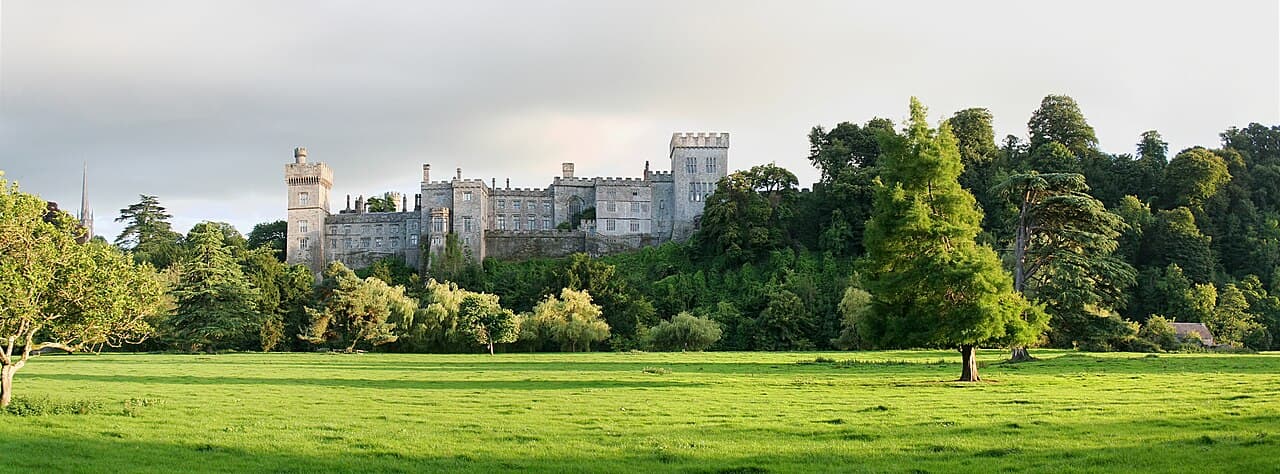
Lismore Castle
Lismore Castle (Irish: Caisleán an Leasa Mhóir) is a prominent hill castle located in the town of Lismore, County Waterford, Ireland. This castle has a rich history stretching back to its original construction in 1185, during the high medieval period. Over the centuries, it has been associated with some of Ireland's most influential noble families, including the Earls of Desmond, the Earls of Cork, and from 1753, the Cavendish family, who hold the title of Duke of Devonshire. Today, it remains the Irish residence of the Duke of Devonshire.
Medieval origins and early history
The first iteration of Lismore Castle was constructed in the late 12th century, specifically in 1185, shortly after the Norman invasion of Ireland. This initial fortress was strategically built on a hill overlooking the River Blackwater, providing commanding views of the surrounding landscape. The castle's location was chosen for its defensive advantages, typical of hill castles of the period, allowing control over key routes and the surrounding lands.
Originally, the castle served as a stronghold for the Earls of Desmond, a powerful noble family in Munster. Over time, the castle passed to the Earls of Cork, who undertook significant modifications and expansions to the structure. These early phases of construction and rebuilding reflected the evolving military and residential needs of the castle's occupants during the medieval period.
Architectural evolution and gothic revival transformation
In the 16th century, Lismore Castle underwent two major reconstructions, replacing the original Norman structures with more modern fortifications and residential buildings suitable for the era's political and social climate. However, the most dramatic transformation occurred in the mid-19th century under the direction of the 6th Duke of Devonshire.
The 6th Duke commissioned extensive rebuilding of the castle in the Gothic revival style, a popular architectural movement during the Victorian era. This style is characterized by pointed arches, intricate stonework, battlements, and ornamental towers, all of which were incorporated into the castle's design to enhance its grandeur and romantic appeal. The renovations included the addition of elaborate turrets, gothic windows, and richly decorated interiors that reflected the tastes and wealth of the Cavendish family.
The castle grounds and gardens
Lismore Castle is also renowned for its extensive and beautifully maintained gardens, which complement the architectural elegance of the castle itself. The gardens feature a variety of formal and informal landscaping elements, including manicured lawns, ornamental flower beds, and mature trees. The grounds extend along the banks of the River Blackwater, providing picturesque views and a tranquil setting.
The gardens have been developed over centuries and continue to be a significant attraction for visitors, showcasing horticultural expertise and the integration of natural beauty with historic architecture.
Cultural significance and current status
Throughout its history, Lismore Castle has played an important role in Ireland's cultural and aristocratic heritage. It has been a residence for influential families and a site of historical events that reflect the complex history of Ireland from the medieval period to modern times.
Today, the castle remains a private residence but is occasionally opened to the public for tours and events, allowing visitors to explore its rich history and architectural splendor. The castle's preservation as a well-preserved hill castle with significant Gothic revival elements makes it a valuable example of Ireland's architectural evolution and noble lineage.
Notable architectural features
- Defensive hilltop location: Provides strategic views and natural fortification.
- Gothic revival turrets and battlements: Added in the 19th century to enhance the castle's romantic aesthetic.
- Pointed gothic windows: Characteristic of the Victorian-era renovations.
- Ornate stonework and interiors: Reflect the wealth and taste of the Cavendish family.
- Extensive gardens and riverfront setting: Integrate landscape design with historic architecture.
Frequently asked questions (FAQ)
- When was Lismore Castle originally built?
- Lismore Castle was originally constructed in 1185 during the high medieval period, shortly after the Norman invasion of Ireland.
- What architectural style defines Lismore Castle today?
- The castle is predominantly known for its Gothic revival architecture, extensively remodeled in the mid-19th century under the 6th Duke of Devonshire.
- Can visitors tour Lismore Castle?
- Lismore Castle is a private residence but is occasionally open to the public for guided tours and special events, providing a chance to explore its historic interiors and gardens.
- What families have owned Lismore Castle?
- The castle has been owned by the Earls of Desmond, the Earls of Cork, and since 1753 by the Cavendish family, the Dukes of Devonshire.
- Where is Lismore Castle located?
- Lismore Castle is situated in the town of Lismore in County Waterford, Ireland, overlooking the River Blackwater.
Photo gallery

Information
Current owner
Private owner
Loading map...
Visitor reviews
No reviews yet. Been here? Write the first review and help other travelers!
Write the first reviewVisited this castle? Share your experience
Your review helps other travelers and adds first-hand knowledge to our encyclopedia.



