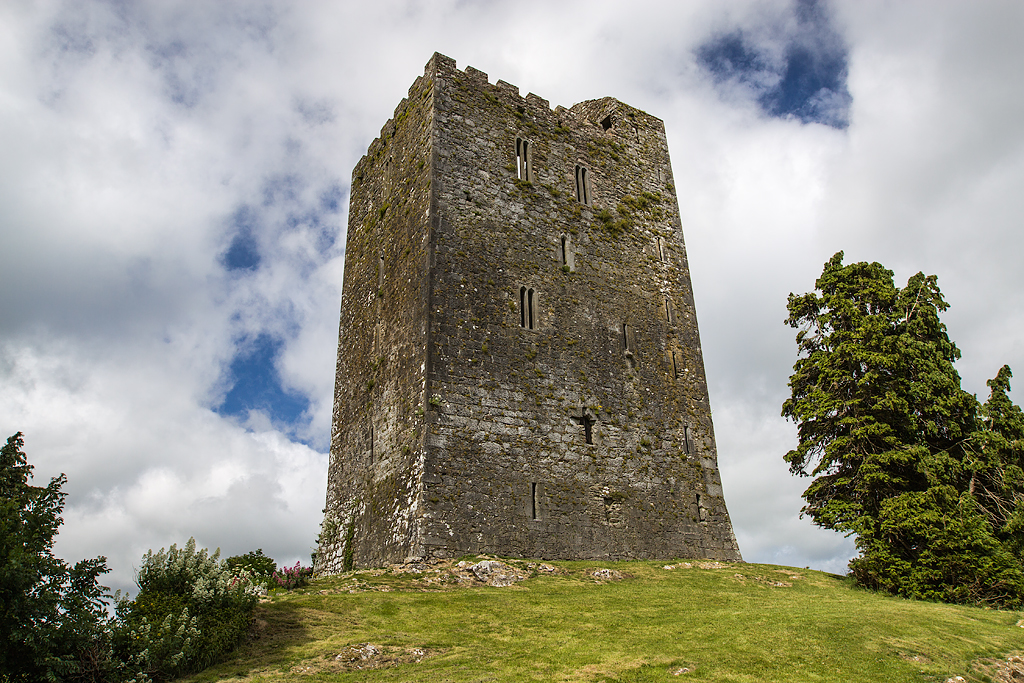
Lisfinny Castle
Lisfinny Castle is a 15th-century tower house located on a hillside above the River Bride near the hamlet of Tallowbridge in County Waterford, Ireland. This castle, built around 1460, is attributed to the Earl of Desmond, a powerful noble family influential in Munster during the late medieval period. The castle's strategic position on elevated ground provided commanding views of the surrounding landscape and the river valley, which was typical for defensive structures of the time.
Architectural features and construction
Lisfinny Castle is a classic example of a late medieval Irish tower house, a type of fortified residence common from the 15th century onward. Its robust stone construction features thick walls designed to withstand attacks and sieges. The castle's vertical emphasis is typical of tower houses, with several floors connected by narrow staircases. Defensive features would have included narrow slit windows for archers and a strong entrance likely protected by a heavy door and possibly a murder hole or machicolation for defense.
The castle's location on a hillside above the River Bride not only provided natural defense but also access to water and control over local routes. While much of the interior remains uncertain due to its current ruined state, tower houses like Lisfinny typically contained a great hall, private chambers, and storage areas stacked vertically. The castle's footprint and remaining walls suggest a rectangular plan, common among Desmond castles.
Historical significance and ownership
Lisfinny Castle played a role during the turbulent times of the Desmond Rebellions in the 16th century. During the Second Desmond Rebellion (1579–1583), the castle was garrisoned by Spanish soldiers who supported the Irish rebels against English rule. This highlights the castle's military importance and its involvement in wider European conflicts.
Following the rebellion, the castle was confiscated and granted to Sir Walter Raleigh in 1587, reflecting the English crown's policy of redistributing lands to loyal subjects. Raleigh, an explorer and courtier, held the castle briefly before selling it in 1602 to Sir Richard Boyle, the Earl of Cork, an influential figure who amassed extensive estates in Munster.
By 1641, Lisfinny Castle was described as a ruin, indicating it had fallen out of military and residential use. The decline of tower houses in Ireland during this period was common due to changing military technology and political shifts.
Later history and cultural anecdotes
In the centuries following its decline, Lisfinny Castle remained a ruin while a new Georgian house was constructed nearby, reflecting changing architectural tastes and residential needs.
Remarkably, the castle saw a brief resurgence in 1888 during the Land War, a period of agrarian agitation in Ireland. The lessee, Douglas Pyne, supported tenant rights and used the castle as a fortified refuge when authorities attempted to arrest him. Pyne barricaded himself inside with provisions, forcing the police to camp outside. He eventually escaped during a foggy morning, an event that adds a colorful chapter to the castle's history.
Current status and accessibility
Today, Lisfinny Castle stands as a ruined tower house on private farmland, limiting public access. Despite its condition, the castle remains an intriguing example of medieval Irish architecture, with its tower still prominent in the landscape. Visitors interested in Irish castles and medieval history value Lisfinny for its connections to the Desmonds, Raleigh, and the Earl of Cork, as well as its role in local historical events.
The castle's interior is not accessible to the public, and its preservation state reflects the challenges of maintaining such historic structures on private land. However, its silhouette and ruins continue to attract interest from historians and enthusiasts of Irish heritage.
Frequently asked questions (FAQ)
- How do I visit Lisfinny Castle?
- Lisfinny Castle is located on private farmland and is not open to the public. Visitors can view the castle ruins from nearby public roads but cannot enter the site.
- What is the historical significance of Lisfinny Castle?
- Lisfinny Castle was built around 1460 by the Earl of Desmond and played a role in the Second Desmond Rebellion. It was later owned by Sir Walter Raleigh and the Earl of Cork.
- When was Lisfinny Castle built?
- Lisfinny Castle was likely constructed around 1460 during the late medieval period, typical of Irish tower houses of that era.
- Can I explore the interior of Lisfinny Castle?
- The interior of Lisfinny Castle is not accessible to the public as it is on private property and in a ruined state.
- Why did Lisfinny Castle fall into ruin?
- The castle fell into ruin by 1641 due to changing political and military conditions, and the decline of tower houses in Ireland during that period.
Information
Current owner
Private owner
Loading map...
Visitor reviews
No reviews yet. Been here? Write the first review and help other travelers!
Write the first reviewVisited this castle? Share your experience
Your review helps other travelers and adds first-hand knowledge to our encyclopedia.