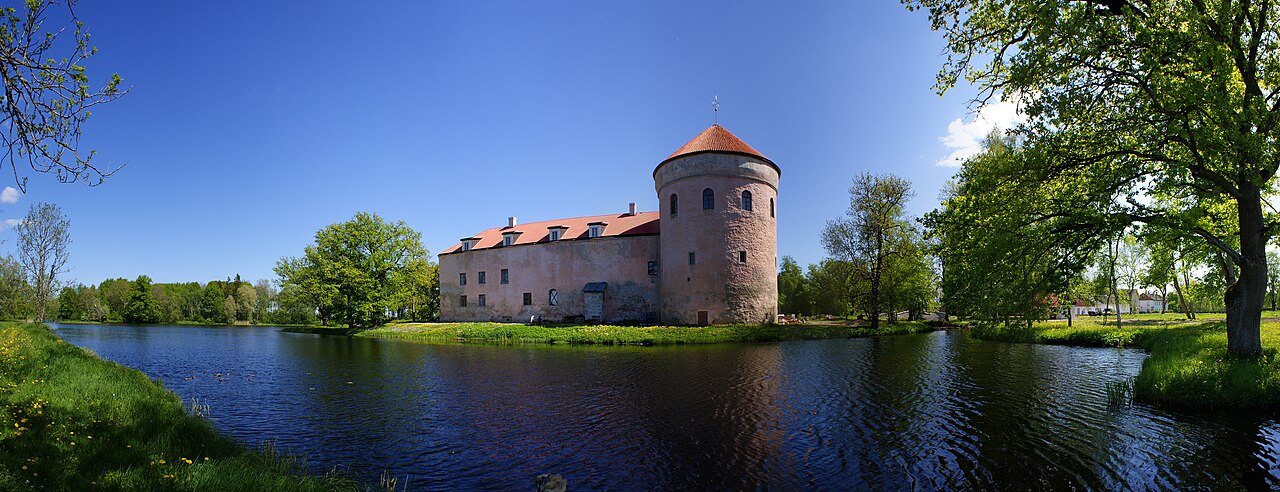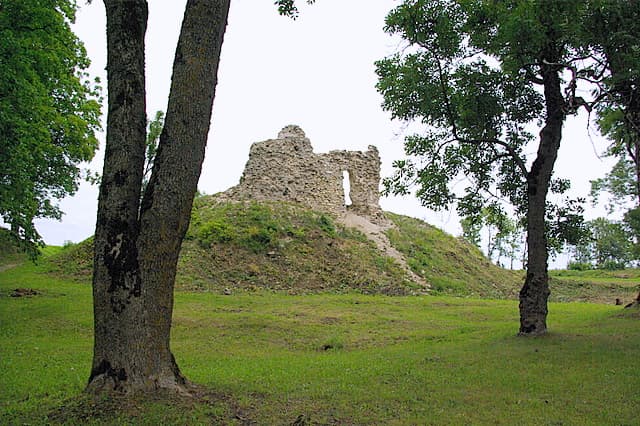
Lihula Castle ruins stand as a significant historical monument in Läänemaa, Estonia, reflecting the complex medieval history of the Baltic region. Constructed in the 13th century, this hill castle was a strategic stronghold jointly built and controlled by the Livonian Order and the bishopric of Ösel-Wiek. Its location on a prominent limestone hilltop, known locally as Lihula Lossimägi, provided natural defensive advantages that were enhanced by sophisticated fortifications typical of the High Medieval period.
The castle's construction began in 1238 and was completed by 1242, marking it as one of the earliest stone fortifications in the region. The dual authority over the castle—split between the religious bishopric and the military Livonian Order—created a unique governance and architectural arrangement. The bishop controlled the main gate and gate tower, while the order was restricted from building towers on their side, emphasizing the castle's dual religious and military functions.
Historical background and political significance
The origins of Lihula Castle are deeply intertwined with the Christianization and conquest of Estonia during the early 13th century. In 1211, Archbishop Albert of Riga appointed Theodorich as bishop of Estonia, intending to establish Lihula as the episcopal seat. This move was part of a broader effort to consolidate Christian ecclesiastical authority in the region. The area was contested by various powers, including local Estonian tribes, the Livonian Order, and external forces such as the Swedes and Danes.
Swedish troops briefly occupied the site in 1220 but were expelled after the destruction of the wooden settlement. Peace treaties followed, but the region remained volatile. Between 1234 and 1251, Lihula served as the residence of the bishop of Ösel-Wiek, while simultaneously, from 1241 to 1247, it functioned as the commandery center of the Livonian Order. This dual role underscored the castle's importance as both a religious and military hub.
The castle witnessed significant conflict, notably in 1298 during a civil war within Livonia when the Livonian Order seized control from the bishopric and captured Bishop Konrad I. This event also led to the destruction of the Elisabeth church within the castle grounds, highlighting the violent struggles for dominance in the region.
Architectural features and defensive structures
Lihula Castle was strategically built on an oval-shaped hilltop with natural steep escarpments to the north and west, providing formidable defense. The south and east sides, being more accessible, were protected by two concentric outer works separated by dry moats and stone walls. This layered defense system was enhanced in the 16th century with the addition of earthen bastions and further moats, reflecting advancements in military architecture during the Livonian War.
The castle's perimeter was enclosed by a high ring wall that also served as the outer wall of the internal buildings, a design that maximized defensive capabilities while economizing on construction materials. The main gate and gate tower, under bishopric control, were critical defensive points, with archaeological excavations revealing remnants of the pre-defense system and gate fortifications.
Inside the castle, excavations have uncovered the foundations of a chapel, a spiral staircase cellar, and various masonry structures that indicate the complexity of the internal layout. The division of the castle into two halves—one for the bishopric and the other for the Livonian Order—was physically manifested in the building arrangement and restrictions on construction rights.
Military history and decline
Lihula Castle played a pivotal role in regional conflicts throughout the medieval and early modern periods. During the Northern Seven Years' War in 1563, it was occupied by Swedish forces and administered by commanders such as Klaus Kursell and Gerhard Dönhoff. The castle's strategic value made it a contested site during the protracted Livonian War (1558–1583), during which it changed hands multiple times between Russian and Swedish forces.
The castle was last besieged in 1581, suffering severe damage that rendered it militarily obsolete. Following the war, the decision was made not to restore the castle. In 1643, the Queen of Sweden authorized its demolition, marking the end of its functional use. Despite this, the castle remained a recognized landmark in diplomatic agreements, such as the 1595 Treaty of Teusina, which formalized territorial claims in the region.
Archaeological research and preservation efforts
Interest in Lihula Castle's ruins was revived in the late 20th century, with significant archaeological excavations conducted between 1990 and 1996 under the direction of archaeologist M. Mandeli. These excavations uncovered important structural elements, including parts of the castle's gate, chapel, outer fortifications, and a spiral staircase cellar.
These findings have contributed to a deeper understanding of the castle's architectural and historical significance, highlighting its unique status among Baltic medieval fortifications. Conservation efforts have focused on stabilizing the exposed foundations and preventing further deterioration, ensuring that the ruins remain accessible for educational and cultural purposes.
Current condition and visitor experience
Today, the Lihula Castle ruins are in a ruinous state, with only fragmentary remains of the original structures visible. The site offers visitors a tangible connection to Estonia's medieval past, with interpretive signage and preserved foundations providing insight into the castle's layout and defensive features.
The castle's location on a hilltop offers scenic views of the surrounding landscape, enhancing its appeal as a historical site. Visitors can explore the remains of the defensive walls, gate, and chapel foundations, gaining an appreciation for the castle's strategic design and turbulent history.
Cultural and heritage significance
Lihula Castle is recognized as one of the most unique 13th-century defensive buildings in the Baltic region. Its dual function as a religious and military fortress reflects the complex power dynamics of medieval Estonia. The castle's ruins serve as a symbol of the region's contested history and the interplay between ecclesiastical authority and military orders.
As a protected heritage site, Lihula Castle contributes to Estonia's cultural tourism and offers valuable opportunities for historical education and archaeological study. Its preservation underscores the importance of maintaining connections to the medieval past in understanding the broader historical narratives of the Baltic states.
Frequently asked questions (FAQ)
- How do I get to Lihula Castle ruins?
- Lihula Castle ruins are located in the town of Lihula in Läänemaa County, Estonia. They are accessible by car and local roads, with parking available nearby. Public transport options include regional buses connecting Lihula with larger cities like Haapsalu and Tallinn.
- What is the best time to visit Lihula Castle ruins?
- The best time to visit Lihula Castle ruins is during the late spring to early autumn months (May to September) when the weather is mild and the site is more accessible. During this period, visitors can comfortably explore the outdoor ruins and surrounding landscape.
- Is there an entrance fee to visit Lihula Castle ruins?
- Visiting Lihula Castle ruins is generally free of charge as it is an open-air historical site. However, some guided tours or special events may have associated fees. It is advisable to check locally for any updates on ticketing or access restrictions.
- What architectural styles are evident in Lihula Castle?
- Lihula Castle primarily exhibits characteristics of <strong>High Medieval</strong> military architecture with influences from <strong>Gothic</strong> style in its structural elements. The castle’s defensive design includes concentric walls, moats, and bastions typical of medieval fortifications.
- Can visitors explore the interior of the castle?
- Since Lihula Castle is in ruins, there is no intact interior to explore. Visitors can walk around the foundation remains, defensive walls, and gate structures to get a sense of the castle’s layout and historical significance.
Photo gallery

Information
Website
Visit websiteSources & official resources
Verify the information above using these authoritative references.
Loading map...
Visitor reviews
No reviews yet. Been here? Write the first review and help other travelers!
Write the first reviewVisited this castle? Share your experience
Your review helps other travelers and adds first-hand knowledge to our encyclopedia.