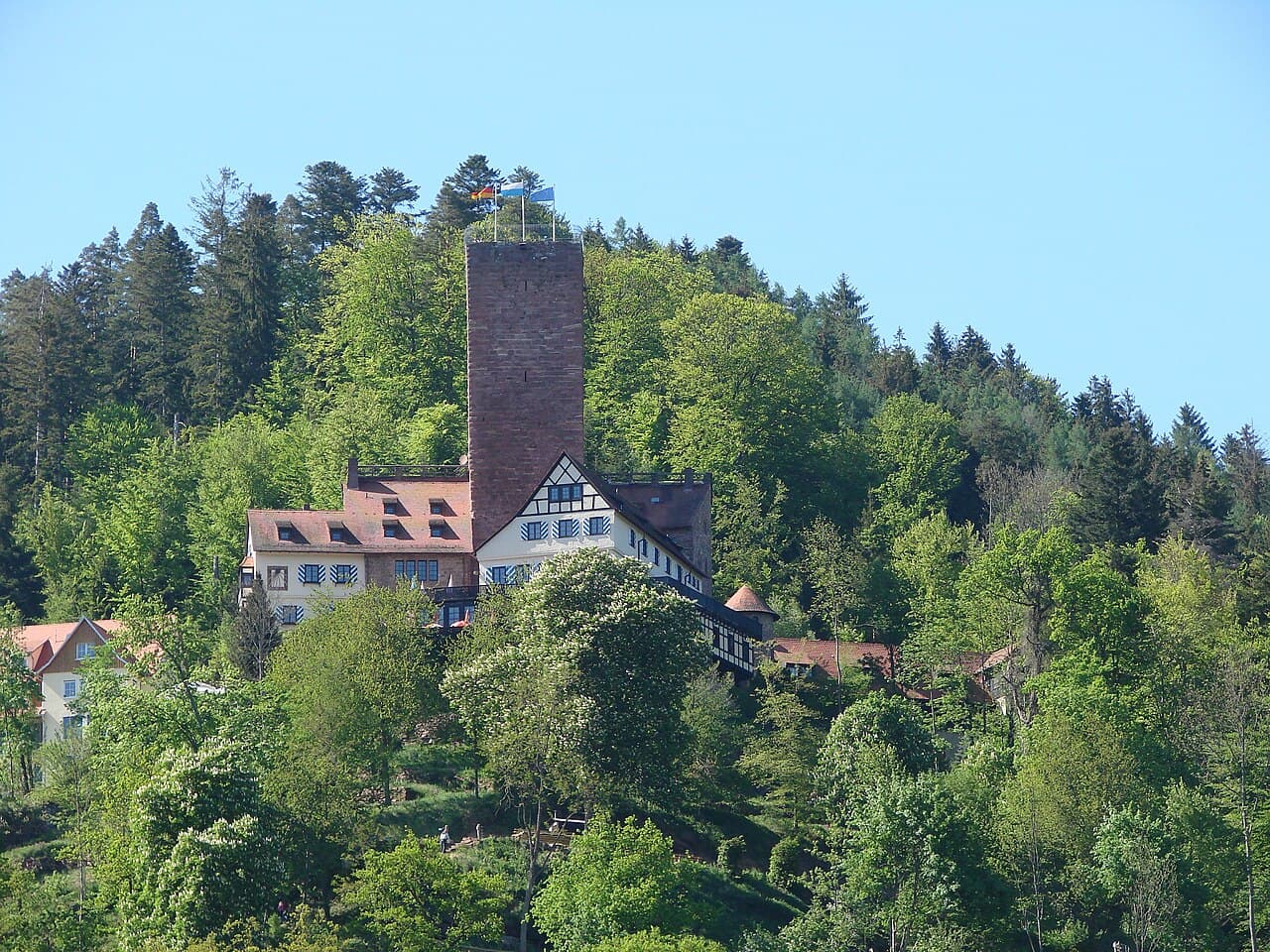
Liebenzell Castle
Liebenzell Castle is a prominent hill castle perched on a rocky spur above the town of Bad Liebenzell in the district of Calw, Baden-Württemberg, Germany. Constructed in the 12th century by the Counts of Calw, it stands as a significant medieval fortification in the Württemberg part of the Black Forest. The castle’s strategic location at an elevation of approximately 450 meters allowed it to oversee important regional routes and exert control over the surrounding landscape.
The castle's design features an irregular pentagonal layout centered around a mighty shield wall and a robust square bergfried. These defensive structures exemplify early Romanesque military architecture with their use of rusticated ashlar masonry (buckelquader) and formidable dimensions. The bergfried, standing 32 meters tall with walls two meters thick, served both as a lookout tower and a last refuge during sieges. Its high entrance, located six meters above ground, was a common defensive feature to prevent easy access by attackers.
Historical development and ownership
The castle was originally built by the Counts of Calw in the early 12th century. By 1196, ownership had passed to the Counts of Eberstein, who undertook significant expansions between 1220 and 1230. These enhancements included strengthening the fortifications and enlarging the residential quarters, reflecting the evolving needs of medieval nobility for both defense and comfort.
In 1273, the last knight associated with the castle, Ludwig von Liebenzell, transferred the castle to the Teutonic Order, a religious military order. The following year, the property was sold to Margrave Rudolf of Baden, linking the castle to the expanding Baden territory. This transition marked a shift in the castle’s political significance within the region.
Destruction and restoration
By the early 16th century, Liebenzell Castle had fallen into decline and partial ruin. Only essential structures such as the shield wall and bergfried remained intact. The castle suffered further destruction in 1692, likely related to regional conflicts of the period. For centuries, it remained in a ruined state until a major reconstruction effort in 1954 revitalized the site.
The 20th-century restoration was led by Gustav-Adolf Gedat, a politician and youth leader, who repurposed the castle as a center for youth education and intercultural dialogue. Today, the castle is owned and managed by the International Forum Burg Liebenzell and functions as a youth training center and conference venue. It also houses a restaurant, making it accessible to visitors and fostering community engagement.
Architectural features and layout
Fortifications
The castle’s shield wall is a dominant feature, rising approximately 17.5 meters high and 2.7 meters thick. Constructed from rusticated ashlar blocks, it exemplifies the Romanesque style typical of early 13th-century fortress architecture. This wall was designed to withstand sieges and artillery attacks, protecting the inner castle buildings.
The bergfried
Integrated into the shield wall is the imposing square bergfried, measuring about 9 by 9 meters at its base. This six-story tower reaches a height of 32 meters and features a high entrance set six meters above ground level for defensive purposes. The bergfried’s walls are two meters thick, providing substantial protection. Inside, a garderobe (medieval latrine) is built into the structure, indicating the tower’s role as a habitable refuge during attacks. Today, the bergfried serves as a viewing tower, offering panoramic views of the surrounding Black Forest landscape.
Residential buildings
The main residential building, or palas, is notable for its slender ogival windows with pointed arches, reflecting a stylistic transition from Romanesque to early Gothic influences. These ornamental openings provided both light and aesthetic refinement to the great hall, which was the center of noble life within the castle. While much of the original palas has been altered or rebuilt over time, these architectural details remain evocative of the castle’s medieval heritage.
Cultural significance and present use
Liebenzell Castle holds cultural and historical importance as a symbol of medieval power in the Württemberg Black Forest region. Its preservation and restoration have allowed it to serve modern purposes beyond its original military and residential functions. The castle’s role as a youth training center under the International Forum Burg Liebenzell emphasizes education, intercultural exchange, and community involvement.
Visitors to the castle can explore its well-preserved defensive walls, climb the bergfried for expansive views, and enjoy the castle’s restaurant facilities. The site hosts various educational programs and events, linking the castle’s medieval past with contemporary social and cultural activities.
Visiting information
The castle is open to the public during specified hours, providing access to its historic structures and scenic surroundings. Visitors are encouraged to explore the bergfried tower and the remnants of the shield wall to appreciate the castle’s architectural and historical significance. The presence of a restaurant on site enhances the visitor experience by offering local cuisine in a historic setting.
Frequently asked questions (FAQ)
- How do I get to Liebenzell Castle?
- Liebenzell Castle is located in Bad Liebenzell, Germany, and is accessible by car or public transport. If you are traveling by train, the nearest station is Bad Liebenzell, from where you can take a short walk to reach the castle.
- What is the historical significance of Liebenzell Castle?
- Liebenzell Castle, built in the 13th century, played a crucial role in the region's feudal system and served as the residence of the Lords of Liebenzell. It has witnessed numerous historical events and has been well-preserved, making it a valuable site for understanding the medieval period in Germany.
- When was Liebenzell Castle last renovated?
- Liebenzell Castle has undergone several renovations over the centuries, with significant restoration work completed in the 20th century to maintain its structural integrity and historical features. The most recent renovations focused on enhancing visitor accessibility and preserving the castle's medieval architecture.
- Can I visit Liebenzell Castle year-round?
- Yes, Liebenzell Castle is open to visitors throughout the year, but specific opening hours may vary by season. It is advisable to check the official website for the latest information on visiting hours and any potential seasonal closures.
- Why is Liebenzell Castle a popular tourist attraction?
- Liebenzell Castle attracts visitors due to its stunning views, rich history, and beautiful architecture. The castle offers guided tours that provide insights into its past, making it an enriching experience for history enthusiasts and casual visitors alike.
- Is it possible to host events at Liebenzell Castle?
- Yes, Liebenzell Castle offers facilities for private events, including weddings and corporate gatherings. The picturesque setting and historical ambiance make it a unique venue for memorable occasions.
- What are the ticket prices for visiting Liebenzell Castle?
- Ticket prices for Liebenzell Castle are generally affordable, with discounts available for students and seniors. Children under a certain age may enter for free, so it's best to check the official website for the most up-to-date pricing information.
- What are the best times to visit Liebenzell Castle?
- The best times to visit Liebenzell Castle are during the spring and early fall when the weather is mild and the surrounding landscape is in full bloom. Visiting during these seasons allows you to enjoy the castle grounds and nearby hiking trails at their best.
- Are there any nearby attractions to visit along with Liebenzell Castle?
- Yes, there are several nearby attractions, including the beautiful Palatine Forest and the charming town of Bad Liebenzell itself. Visitors can also explore other historical sites and enjoy local restaurants and shops in the area.
Photo gallery

Information
Website
Visit websiteSources & official resources
Verify the information above using these authoritative references.
Loading map...
Visitor reviews
No reviews yet. Been here? Write the first review and help other travelers!
Write the first reviewVisited this castle? Share your experience
Your review helps other travelers and adds first-hand knowledge to our encyclopedia.



