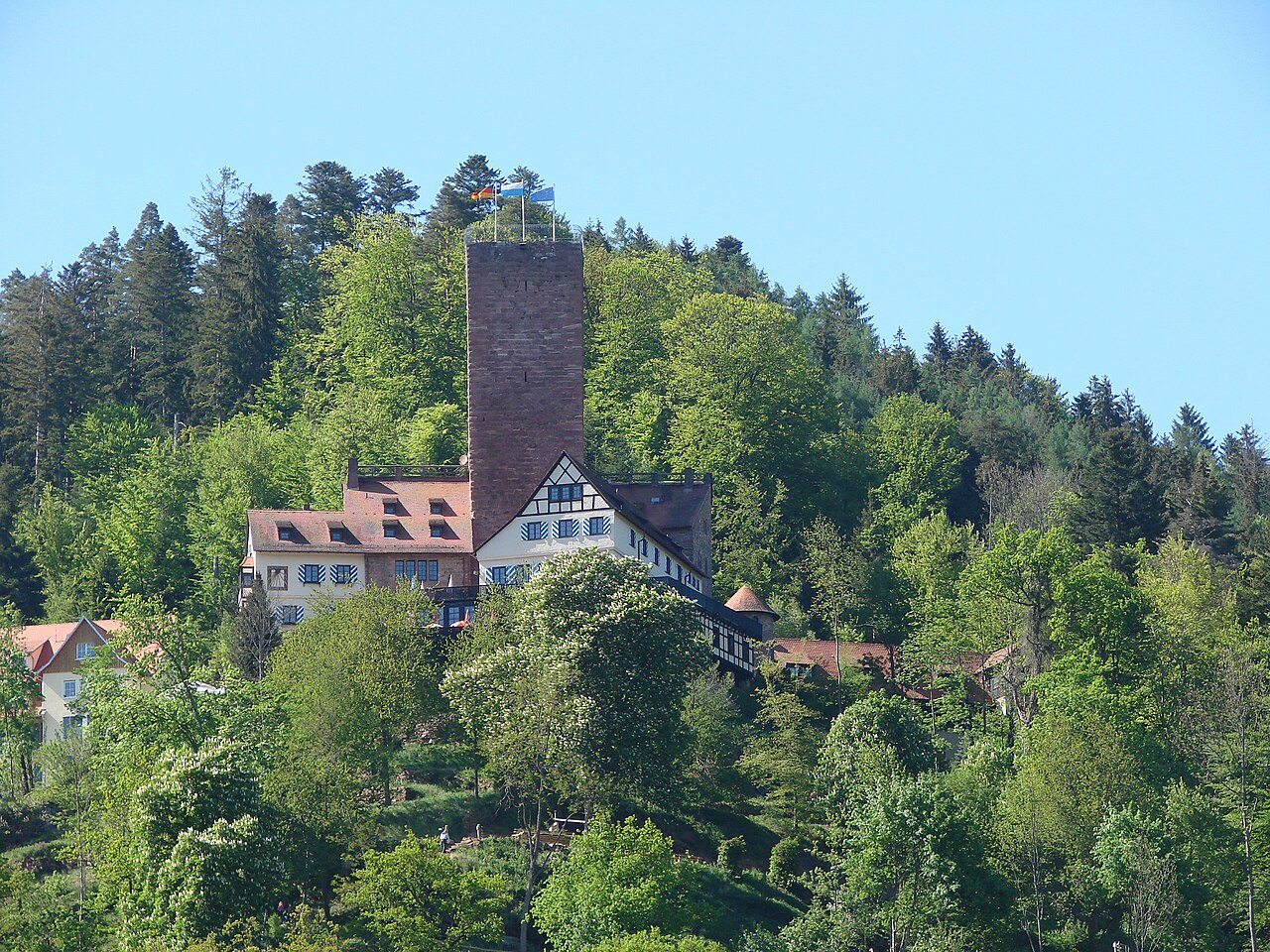
Burg Steinegg
Burg Steinegg stands as a remarkable example of a hill castle with a layered history that spans from the High Middle Ages through the Renaissance and into modern times. Located in the municipality of Neuhausen in southwestern Germany, this castle's origins trace back to the mid-12th century when it was first constructed by Adalbert von Steinegg, a ministerial vassal serving the powerful Counts of Calw. The earliest documentary evidence dates to around 1150, situating the castle firmly within the medieval feudal landscape of the region.
Medieval origins and early history
The original hilltop fortress of Burg Steinegg was strategically positioned approximately 410 meters above sea level on a terraced hill, providing commanding views over the surrounding valley and forested landscape. This elevated location was typical of medieval defensive architecture, designed to maximize visibility and protection. The castle initially served as a fortified residence for the von Steinegg family, who played a significant role as ministerials in the service of regional counts.
In 1324, the castle passed into the hands of Wolf I of Stain, marking the beginning of a new chapter in its ownership. The early 15th century witnessed significant political turmoil, notably the defeat of the Schleglerbund in 1407, a coalition of knightly families in the region. Following this defeat, Burg Steinegg was sold to Diether V of Gemmingen, whose family would profoundly influence the castle's development for centuries.
Transition to a renaissance residence
Rather than residing in the original hilltop castle, Diether V's son, Diether (1398–1478), initiated the construction of a new lower castle beneath the old medieval site during the 15th century. This shift from the hilltop to a lower elevation reflected evolving defensive and residential preferences, as well as the changing nature of castle architecture in the late medieval period.
The new castle became the administrative center for the Gemmingen lordship, reinforcing their regional influence. In a strategic political move, Diether enfeoffed the castle to the Margrave of Baden, aligning his family with one of the most powerful territorial lords in southwestern Germany. The construction of a castle chapel in 1520 further enhanced the estate, underscoring the importance of religion and status in noble residences during the early 16th century.
Renaissance expansions and architectural features
During the late 16th century, Hans Pleikard von Gemmingen (1546–1603) undertook significant expansions of Burg Steinegg in the Renaissance architectural style. These renovations modernized the castle, incorporating contemporary design elements and improving its residential comfort while maintaining its defensive capabilities.
The castle's layout from this period includes characteristic Renaissance features such as symmetrical facades, enlarged windows, and decorative stonework. The presence of both the original castle chapel and a nearby forest chapel at Hamberg—a rock-bound sanctuary nestled within the surrounding woodland—reflects the estate's spiritual dimension. These chapels were enlarged and embellished in the early 18th century under the direction of Karl Dietrich Anton von Gemmingen (1694–1745), demonstrating ongoing investment in the castle's religious and cultural significance.
Survival through conflict and restoration efforts
Burg Steinegg notably escaped destruction during the Thirty Years' War and the Nine Years' War by means of substantial payments, illustrating the Gemmingen family's diplomatic acumen in turbulent times. However, a devastating fire in 1694 severely damaged the castle while its lord, Karl Dietrich von Gemmingen, was absent. The castle was promptly rebuilt in 1695, adapting to the needs of the period.
Following centuries of noble residence, the castle changed hands in the 19th century when it was transferred to the state of Baden in 1839. Shortly thereafter, Eduard von Gemmingen-Steinegg reacquired the property but controversially ordered the removal of its roofs in 1840, accelerating its deterioration.
Restoration efforts began in earnest in 1928, led by Freiin St. Clair von Gemmingen-Steinegg and continued by Irmgard von Bistram after 1951. In 1958, stewardship passed to the Protestant parish of Pforzheim under a hereditary building lease. Supported by church funds, government subsidies, and family contributions, the castle was restored and adapted for use as a leisure and youth center, ensuring its preservation and continued community engagement.
Architectural remains and current status
Today, Burg Steinegg presents a fascinating architectural palimpsest, where the foundational remnants of the original medieval hilltop fortress coexist with the largely preserved Renaissance lower castle. The castle's location in a small valley surrounded by a forest park near the village of Steinegg offers a picturesque setting that highlights its historical and cultural importance.
The castle chapel from 1520 and the forest chapel at Hamberg remain significant features, embodying the spiritual heritage of the estate. The castle's fabric, having undergone extensive restoration, now serves as a leisure home and youth center, blending historical preservation with contemporary use.
Burg Steinegg stands as a testament to the architectural evolution from medieval fortification to Renaissance residence and the enduring legacy of the noble families who shaped its history. Its survival through wars, fires, and neglect, followed by dedicated restoration, underscores its significance as a cultural landmark in southwestern Germany.
Frequently asked questions (FAQ)
- How do I visit Burg Steinegg and what are the opening hours?
- Burg Steinegg is managed by the Protestant parish of Pforzheim and is open to visitors primarily during special events and by appointment. Opening hours may vary, so it is recommended to check with the parish or local tourist information before planning your visit.
- What is the historical significance of Burg Steinegg?
- Burg Steinegg has a rich history dating back to the 12th century, serving as a noble residence and administrative center for the von Steinegg and Gemmingen families. Its architectural evolution from a medieval hilltop fortress to a Renaissance lower castle reflects important regional developments.
- Can I explore the chapels at Burg Steinegg?
- Visitors can view the castle chapel built in 1520 and the nearby forest chapel at Hamberg, which were expanded in the early 18th century. These chapels highlight the spiritual heritage of the castle and are key features of the site.
- Is Burg Steinegg accessible for visitors with mobility issues?
- Due to its hilltop location and historic structures, accessibility may be limited for visitors with mobility challenges. It is advisable to contact the managing parish for specific information and assistance regarding access.
- What architectural styles are represented at Burg Steinegg?
- Burg Steinegg showcases a blend of <strong>High Medieval</strong> origins with significant <strong>Renaissance</strong> architectural features introduced during late 16th-century expansions, including symmetrical facades and decorative stonework.
Information
Sources & official resources
Verify the information above using these authoritative references.
Loading map...
Visitor reviews
No reviews yet. Been here? Write the first review and help other travelers!
Write the first reviewVisited this castle? Share your experience
Your review helps other travelers and adds first-hand knowledge to our encyclopedia.