Lichnice Castle
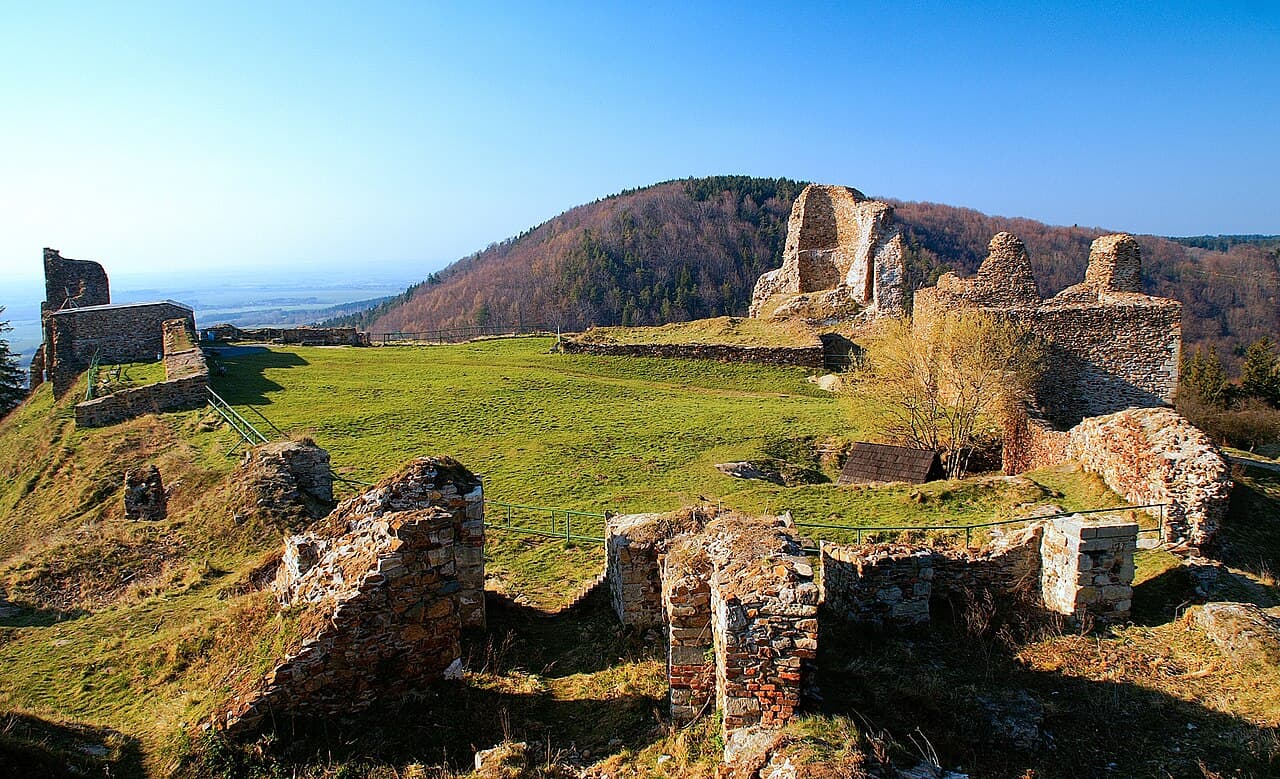
Lichnice Castle stands as a remarkable example of a 13th-century hill castle nestled on the edge of the Iron Mountains in the municipality of Třemošnice, Czechia. This historic fortress, now in ruins, offers a vivid glimpse into Bohemian medieval architecture, royal ambitions, and the turbulent conflicts that shaped the region. Originally constructed as a royal stronghold, the castle's strategic location atop a triangular rocky plateau provided natural defense augmented by formidable man-made fortifications.
Early history and royal origins
The origins of Lichnice Castle trace back to the first half of the 13th century, likely commissioned by the Bohemian crown under King Václav I. Initially named Lichtenburk, the castle was intended as a royal base to assert control over the surrounding territory. Its triangular floor plan and layout reflect typical high medieval military architecture, with defensive walls enclosing living quarters and key towers.
The castle was first documented in 1261 when it was held by Smil of Ronow, who adopted the name Smil of Lichtenburg and established the noble von Lichtenburg family. Despite ambitions for a grand palace complex, financial and political constraints led to a scaled-back fortress centered around a large circular bergfried tower, which served as the main defensive stronghold.
Architectural features and construction phases
Original gothic layout
The castle's initial construction utilized locally sourced paragneiss stone, combined with chalk sandstone and granite, forming robust walls that have endured centuries. The core area measured approximately 37 by 35 by 32 meters, enclosed by defensive walls and featuring two main residential towers. The northeast corner's bergfried tower is a prominent surviving element, approximately 11.5 meters in diameter, designed to dominate the landscape and serve as a refuge during attacks.
Additional fortifications included a barbican protecting the main entrance and a parkán or outer ward, typical of Gothic military design. The western wall housed the original palace with vaulted rooms and intricately carved stone tracery windows, stylistically dated to the 1260s, highlighting the castle's early architectural sophistication.
Late gothic modifications and expansions
In the late 15th century, under the ownership of the Trčka of Lípa family, Lichnice Castle underwent significant renovations reflecting late Gothic architectural styles. The original gate was replaced by a large polygonal barbican to enhance defense against evolving siege tactics. A vaulted palace with a complex layout was added in the northwest sector, alongside expanded residential and service buildings along the northern and southwestern walls.
Defensive adaptations included the construction of a massive shield wall at the southern corner between 1520 and 1522, confirmed by dendrochronological analysis. Earthworks were widened to support artillery, signaling the castle's response to the introduction of gunpowder weaponry in warfare.
Role in the hussite wars and later history
Lichnice Castle played a notable role during the Hussite Wars in the early 15th century. It was captured by Hussite forces in 1421 without significant resistance but was soon retaken by Catholic loyalists. The castle endured a prolonged siege by the Hussite faction known as the "Orphans" from 1428 to 1429. Despite attempts to starve the defenders, the castle's garrison successfully resisted, conducting sorties that inflicted heavy losses on the besiegers.
Following the wars, the castle returned to royal control and later passed into noble hands. Its military importance declined after a fire in 1610 and during the Thirty Years’ War, when it saw limited use. Subsequently, King Ferdinand III ordered partial demolition to prevent its military reuse. By the 18th century, Lichnice was described as a ruin, with stones repurposed by locals.
Archaeological efforts and preservation
In the 20th century, archaeological excavations and conservation efforts began, notably from 1933 under the Czech Tourist Club. These initiatives have stabilized remaining structures and uncovered foundations of former buildings, providing insights into the castle's complex history.
Restoration work includes the reconstruction of the castle gate in 1907, using recovered architectural fragments. A lookout platform and a small museum within the ruins display artifacts and interpret the site's layered past for visitors.
Castle layout and natural defenses
Lichnice Castle occupies a naturally defensible triangular rocky plateau known as an ostroh, measuring roughly 79 by 100 by 115 meters and covering about 0.46 hectares. The site is protected by steep ravines on most sides, supplemented by a wide moat and an outer earthwork rampart. These features combined to create a formidable defensive position in medieval Bohemia.
The use of durable paragneiss stone in construction, together with chalk sandstone and granite, contributed to the castle's longevity despite centuries of exposure and conflict.
Siege works and battlefield archaeology
Remnants of siege works from the 1428–1429 Hussite siege remain visible around the castle. Approximately 450 meters south on Kobylí hlava hill, earthwork fortifications and platforms likely served as a command post and artillery positions. Archaeological finds include 437 fragments of 15th-century kitchen and table ceramics, indicating the presence of a temporary military camp during the siege.
Visiting lichnice castle today
Today, Lichnice Castle is owned by the municipality of Třemošnice and is accessible to the public as a preserved ruin. Visitors can explore the remains of the bergfried tower, the reconstructed gate, and the surrounding fortifications. The onsite museum offers historical context and displays artifacts excavated from the site.
The castle's dramatic setting on a rocky plateau with panoramic views of the Iron Mountains makes it a popular destination for history enthusiasts and hikers alike. Its rich history, architectural evolution, and role in significant medieval conflicts contribute to its cultural heritage significance in Czechia.
Frequently asked questions (FAQ)
- How do I get to Lichnice Castle?
- Lichnice Castle is located near the village of Podhradí in the municipality of Třemošnice, Czechia. It is accessible by local roads and hiking trails from Třemošnice and nearby towns. Visitors are advised to check local maps and transportation options before planning their visit.
- What is the best time to visit Lichnice Castle?
- The best time to visit Lichnice Castle is during the late spring to early autumn months when weather conditions are favorable for hiking and outdoor exploration. The castle ruins are open year-round, but some paths may be challenging in winter due to snow and ice.
- Is Lichnice Castle suitable for families and children?
- Yes, Lichnice Castle is suitable for families and children who enjoy outdoor activities and history. However, as the site is a ruin on a rocky plateau, parents should supervise children closely to ensure safety around uneven terrain and steep drops.
- Are there guided tours available at Lichnice Castle?
- Guided tours may be available through the local municipality or tourist organizations during the peak season. Visitors should inquire locally about tour schedules and availability to enhance their understanding of the castle's history and architecture.
- What architectural style is Lichnice Castle built in?
- Lichnice Castle primarily features Gothic architectural elements, with initial construction in the 13th century and significant late Gothic modifications in the 15th and 16th centuries.
Photo gallery

Information
Sources & official resources
Verify the information above using these authoritative references.
Loading map...
Visitor reviews
No reviews yet. Been here? Write the first review and help other travelers!
Write the first reviewVisited this castle? Share your experience
Your review helps other travelers and adds first-hand knowledge to our encyclopedia.