Levadia Medieval Castle
The Levadia medieval castle stands as a testament to the rich and turbulent history of central Greece, prominently located on the steep hill of Prophet Elias at the southern edge of the city of Levadia. This hill castle occupies a naturally defensible position, surrounded on three sides by the deep Herkyna river gorge, with only a narrow land connection to the main hill, making it a formidable stronghold throughout its history. Its origins trace back to the Byzantine period, marking the beginning of its strategic importance in the region.
Over the centuries, the castle evolved through successive phases of construction and modification, reflecting the influence of various ruling powers. After the Byzantines, the castle was altered by the Franks, but its most defining transformation occurred under the Catalan Company following their victory over the Franks at the Battle of Kopais in 1311. The Catalans established the castle as their fortified base, making Levadia the city with the strongest Catalan influence outside the Kingdom of Aragon during the 14th century. This period saw the castle become a vibrant center of Catalan culture and military presence.
Historical significance and military role
The castle's strategic location made it a coveted prize for various powers. In 1430, it was besieged by the Navarrese forces, and despite a determined defense, it fell due to internal betrayal by a Greek from Durazzo. Shortly thereafter, in 1460, the castle was captured by the Ottoman Empire under Mehmed II. The Ottomans recognized its military value, maintaining it as a garrison and adapting the fortifications with their masonry techniques, incorporating soft stones and bricks into repairs and reconstructions.
During the Greek War of Independence in 1821, the castle once again played a defensive role when nearly a thousand Greek revolutionaries sought refuge within its walls during a prolonged siege by Ottoman forces. Following Greek independence in 1830, the castle lost its military function and gradually fell into disuse and partial ruin. The only notable construction after this period is the Church of Hagia Sophia, built in the late 19th or early 20th century within the castle precincts.
Architectural layout and fortifications
Outer enclosure and medieval city wall
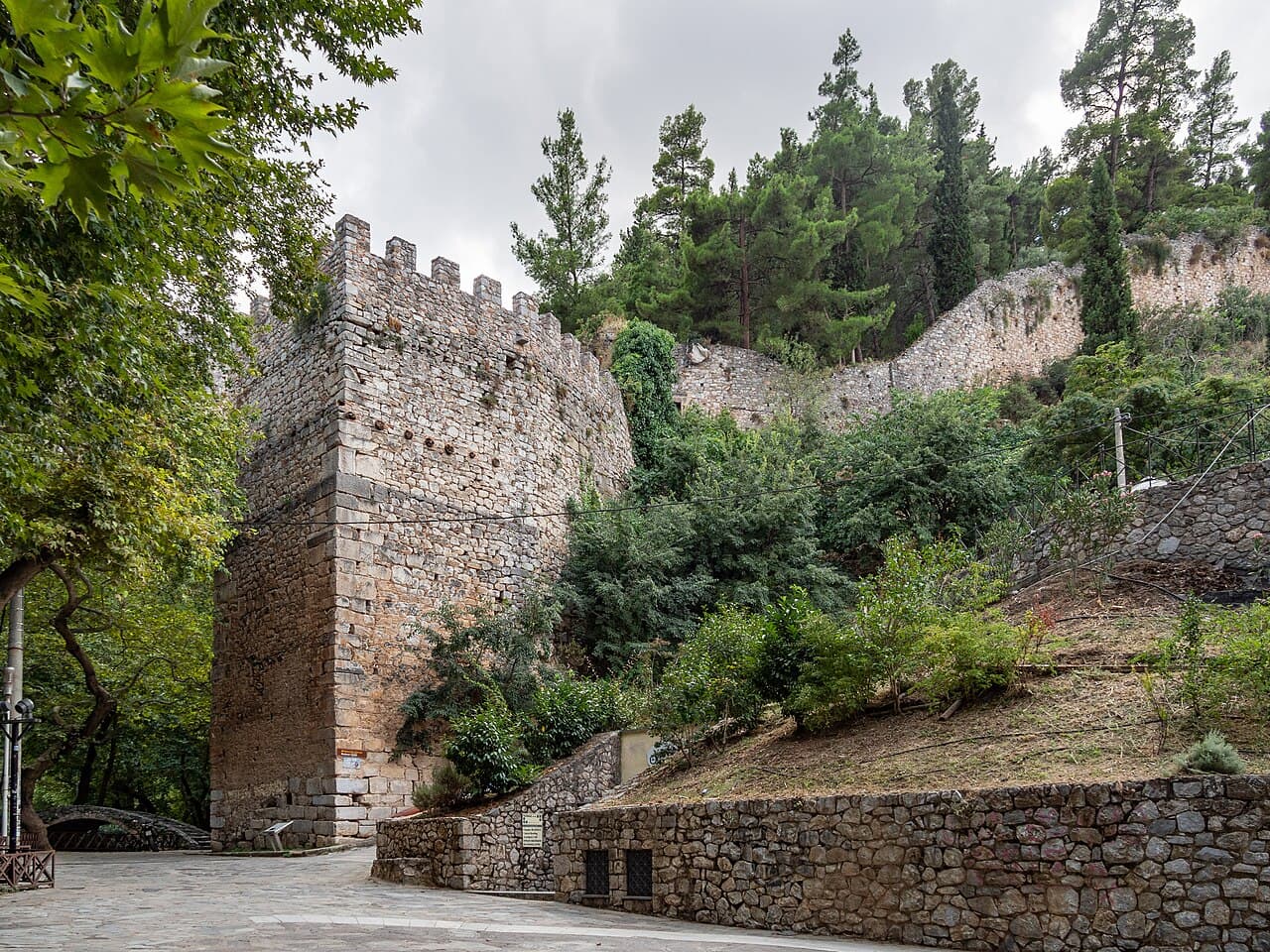
The castle's defensive design is characterized by three concentric terraced enclosures ascending the northern slope of the hill. The outer enclosure encompasses the area that once housed the medieval town of Levadia, which expanded beyond the castle walls during Ottoman rule. This enclosure features a largely intact vertical wall constructed of roughly cut stones set in horizontal layers, with mortar mixed with fragments of broken roof tiles. Reinforced by rectangular towers, the wall includes a wall-walk on the inside, allowing defenders to patrol the perimeter.
One remarkable feature of the outer wall is the eastern section that descends steeply toward the Herkyna gorge and the nearby Krya springs. This section culminates in a substantial rectangular tower measuring approximately 8.5 by 15 meters and rising 12 meters high. The tower's base incorporates large ashlar blocks repurposed from ancient structures, while the upper portions match the masonry style of the outer wall. Narrow vertical openings at various levels provided archers with defensive positions. Internally, a stone staircase descends three floors to the spring below, underscoring the tower's critical role in protecting the water source and controlling access to the gorge.
Middle enclosure and fortress
The middle enclosure served as the main fortress, facing the urban area and secured by a robust wall approximately 1.20 to 1.50 meters thick. This wall, built similarly to the outer enclosure but lacking arrow slits, is fortified by three rectangular towers. The main gate is guarded by a tower with an outer defensive barbican, enhancing its security. The largest tower in this section measures nearly 8.7 meters on each side, with an entrance located on the first floor accessible via the wall-walk. Wooden stairs likely connected the tower's floors internally.
Within this enclosure stands a notable two-level building housing two churches: the Church of Hagia Sophia on the upper floor and the Church of Saint Barbara below. Earlier scholarly searches for the Church of Saint George, famed during the Catalan period for its relic of Saint George's head, did not uncover surviving remains, leaving its exact location uncertain.
Inner enclosure and acropolis
The inner enclosure, or acropolis, crowns the hilltop with a roughly triangular layout. This area represented the castle's last defensive bastion, strongly fortified around a central donjon tower that functioned as the commander's residence and refuge during sieges. Today, only the lower sections of the donjon's walls remain, measuring about 7 meters on each side. The original entrance was on an upper floor that no longer exists, emphasizing the tower's defensive design.
Preservation and archaeological efforts
By the early 19th century, parts of the castle had begun to deteriorate, compounded by natural disasters and the removal of stone for other construction purposes. However, scientific interest in the site increased notably in the late 19th century, with important studies conducted by the Catalan historian Rubio y Lluch. In the mid-20th century, archaeologist P. Lazaridis led significant conservation and restoration efforts to stabilize and preserve the remaining structures.
Between 1993 and 1995, further restoration and adaptive reuse projects were undertaken under the guidance of municipal authorities and archaeological experts. These efforts helped conserve the castle's key features, including its walls, towers, and churches, ensuring that the historical and cultural significance of this medieval fortress continues to be appreciated by visitors and scholars alike.
Levadia castle's cultural and historical legacy
The Levadia medieval castle stands as a remarkable example of a multi-period fortress that encapsulates the complex history of central Greece. From its Byzantine origins through its Catalan fortifications and Ottoman adaptations, the castle illustrates the layered military and cultural influences that shaped the region. Its architectural features, including the concentric walls, fortified towers, and religious buildings, reflect the evolving defensive needs and artistic styles from the Middle Ages to the early modern period.
Today, the castle remains an important heritage site, offering insights into medieval military architecture and the historical dynamics of Greek territories under Byzantine, Frankish, Catalan, and Ottoman control. Its commanding position overlooking the Herkyna river gorge continues to captivate visitors, making it a significant landmark in the municipality of Levadia and a valuable resource for understanding Greece's medieval past.
Frequently asked questions (FAQ)
- When was Levadia medieval castle originally built?
- Levadia medieval castle was originally constructed during the Byzantine period, marking its initial strategic importance in the region.
- What architectural features define Levadia castle?
- Levadia castle features three concentric terraced enclosures with fortified walls, rectangular towers, a central donjon, and churches within the middle enclosure.
- Can visitors explore the churches inside the castle?
- Yes, the castle houses the Church of Hagia Sophia and the Church of Saint Barbara within the middle enclosure, which are notable historical religious sites.
- What role did the castle play during the Greek War of Independence?
- During the Greek War of Independence in 1821, the castle served as a refuge for nearly a thousand revolutionaries during a siege by Ottoman forces.
- Who controlled Levadia castle after the Catalan Company?
- After the Catalan Company, the castle was captured by the Navarrese forces in 1430 and later by the Ottoman Empire in 1460 under Mehmed II.
Photo gallery

Information
Loading map...
Visitor reviews
No reviews yet. Been here? Write the first review and help other travelers!
Write the first reviewVisited this castle? Share your experience
Your review helps other travelers and adds first-hand knowledge to our encyclopedia.