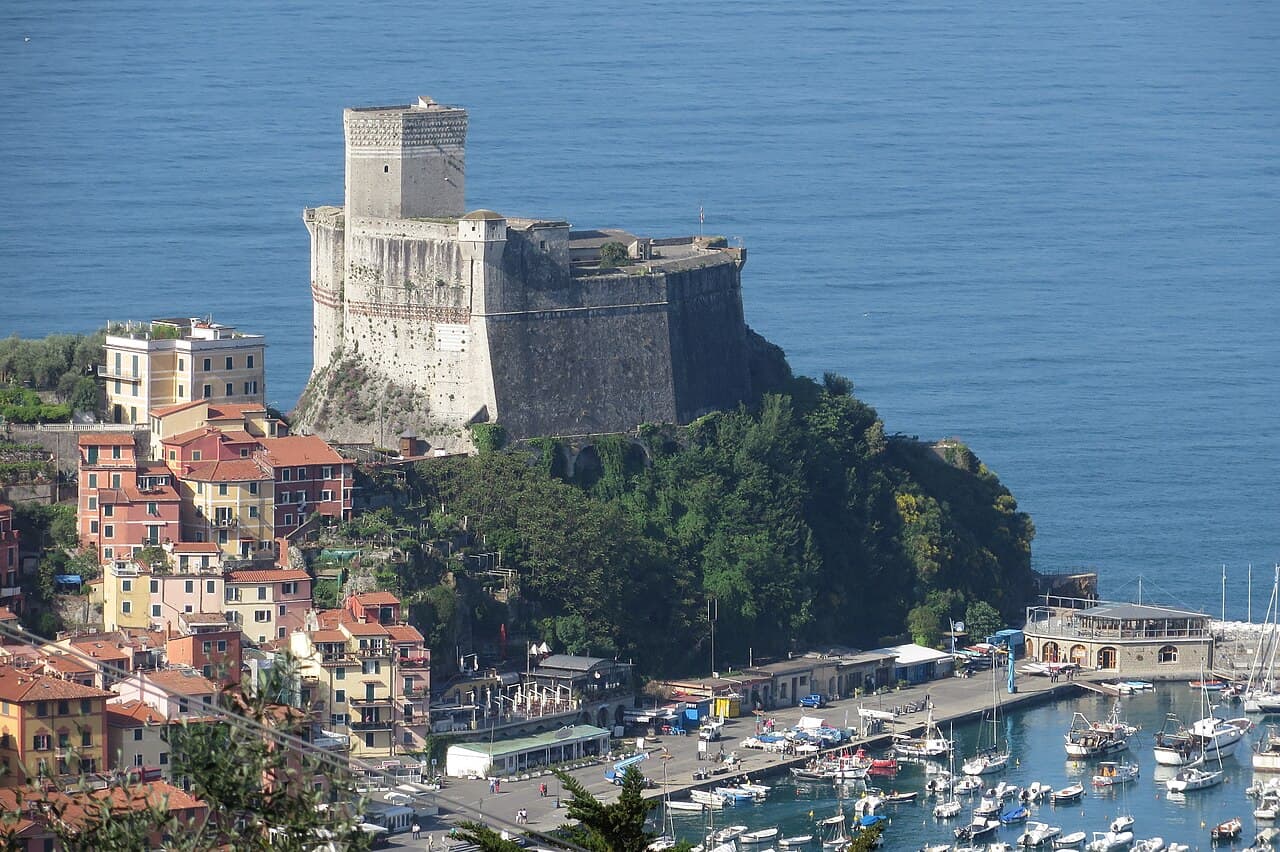
Lerici Castle
Lerici Castle stands prominently on a rocky promontory overlooking the Bay of Lerici and the Gulf of La Spezia in Liguria, Italy. Established in 1152 during the High Medieval period, this hill castle has played a significant role in controlling maritime access to one of the Mediterranean's strategic naval gateways. Its commanding position allowed it to serve as a military stronghold amid centuries of naval conflicts and territorial disputes in the region.
The castle's origins trace back to the Pisan domination of the area. The first known construction phase began in 1152 under the Pisans, who erected the castle's oldest surviving feature, the distinctive pentagonal tower. This tower was part of the initial defensive layout designed to secure the gulf entrance from rival maritime powers. The castle's early form was primarily focused on fortification and surveillance, reflecting the military architecture of the 12th century.
Medieval construction and architectural evolution
By 1241, the castle had undergone significant expansion while still under Pisan control. The original fortress was extended to include additional walls and defensive structures, adapting to the evolving military needs of the time. The castle's layout was designed to maximize defense, with thick stone walls, battlements, and lookout points strategically positioned to monitor naval movements.
Following the decline of Pisan influence, the Genoese took control of Lerici and continued to reinforce and enlarge the castle. Their contributions included strengthening the curtain walls and adding bastions to improve resistance against artillery, which was becoming increasingly important in the late medieval period. These enhancements transformed Lerici Castle into a formidable fortress capable of withstanding sieges and naval attacks.
The 16th-century fortifications
The third major phase of construction began in 1555, marking the completion of the castle's fortifications as they are largely seen today. This period saw the addition of comprehensive defensive works, including reinforced walls, ramparts, and artillery platforms, designed to counter the threats posed by emerging gunpowder weapons. The castle's current pentagonal shape and robust bastions date from this era, reflecting Renaissance military architectural principles adapted to the rugged Ligurian coastline.
Strategic importance and historical context
Lerici Castle's location on the eastern border of Liguria made it a crucial defensive outpost. It guarded the maritime routes leading into the Gulf of La Spezia, a vital naval and commercial harbor. Throughout the Middle Ages, the castle was a focal point of conflict between maritime republics, including Pisa and Genoa, whose rivalry shaped much of the region's history.
The castle's walls bear inscriptions and marks left by various occupants, providing tangible evidence of its contested past. Its role as a military bastion continued into the early modern period, maintaining its significance as a coastal fortress well into the Renaissance.
Architectural features and layout
The castle's pentagonal tower remains a defining feature, symbolizing its origins and military purpose. Surrounding this tower are thick curtain walls equipped with battlements and embrasures for archers and later artillery. The fortress includes multiple bastions and ramparts designed to cover all approaches, with a layout that takes full advantage of the natural rocky outcrop.
Its elevated position offers commanding views of the sea and surrounding coastline, allowing defenders to spot approaching ships from a distance. The castle's entrance is fortified and was historically protected by gates and defensive barriers to control access.
Current use and cultural significance
Today, Lerici Castle is not only a historical monument but also houses a museum of palaeontology, showcasing fossils and geological specimens from the region. This cultural adaptation has made the castle an important destination for both history enthusiasts and scientific visitors.
The castle remains one of the most impressive and well-preserved fortifications in Liguria, attracting tourists with its dramatic setting and rich history. Its blend of medieval and Renaissance military architecture offers valuable insights into the evolution of coastal defense systems in Italy.
Visitor information and accessibility
Visitors to Lerici Castle can explore its extensive ramparts, towers, and museum exhibits. The site provides panoramic views of the Gulf of La Spezia and the Ligurian Sea. The castle is accessible from the town of Lerici, which is well connected by road and ferry services.
Guided tours often highlight the castle's historical phases, architectural features, and its role in regional conflicts. The museum's palaeontological collection adds an educational dimension, making the castle a multifaceted cultural attraction.
Frequently asked questions (FAQ)
- How do I get to Lerici Castle?
- Lerici Castle is located in the town of Lerici, accessible by car, local bus, or ferry from nearby towns. The castle is within walking distance from the town center.
- What is the historical significance of Lerici Castle?
- Lerici Castle played a key role in controlling access to the Gulf of La Spezia and was central to conflicts between Pisa and Genoa during the Middle Ages.
- Can I visit the museum inside Lerici Castle?
- Yes, Lerici Castle houses a palaeontology museum open to the public, featuring fossils and geological exhibits from the region.
- When is the best time to visit Lerici Castle?
- The best time to visit is during spring and early autumn when weather is mild and the castle's views of the Gulf are clear and pleasant.
- Are guided tours available at Lerici Castle?
- Guided tours are often offered, providing detailed insights into the castle's architecture, history, and museum collections.
Photo gallery

Information
Current owner
Municipality
Loading map...
Visitor reviews
No reviews yet. Been here? Write the first review and help other travelers!
Write the first reviewVisited this castle? Share your experience
Your review helps other travelers and adds first-hand knowledge to our encyclopedia.


