Lenzburg Castle
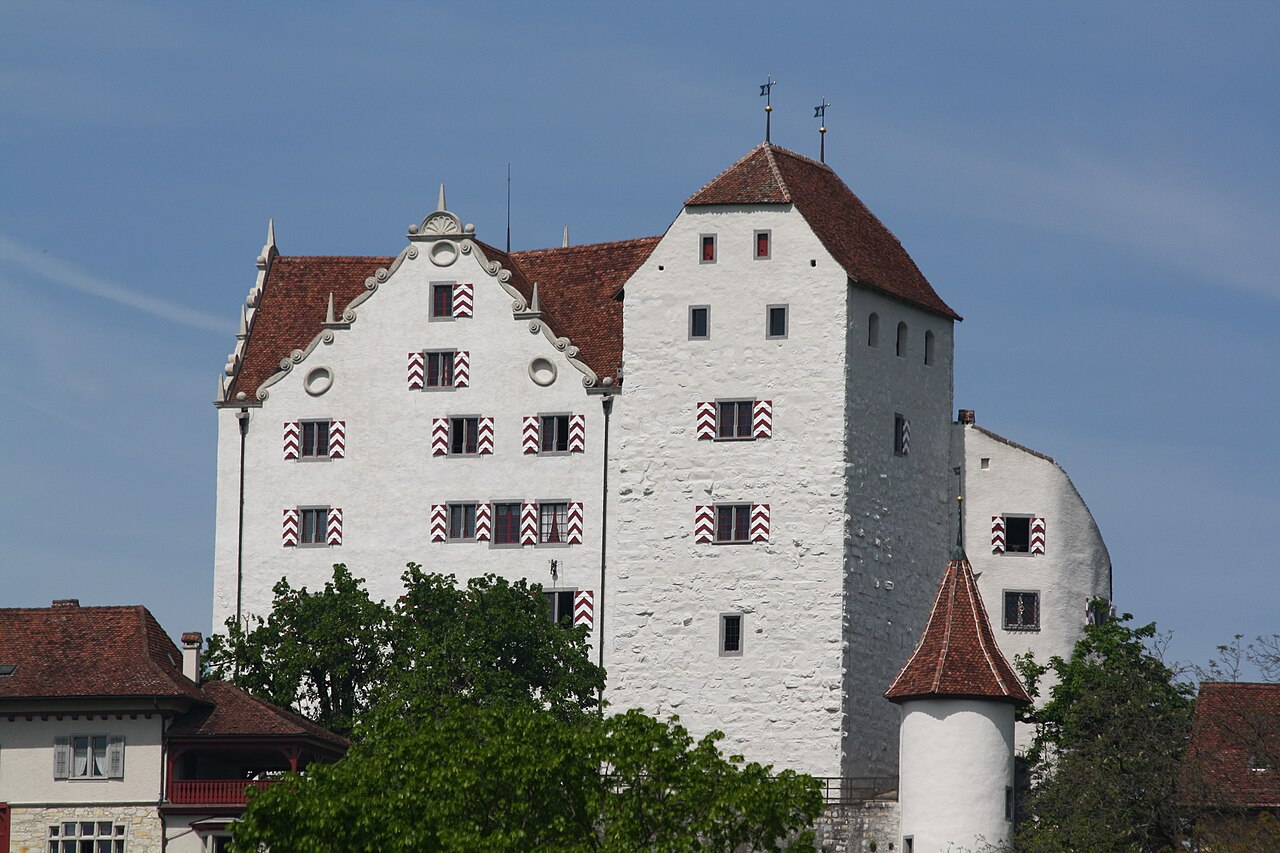
Lenzburg Castle stands as one of the oldest and most significant castles in Switzerland, perched prominently above the old town of Lenzburg. Its strategic location on a nearly circular hill, rising approximately 100 meters above the surrounding plain, has made it a focal point of regional power and defense since the 11th century. The castle's commanding presence and rich history reflect the evolution of medieval fortifications and the shifting political landscape of the High Medieval period through the early modern era.
The castle hill itself, with an altitude of 504 meters and a diameter of about 250 meters, has been a site of human settlement since prehistoric times. Archaeological excavations have uncovered Neolithic burial grounds dating back to around 3000 BCE, as well as artifacts from the Bronze Age, Roman, and Alemannic periods. These findings highlight the hill’s long-standing significance as a cultural and strategic location well before the castle’s construction.
Early history and medieval origins
The origins of Lenzburg Castle are closely tied to the Counts of Lenzburg, who established their seat here in the early 11th century. The first documented mention of the castle dates to 1077, associated with Ulrich III, a notable figure involved in the Investiture Controversy, a major conflict between secular and ecclesiastical powers. The castle's initial construction included the palas, a four-story fortified residence built around 1100, characterized by its robust stonework and defensive features.
Following the extinction of the Lenzburg family line in 1173, the castle passed to Emperor Frederick Barbarossa, who managed the inheritance and granted much of the surrounding land to his son, Otto I of Burgundy. After Otto’s death in 1200, the region saw a decline in Staufer influence. By around 1230, the castle came into the hands of the Counts of Kyburg through marriage. The Kyburgs established a fortified market settlement at the castle’s western base, which developed into the modern town of Lenzburg.
Habsburg control and bernese administration
After the Kyburg family line ended in 1264, Rudolf I of Habsburg became guardian of the Kyburg heiress and acquired the castle in 1273, marking the beginning of Habsburg dominance. Under the Habsburgs, the castle served as a regional administrative center and residence for nobility, including Duke Frederick II, who initiated construction of the Ritterhaus (Knights’ House) for a planned royal marriage. However, his death in 1344 left the Ritterhaus incomplete.
In 1369, the castle was held as a fief by the Ribi-Schultheiss family, who successfully defended it during the 1375 Gugler siege. The political landscape shifted again in 1415 when the city of Bern conquered western Argovia. By 1442, Bern had fully acquired Lenzburg Castle, establishing it as the seat of the Bernese bailiff. The castle became a center for military, judicial, and fiscal administration in the region.
Fortifications and military significance
The castle’s military importance increased after Bern adopted the Reformation in 1528. During the Kappel Wars of 1529 and 1531, Lenzburg Castle served as a Protestant stronghold, controlling key crossings over the nearby Reuss River. Significant fortification works took place in the 17th century, including the construction of a double curtain wall and double gatehouse in 1625, as well as an imposing east bastion with an 11-meter-high wall built between 1642 and 1646 to defend against cannon fire.
The defensive complex included a zwinger or defensive courtyard between the two gatehouses, enhancing the castle’s ability to repel attackers. The bastion’s earth mound caused moisture issues in adjacent buildings, leading to architectural modifications such as the construction of a new bailiff’s residence between 1672 and 1674. The castle’s fortifications reflect the transition from medieval to early modern military architecture, adapting to the advent of gunpowder artillery.
Architectural features and layout
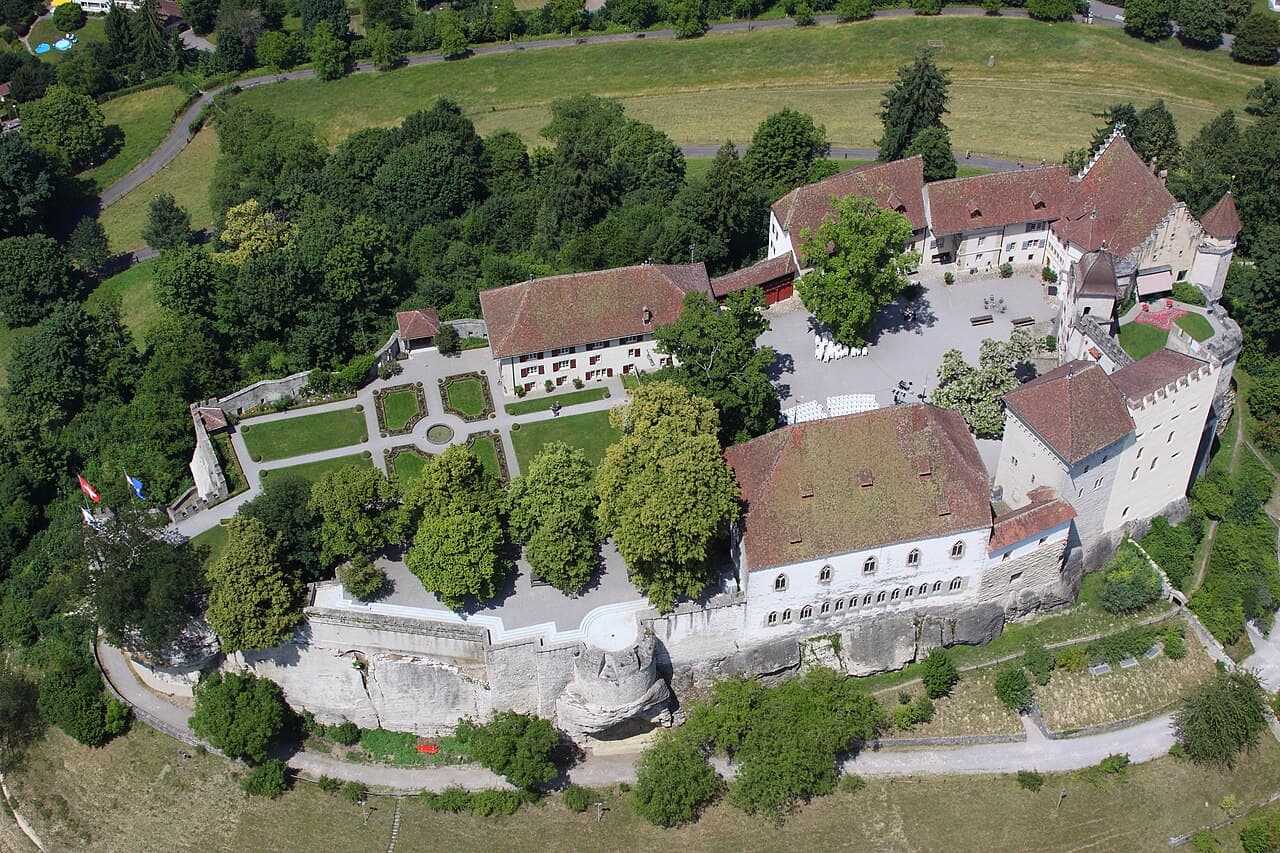
Lenzburg Castle is enclosed by a late 15th-century ring wall built directly on the rock, featuring crenellations with sloped merlons covered by tiles. The castle’s seven main buildings form a horseshoe shape around a central courtyard open to the southwest. Architectural styles range from Gothic to Baroque, spanning from the 12th to the early 18th centuries.
The palas and donjon
The palas, dating to circa 1100, is a rectangular, four-story stone building originally designed as the count’s residence. Its entrance was initially on the second floor, accessed by an external wooden staircase. The palas housed living quarters, storage, and a fireplace, and later included a torture chamber during Bernese rule. Restoration efforts in the late 20th century adapted the interior for museum use.
Attached to the palas is the donjon, a massive square tower measuring 10 by 10 meters with walls three meters thick. Construction began around 1150 but was halted after the death of Ulrich IV, remaining unfinished for over 170 years. It was completed in 1344 with thinner upper floors. The donjon served as a prison from the early 17th century and was connected to the Ritterhaus by a functional building in the 18th century. Restoration in the 1970s and 1980s restored much of its original character.
Ritterhaus and other buildings
The Ritterhaus or Knights’ House started in 1339 but was left incomplete after Duke Frederick II’s death. The western part was rebuilt in the early 16th century, while the eastern walls remain from the original structure. By the late 16th century, it was repurposed as a barn and grain storage, with defensive embrasures added. Later renovations restored its Gothic windows and removed added floors, preserving its medieval character.
The Bernerhaus (also called Stapferhaus or Hintere Haus) was constructed around 1600 by combining a stable and mill, later expanded to increase grain storage. It features a hipped roof with Alsatian tiles and includes loggias on its eastern facade. It has served various functions, including housing a foundation and currently operating as a restaurant and conference venue.
Gardens, museum, and modern use
The castle’s courtyard garden was restored in the 1980s to reflect its 18th-century French style, featuring intersecting paths, a limestone fountain crafted from local stone, and a pavilion attached to the castle walls. This garden adds to the castle’s historical ambiance and visitor experience.
Today, Lenzburg Castle functions as a prominent museum complex, housing the Historical Museum of Argovia (Museum Aargau). The museum’s extensive collections include approximately 40,000 artifacts sourced from cantonal and private collections, public acquisitions, and gifts. The castle’s interior is divided into four main sectors: the bailiff’s residence as a residential museum, permanent exhibitions in the palas and donjon, historical workshops and temporary exhibitions in the eastern bastion, and a children’s museum in the bailiff’s attic.
The castle is accessible via a pedestrian path or an elevator installed between the donjon and Ritterhaus, providing disabled access. Its rich history, architectural diversity, and cultural offerings make Lenzburg Castle a vital heritage site and popular tourist destination in Switzerland.
Archaeological significance and heritage status
The castle hill is recognized as a heritage site of national significance, not only for its medieval structures but also for the prehistoric archaeological remains found on its slopes. The discovery of Neolithic graves and artifacts from multiple historical periods underscores the site’s continuous human occupation and strategic importance over millennia.
Lenzburg Castle’s preservation and restoration efforts have maintained its historical integrity while adapting it for modern cultural use. It stands as a testament to the region’s complex history, from prehistoric settlements through medieval power struggles to contemporary heritage conservation.
Frequently asked questions (FAQ)
- What are the opening hours of Lenzburg Castle?
- Lenzburg Castle is typically open to visitors from 10 AM to 5 PM from April to October. During the winter months, the opening hours may vary, so it's advisable to check the official website for the most accurate information. Guided tours are also available at specific times throughout the day.
- How do I get to Lenzburg Castle?
- Lenzburg Castle is easily accessible by public transport, with regular trains and buses connecting to Lenzburg from major cities like Zurich and Lucerne. If you are driving, there is parking available nearby. The castle is situated on a hill, offering a scenic view during your approach.
- What is the historical significance of Lenzburg Castle?
- Lenzburg Castle is one of the oldest and most important castles in Switzerland, dating back to the 11th century. It served as a royal residence and military stronghold throughout its history, reflecting the power dynamics of the region. Today, it stands as a testament to medieval architecture and Swiss heritage.
- Can I take photographs inside Lenzburg Castle?
- Yes, visitors are allowed to take photographs inside Lenzburg Castle, but flash photography may be restricted in certain areas to protect the exhibits. It's a great opportunity to capture the stunning architecture and beautiful views from the castle's towers. Just be respectful of other visitors and the historical artifacts.
- When is the best time to visit Lenzburg Castle?
- The best time to visit Lenzburg Castle is during the warmer months from April to October when the weather is pleasant and the gardens are in full bloom. Additionally, many events and activities are held during this period, enhancing your experience. However, visiting in the winter can also be charming if you enjoy a quieter atmosphere.
- Is it possible to book a guided tour of Lenzburg Castle?
- Yes, guided tours of Lenzburg Castle are available and can be booked in advance for a more in-depth exploration of its history and architecture. These tours typically include access to areas not open to the general public. It’s recommended to check the castle's official website for tour availability and pricing.
- What are the ticket prices for Lenzburg Castle?
- Ticket prices for Lenzburg Castle vary depending on age and the type of ticket purchased. Generally, adult tickets are around CHF 12, while discounts are available for children, students, and seniors. Family tickets and group rates may also be offered, so it’s best to check the official website for the most current pricing information.
- Are there any nearby attractions to visit after Lenzburg Castle?
- Yes, there are several nearby attractions worth exploring after visiting Lenzburg Castle. The charming town of Lenzburg itself offers picturesque streets and local shops, while the beautiful Aare River provides opportunities for walks and picnics. Additionally, the nearby Habsburg Castle and the city of Aarau are great options for further exploration.

Information
Website
Visit websiteSources & official resources
Verify the information above using these authoritative references.
Loading map...
Visitor reviews
No reviews yet. Been here? Write the first review and help other travelers!
Write the first reviewVisited this castle? Share your experience
Your review helps other travelers and adds first-hand knowledge to our encyclopedia.