Lembeck Castle
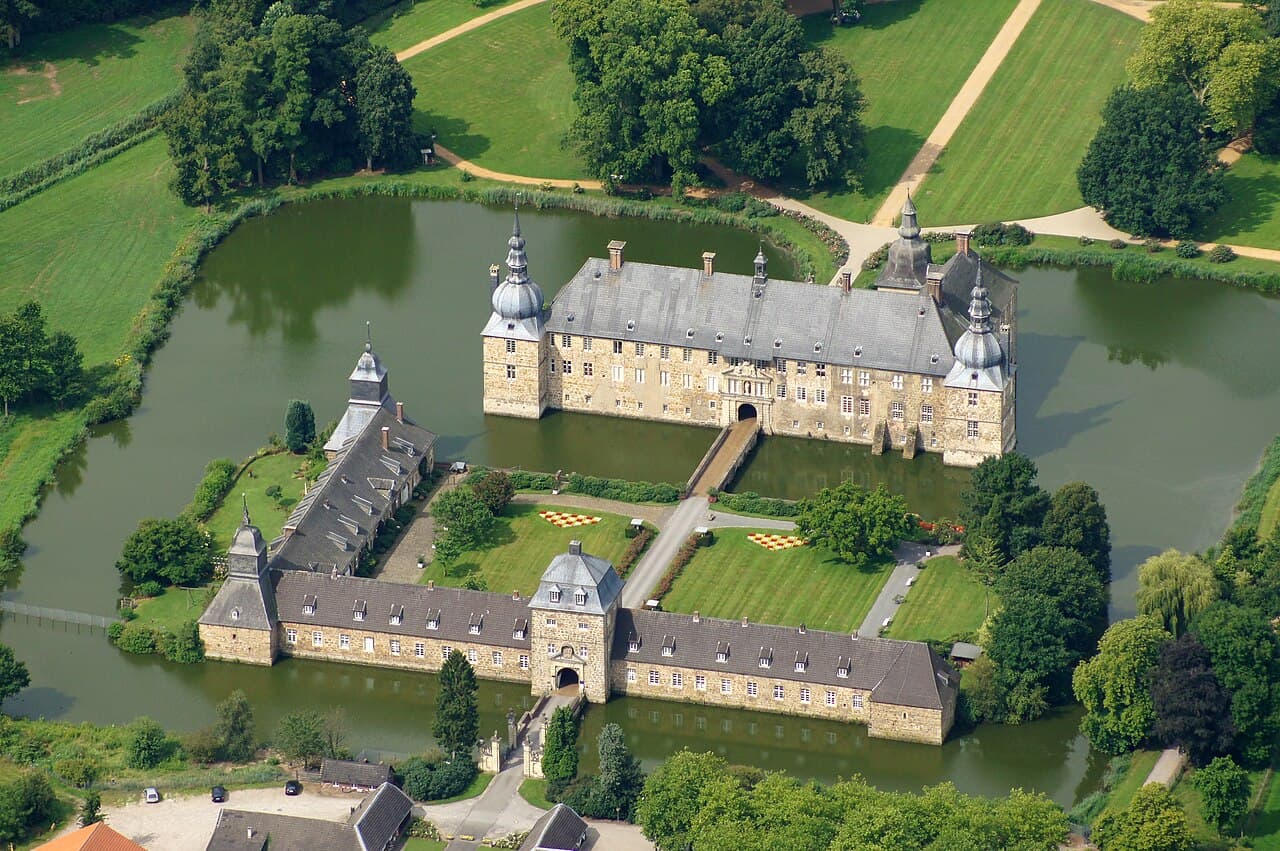
Lembeck Castle is a remarkable example of a Renaissance moated castle situated in the scenic Hohe Mark Nature Park near Dorsten, Germany. Surrounded by the dense 'Hagen' and 'Kippheide' forests, the castle's strategic location on an island formed by damming the Lembeck meadow stream creates a striking rectangular moat measuring approximately 190 by 160 meters. This water feature not only served defensive purposes but also enhances the castle's aesthetic appeal, reflecting its imposing structures in the tranquil waters.
The castle complex is laid out along a grand east-west axis extending about 500 meters, a design characteristic of the period's emphasis on symmetry and order. This axis is approached from the east by a 200-meter-long avenue leading to the outer bailey, which originally comprised three wings but today consists of two wings and a central gatehouse. The outer bailey's two-story gatehouse, constructed from finely worked ashlar sandstone, is topped with a mansard roof added in the 18th century. The keystone above the gateway prominently displays the coats of arms of Dietrich Conrad Adolf von Westerholt zu Lembeck and his wife Marie Theodora von Waldbott-Bassenheim-Gudenau, dated 1692, marking the completion of significant rebuilding efforts during that period.
Architectural features and layout
The outer bailey is flanked by single-story corner towers with distinctive Welsh hoods and keyhole embrasures in their basements, indicative of the castle's defensive design. Additional embrasures are found on the southeast tower and the towers adjacent to the gatehouse, underscoring the fortification's military function alongside its residential role.
The main manor house, accessible via the outer courtyard and a stone-arched bridge, was initially planned as a three-winged structure but was ultimately completed with two wings due to financial constraints. The east wing, featuring two pavilion towers, was finished in 1679, while the northern wing was incorporated into the reconstruction between 1674 and 1679. The manor house's facade facing the inner courtyard is notable for its Renaissance bay window supported by elegantly curved sandstone consoles. The windows of this bay window contain historic glass panes dated up to 1677, providing valuable insight into the construction timeline.
The entrance to the manor house is marked by a grand sandstone portal resembling a central risalit, adorned with the coats of arms of Burchardt von Westerholt zu Lembeck and Clara von der Recke. Behind this portal lies a passage hall inspired by Italian Renaissance and Mannerist architecture, similar to those found in the Palazzo Pitti and Palazzo Farnese. This passage allowed guests to enter and have their carriages turned or parked without exposure to inclement weather.
Historical development and ownership
The origins of Lembeck Castle date back to the 12th century, with the earliest record in 1177 mentioning Adolf von Lembeck, a knight serving under the Bishopric of Münster. The castle was initially a fortified residence for the Lords of Lembeck, who managed the surrounding lands. The male Lembeck line ended in 1526, and through marriage, the estate passed to the von Westerholt family. Bernhard I von Westerholt officially received the lordship in 1536, during a period marked by religious and political upheaval, including opposition to the Anabaptist movement.
The castle endured significant challenges during the Eighty Years' War and the Thirty Years' War, including occupation by General Peter Melander von Holzappel in 1633. Ownership changed hands within the von Westerholt family amid these conflicts, with Burckhardt Wilhelm von Westerholt restoring possession in 1641. From 1670 to 1692, Dietrich Conrad Adolf von Westerholt-Lembeck, who became a hereditary imperial count, undertook extensive rebuilding, transforming Lembeck into one of the largest moated castles in the Münsterland region.
After Dietrich's death in 1702 without male heirs, the castle passed to the von Merveldt family through his daughter Maria Josepha Anna in 1708. The von Merveldts have maintained ownership since. The castle suffered damage during World War II but was restored and reopened to the public in 1954. It has served various functions, including as a hotel and restaurant until 2016, and currently hosts museum exhibits and cultural events.
Interior design and notable rooms
The interior of Lembeck Castle reflects its Renaissance and Baroque heritage, featuring a French enfilade floor plan where rooms align with facing doors, although not perfectly. Many rooms are paneled in dark oak typical of early Baroque interiors. Noteworthy spaces include the Fidelitas Cabinet, which retains its original allegorical ceiling painting and white oak paneling with pastel stucco frames enclosing small oval portraits.
The castle houses a long corridor nearly 45 meters in length, adorned with 17th-century Flemish tapestries depicting scenes from the tales of Odysseus and Iphigenia. The south tower contains a room with a massive cross-ribbed vault ceiling and wood paneling from Rococo and Empire periods, featuring a fireplace dated 1563 salvaged from earlier castle structures.
Other significant rooms include a bedroom with classicist stucco molding and a Gothic wardrobe circa 1500, a small salon with 18th-century Chinois wallpaper, and the Wittelsbacher Salon, decorated in Rococo Régence style with portraits linking the castle's noble and ecclesiastical history.
The Schlaun Hall, designed by architect Johann Conrad Schlaun, is a late Baroque masterpiece occupying the north wing. It features black marble fireplaces, green silk damask wall coverings, and a richly stuccoed ceiling. This hall was carefully restored after World War II damage and displays portraits of former owners, connecting visitors to the castle's lineage.
Chapel and religious features
The castle chapel, located in the northwest corner of the manor house, is a neo-Gothic addition with a gallery supported by two freestanding pillars and a coffered stucco ceiling decorated in red-brown, blue, and gold. Historical records indicate a chapel existed on the site since at least 1737, with earlier mentions dating back to 1363. The chapel's cellar served various functions over time, including as a prison and wine cellar.
Gardens and surrounding landscape
The original 17th-century gardens of Lembeck Castle were designed in the formal French Baroque style by August Reinking, emphasizing symmetry and axial layouts. In the 19th century, these gardens were transformed into an English landscape park, favoring naturalistic arrangements over formal geometry.
Since 1967, the adjacent Heinrich-Nottelmann-Park has complemented the historic grounds with a notable rhododendron collection featuring 150 species and about 70 other tree types. This park offers recreational amenities such as a playground, petting zoo, and barbecue facilities, blending botanical interest with public enjoyment.
Lembeck Castle stands today as a well-preserved testament to Renaissance and Baroque architecture, noble lineage, and evolving landscape design. Its combination of defensive features, elegant residential quarters, richly decorated interiors, and extensive gardens make it a significant cultural and historical landmark in the Münsterland region.
Frequently asked questions (FAQ)
- How do I visit Lembeck Castle and what are the opening hours?
- Lembeck Castle is open to visitors with guided tours available during the warmer months. Opening hours typically run from 10:00 to 17:00, but it is advisable to check the official website for seasonal variations and special events.
- What architectural styles are featured in Lembeck Castle?
- Lembeck Castle showcases Renaissance architecture with Baroque influences, particularly evident in its symmetrical layout, sandstone portals, and richly decorated interiors.
- Is Lembeck Castle accessible for visitors with mobility issues?
- The castle grounds and main buildings have some accessibility features, but due to historic structures and bridges, full access may be limited. Visitors with mobility concerns should contact the site in advance for assistance.
- Can I explore the gardens and park surrounding Lembeck Castle?
- Yes, the castle's surrounding park and the adjacent Heinrich-Nottelmann-Park are open to the public, offering beautiful landscapes, rhododendron collections, and recreational facilities.
- What is the historical significance of Lembeck Castle?
- Lembeck Castle has a rich history dating back to the 12th century, serving as a fortified noble residence and witnessing important regional conflicts and ownership changes through centuries.
Photo gallery

Information
Sources & official resources
Verify the information above using these authoritative references.
Loading map...
Visitor reviews
No reviews yet. Been here? Write the first review and help other travelers!
Write the first reviewVisited this castle? Share your experience
Your review helps other travelers and adds first-hand knowledge to our encyclopedia.