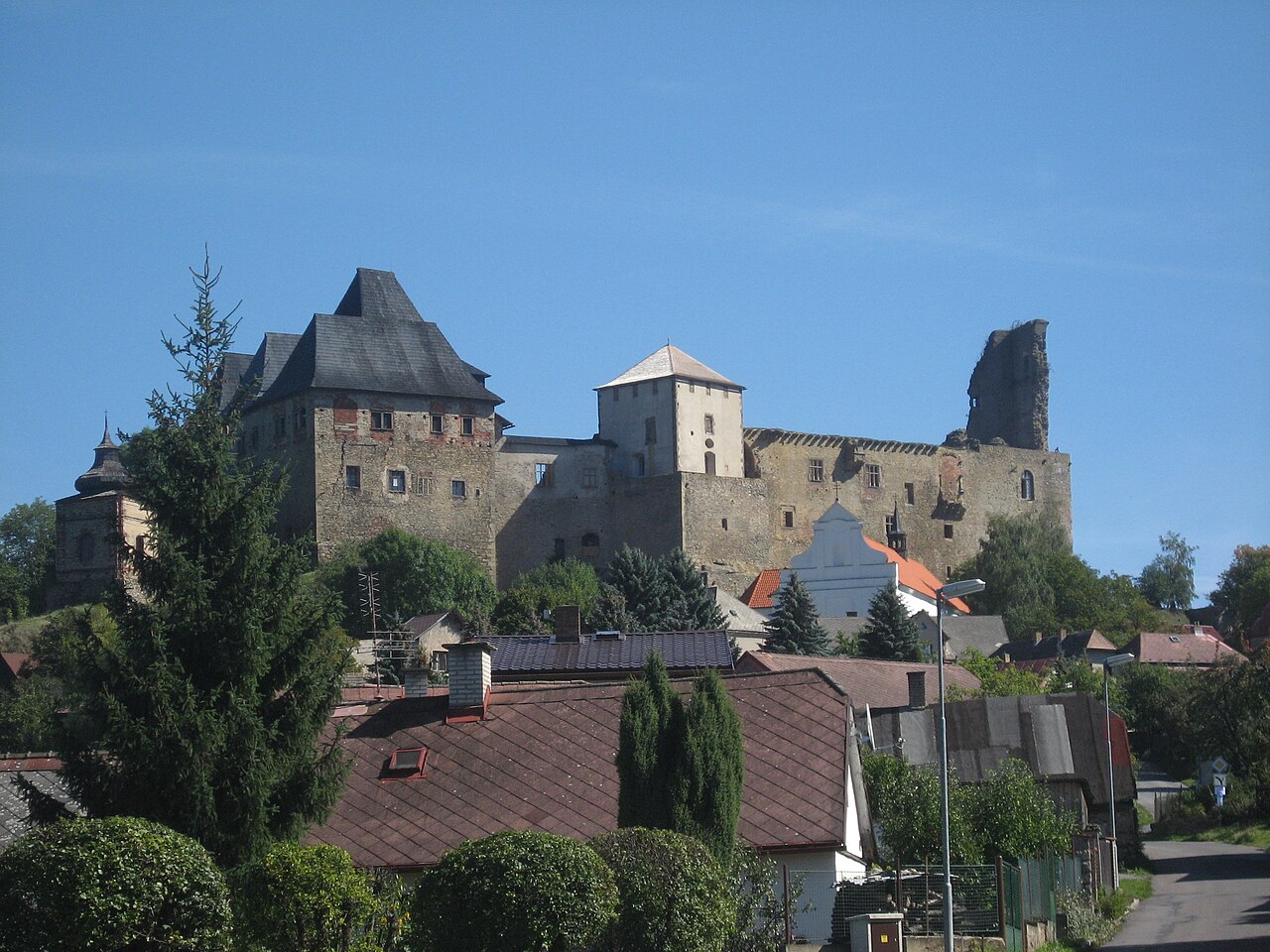
Ledeč nad Sázavou Castle
Ledeč nad Sázavou Castle stands as a prominent hill castle in the town of Ledeč nad Sázavou, Czechia, embodying centuries of architectural evolution and historical significance. Its origins trace back to the early 13th century, founded by the medieval Bohemian knight Slavek of Ledeč. The castle's strategic location atop a hill overlooking the Sázava River valley offered both defensive advantages and control over important trade routes, contributing to the settlement's growth and regional prominence.
The castle's initial construction reflected typical medieval fortification principles, centered around a bergfried—a tall, slender round tower used for defense and surveillance. This was complemented by a three-room palace featuring a distinctive curved outer wall on the eastern side, which formed the early residential quarters. Entry was carefully controlled through a western approach leading to the outer ward, with a secondary gate at the bergfried's base providing access to the inner sanctum.
Medieval origins and early history
The first documentary evidence of the castle dates to 1262, when King Přemysl Otakar II confirmed Slavek of Ledeč's right to hold a market in nearby Hněvkovice. This royal endorsement highlights the castle's role as a local power center during the high medieval period. The surrounding settlement likely developed from an earlier village near the nearby Church of Saints Peter and Paul, emphasizing the castle's integration into the regional social and economic fabric.
Ownership passed to the Ledeč family from Říčany by 1367, who maintained control for several generations. Notably, the Mikuláš brothers were prominent members of this lineage. The castle's history records a tragic event in 1509 when Sophie of Sovinec, wife of Burian Ledecký, and two children perished after a floor collapse during a social dance. This incident illustrates the castle's role as a noble residence and social hub in addition to its defensive functions.
Architectural evolution and renaissance transformation
The castle underwent significant architectural changes in the mid-16th century under the direction of Zdeněk Meziříčský of Lomnice. Reflecting the broader European Renaissance movement, the fortress was transformed into a more comfortable and stylistically refined Renaissance chateau. This included enlarging residential areas and enhancing aesthetic elements, signaling a shift from purely military purposes to noble habitation and representation.
During the late 15th century, prior to the Renaissance renovations, the castle's fortifications were expanded to create a through-fortress layout. This design featured gates on both the west and northeast sides, connected by a continuous curtain wall reinforced with two inward-facing semicircular bastions. These bastions enabled defenders to cover adjacent walls effectively, exemplifying advanced military architecture of the period.
Further fortification enhancements were made in 1636 by Baron Adrian von Enkevort, who added a new gate and two pentagonal bastions. These additions contributed to the castle's layered defense system, adapting it to evolving military technologies and threats.
Later ownership and modifications
Following the Renaissance period, the castle passed through the hands of several noble families, including the Trčka of Lípa, Lobkowicz, Enkenfurt, and Thun-Hohenstein families. Each contributed to the castle's maintenance and occasional modifications, reflecting shifting political and social dynamics in Bohemia.
In 1753, the castle was acquired by Empress Maria Theresa, marking a significant imperial connection. During the Seven Years' War, the castle served as a cavalry barracks, demonstrating its continued strategic importance. Shortly after, Maria Theresa donated the property to the Theresian Institute of Noble Ladies, which managed the estate until 20th-century land reforms.
The castle suffered damage from a fire in 1879, which led to partial repairs and structural changes, including reducing the west wing's second story to one floor. The early 20th century saw further alterations when railway construction in 1903 resulted in the loss of parts of the outer fortifications, altering the castle's defensive perimeter.
Architectural features and layout
Ledeč nad Sázavou Castle today presents as a large three-story complex that illustrates its transformation from a medieval fortress to a Renaissance residence. The original bergfried tower remains a defining feature, symbolizing the castle's defensive origins. The curved eastern palace wall and the successive layers of fortifications, including semicircular and pentagonal bastions, highlight the castle's adaptation to changing military needs.
The castle's entrance sequence, beginning from the west with a path along the southern palace flank, leads visitors through the outer ward into the inner core via a gate at the bergfried's base. This arrangement underscores the castle's layered defense strategy, balancing accessibility with security.
At the end of the 17th century, the Thun family expanded the complex by adding a chapel dedicated to the Assumption of the Virgin Mary. This religious structure reflects the importance of spiritual life within noble residences and adds to the castle's architectural diversity.
Modern usage and cultural significance
Since 1999, the castle has been under the stewardship of the local town authorities, who have undertaken extensive restoration efforts. Among these is the uncovering and restoration of a historic sundial in 2015, which had been hidden beneath layers of plaster, adding to the castle's rich historical narrative.
Today, Ledeč nad Sázavou Castle functions as a museum featuring multiple exhibition circuits. These include displays on regional history, a recreated 1950s retro apartment, and exhibitions dedicated to the region's renowned clockmaking and glass production traditions. The castle also hosts the Jaroslav Foglar Museum and a children's area called "Medvídkové království," enhancing its appeal to diverse audiences.
The castle's tower remains accessible to visitors, offering panoramic views and a tangible connection to its medieval past. Additionally, the site has served as a filming location for numerous Czech and international productions, highlighting its cultural and aesthetic value.
Frequently asked questions (FAQ)
- When was Ledeč nad Sázavou Castle originally built?
- Ledeč nad Sázavou Castle was originally constructed in the early 13th century, likely founded by the knight Slavek of Ledeč.
- What architectural styles are represented in Ledeč nad Sázavou Castle?
- The castle features a mix of architectural styles, including medieval defensive structures and Renaissance chateau elements from the 16th century.
- Can visitors access the castle tower?
- Yes, visitors can climb the castle's tower to enjoy panoramic views of the surrounding region and experience its medieval heritage firsthand.
- What exhibitions can be seen at the castle museum?
- The museum showcases regional history, a 1950s retro apartment, exhibits on clockmaking and glass production, the Jaroslav Foglar Museum, and a children's area.
- Is there a chapel within Ledeč nad Sázavou Castle?
- Yes, the castle includes a chapel dedicated to the Assumption of the Virgin Mary, added by the Thun family at the end of the 17th century.
- How did the castle's function change during the Seven Years' War?
- During the Seven Years' War, the castle was used as cavalry barracks, reflecting its strategic military role beyond noble residence.
- Who owns Ledeč nad Sázavou Castle today?
- The castle is currently owned and managed by the local municipality, which has been responsible for restoration and public access since 1999.
Information
Sources & official resources
Verify the information above using these authoritative references.
Loading map...
Visitor reviews
No reviews yet. Been here? Write the first review and help other travelers!
Write the first reviewVisited this castle? Share your experience
Your review helps other travelers and adds first-hand knowledge to our encyclopedia.