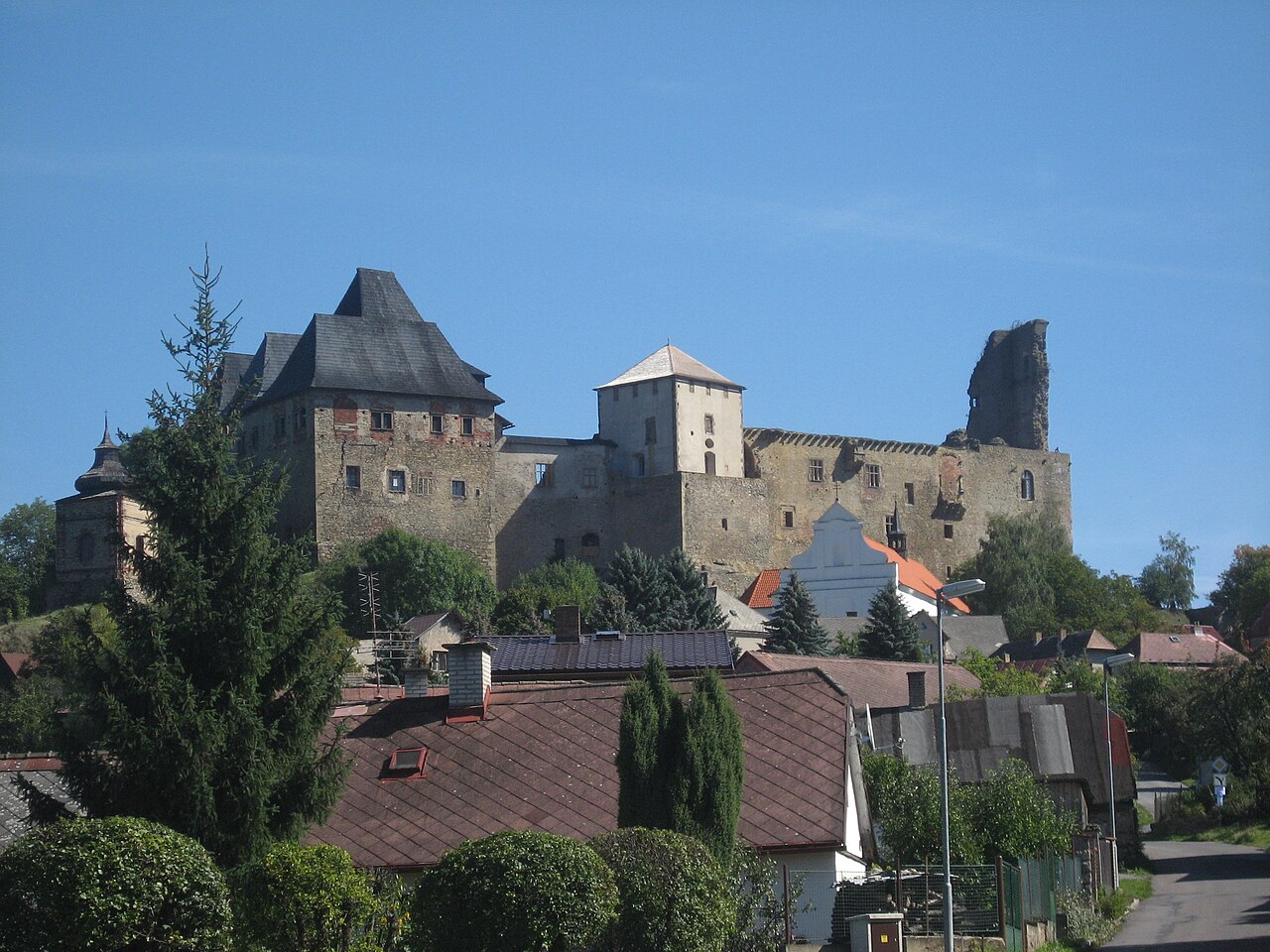
Chřenovice Castle
Chřenovice castle stands as a remarkable example of a medieval hill castle in the Czech Republic, embodying the architectural and historical legacy of the region's noble fortifications. Situated in the municipality of Chřenovice-Ledeč nad Sázavou, this castle occupies a strategic promontory overlooking the right bank of the Sázava River at approximately 370 meters above sea level. Its origins trace back to the medieval period, with its foundation attributed to Lev of Janovice before 1289, an ancestor of the lords of Chřenovice who established the initial fortification on this commanding site.
Medieval origins and ownership history
The castle's early history is closely tied to the local nobility, specifically the family of Chřenovice. By the mid-14th century, the castle was held by brothers Milota and Bernart of Chřenovice, indicating the continuity of noble control. However, by the early 15th century, ownership transitioned from hereditary nobility to prominent urban elites. In 1414, the castle was acquired by Hanuš Otlinger, a citizen of Prague, who soon sold it to Kunrát Náz, a burgher from the influential mining town of Kutná Hora. This transfer reflects the social and economic shifts occurring in Bohemia during this period, where wealthy urban families began to acquire rural estates.
The Náz family maintained possession of Chřenovice castle for several decades. The last known member residing there was Jan Náz, documented in 1474. That year marked another significant change when the castle was sold to the lords of Říčany, a noble family that integrated Chřenovice into the larger Ledeč estate. Following this incorporation, the castle's strategic importance declined, and it was gradually deserted. By 1545, historical records confirm that Chřenovice was no longer inhabited, signaling its transition into ruin.
Recognizing its historical and cultural value, the remains of Chřenovice castle have been protected as a cultural monument since 1963, ensuring the preservation of this medieval site for archaeological study and heritage appreciation.
Architectural features and defensive design
Chřenovice castle is a quintessential example of a bergfried-type fortress, a common design in medieval Central Europe characterized by a tall, often round tower primarily used for defense and as a last refuge rather than as a residential space. The castle's layout is defined by a roughly triangular main enclosure, strategically positioned on the promontory with natural steep slopes on most sides, enhancing its defensive capabilities.
Bergfried tower
The castle's most prominent architectural feature is its round bergfried tower, located at the northwest corner of the enclosure. This tower was originally integrated into the curtain wall that surrounded the castle. The surviving walls of the bergfried at ground level are notably thick, measuring approximately 2.5 meters, which would have provided formidable resistance against siege weaponry. The ruins of the tower rise to nearly 20 meters, preserving its imposing medieval silhouette.
The original entrance to the bergfried was situated high above ground level, about 12 meters up, accessible only via a removable ladder or wooden stairs, a defensive measure to prevent easy access by attackers. The entrance is framed by a vaulted doorway, demonstrating the architectural sophistication of the period. At the upper levels, remnants of battlements survive, including merlons topped with small protective roofs, which would have offered defenders cover while observing and repelling assailants.
Curtain walls and ditches
The castle's defensive perimeter was reinforced by thick curtain walls enclosing the triangular site. Access to the promontory was cut off by two deep, narrow ditches carved across the neck of the hill, creating formidable obstacles for any invading force. These ditches combined with the natural topography made Chřenovice a difficult fortress to assault.
Residential and defensive additions
Within the eastern corner of the castle stood the palace, serving as the residential quarters for the castle's inhabitants. This area was likely the most comfortable part of the castle, providing living space protected within the fortifications.
On the northeastern side, a zwinger was constructed — a narrow enclosed space between two walls designed to trap and expose attackers to defensive fire. This feature also became the location of the castle's main entrance after it was relocated during a later phase of construction, enhancing the security of access.
In the 15th century, additional fortifications were added to adapt to evolving military technology and tactics. A forward bastion was built, consisting of a square tower surrounded by a defensive wall, extending the castle's defensive perimeter and providing a strongpoint against attackers. Although this bastion was still partially visible into the 19th century, it has since disappeared, leaving only archaeological traces.
Historical decline and preservation
Following its integration into the Ledeč estate, Chřenovice castle gradually lost its strategic and residential significance. By the mid-16th century, it was abandoned and fell into ruin. Over the centuries, natural decay and human activities have affected the site. Notably, some damage occurred in recent history due to the construction of a dance floor on or near the castle ruins, which impacted the preservation of the remains.
Despite these challenges, the core structural elements, particularly the bergfried tower and the defensive ditches, remain intact enough to provide valuable insight into medieval fortification design and construction techniques. The site offers a tangible connection to the region's feudal past and medieval military architecture.
Today, Chřenovice castle is recognized as a protected cultural monument, attracting historians, archaeologists, and visitors interested in medieval history and architecture. Its ruins serve as a testament to the region's historical evolution from feudal stronghold to modern heritage site.
Frequently asked questions (FAQ)
- When was Chřenovice castle built?
- Chřenovice castle was founded before 1289 by Lev of Janovice, an ancestor of the local noble family.
- What type of castle is Chřenovice?
- Chřenovice is a hill castle featuring a bergfried tower, a typical medieval defensive structure.
- Can visitors explore the ruins of Chřenovice castle?
- While the castle is in ruins, the site is accessible for visitors interested in medieval architecture and history, though facilities may be limited.
- Why is the bergfried tower significant?
- The bergfried tower served as a last refuge during attacks and is notable for its thick walls, elevated entrance, and battlements with merlons.
- What happened to Chřenovice castle after the 15th century?
- After being incorporated into the Ledeč estate, the castle lost importance, was abandoned by 1545, and eventually fell into ruin.
Information
Website
Visit websiteSources & official resources
Verify the information above using these authoritative references.
Loading map...
Visitor reviews
No reviews yet. Been here? Write the first review and help other travelers!
Write the first reviewVisited this castle? Share your experience
Your review helps other travelers and adds first-hand knowledge to our encyclopedia.