Leap Castle
Leap Castle stands as a significant medieval fortress located in the parish of Coolderry, in Northern Ireland. This hill castle occupies a commanding position overlooking a strategic mountain pass linking the Slieve Bloom Mountains to the province of Munster, historically known as The Leap. Its location was chosen for both defense and control of regional movement, a common consideration in castle siting during the High Medieval period.
The castle's origins trace back to the mid-13th century, circa 1250 AD, constructed by the native Irish O’Bannon clan under the overlordship of the powerful O’Carroll family. While some debate exists about whether the earliest structures date to the 12th or 16th century, archaeological evidence supports a 13th-century foundation replacing an older fortification on a site with deep spiritual significance to Celtic druids, with continuous occupation since the Iron Age.
Historical significance and turbulent past
Leap Castle has witnessed centuries of conflict reflecting the broader political struggles in Ireland. In the early 16th century, it became a focal point of power struggles between Irish clans and English forces. The Annals of the Four Masters document attempts by the Earl of Kildare to seize the castle in 1513 and 1516, resulting in damage to the fortress. Despite internal strife, including fratricidal disputes following the death of Mulrooney O’Carroll in 1532, the O’Carroll family retained control by the mid-1500s.
In 1558, facing increasing pressure from English forces, the O’Carrolls burned Leap Castle to prevent its capture. However, the Earl of Sussex’s troops soon took the castle, only for the O’Carrolls to reclaim and rebuild it the following year, demonstrating the castle's strategic and symbolic importance.
The castle changed hands in the mid-17th century when the English Darby family acquired it through marriage. The Darbys undertook significant expansions in 1753, integrating Gothic architectural elements and adding new wings to the original tower house. This blend of medieval defensive architecture with later stylistic trends reflects evolving tastes and the transition from purely military fortresses to more residential estates.
The 20th century brought further tragedy during the Irish Civil War in 1922, when the castle was deliberately set on fire, destroying most interior furnishings and artworks. Economic pressures and land reforms led the Darby family to abandon the castle in 1928, leaving it in ruin for nearly seventy years.
Architectural features and layout
Tower house and defensive structures
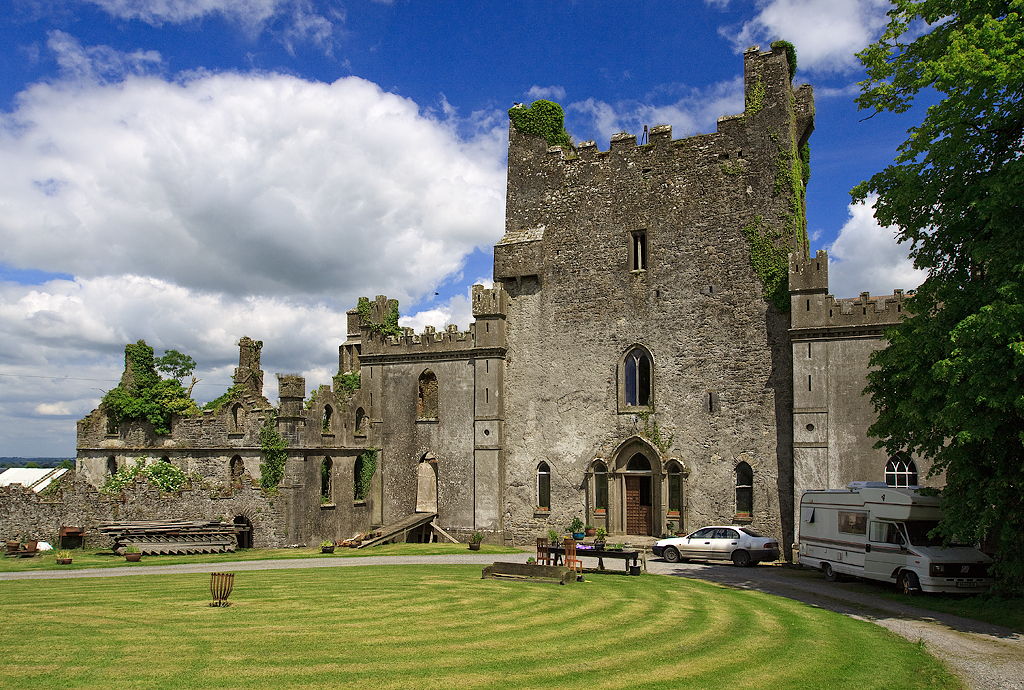
The core of Leap Castle is a substantial tower house constructed from roughly shaped limestone blocks laid without plaster, resulting in walls over two meters thick. The rectangular main tower measures approximately 13 by 10 meters and rises three stories high, topped with a crenellated parapet and a flat saddle roof originally covered with stone slates. Defensive features include surviving machicolations on the south wall, which allowed defenders to attack assailants at the main entrance below.
Attached to the main tower are two short side wings, each two stories tall with a single bay, added in the mid-18th century. These wings exhibit Gothic architectural touches such as pointed arch windows and battlemented parapets, blending medieval defensive motifs with Georgian stylistic elements. The northern wing connects to the Priest’s House, a separate building dating back to around 1571 but altered during the Georgian period.
Interior chambers and notable rooms
Inside the tower, the first floor houses a vaulted hall featuring a large fireplace in the northeast corner. This room has been restored to include a gallery and once had flooring designed with polished slate and sandstone arranged to mimic black and white marble, complemented by decorative stucco cornices on the ceiling, which added a touch of elegance to the fortified space.
One of the castle’s most infamous rooms is the Bloody Chapel on the second floor, named for its grim history. This chamber contains a narrow opening leading down through a trapdoor to a small oubliette, a hidden dungeon discovered during 20th-century renovations. Excavations revealed human bones and a mid-19th-century gold pocket watch, confirming its use as a prison or execution site.
The Bloody Chapel connects via a slender corridor embedded in the thickness of the north wall to the ruins of the former northern wing, illustrating the castle’s complex internal layout and defensive design.
Later additions and service yard
Adjacent to the main tower is a service yard developed around 1860 in a neo-Gothic style under the Darby family's ownership. This yard comprises two parallel, two-story buildings forming a quadrangle around an interior courtyard. The northern building features a hipped slate roof, seven bays with pointed arch windows in yellow brick surrounds, and a central pointed arch gateway. Distinctive chimneys combine yellow brick and red tile, topped with battlemented parapets on a stone cornice.
The southern service building served as a coach house on the ground floor, with large segmental-arched doors opening onto the courtyard. Above, the upper floor housed the Orange Hall, named after the Protestant Orange Order, and features slate roofing and Gothic architectural elements consistent with mid-19th-century additions.
East of the service yard lies a walled garden enclosed by a perimeter wall, serving as a private outdoor space linked to the castle’s domestic functions.
Restoration and preservation
After decades of neglect, Leap Castle was purchased in 1974 by Australian historian Peter Bartlett, who began restoration efforts. Following his death, stewardship passed to musician Sean Ryan and his wife Anne, who have continued rehabilitating much of the tower house and the adjoining south wing, restoring the castle closer to its historical state.
Most rooms within the tower house have been restored to usable condition, except the second floor. The original south entrance has been converted into a window opening, while a grand Gothic-style entrance on the west side dates from the 18th-century expansions.
Since 1976, Leap Castle has been protected as a National Monument, ensuring its preservation as a vital piece of Ireland’s cultural and architectural heritage.
Legend and paranormal reputation
Leap Castle is renowned not only for its architectural and historical significance but also for its reputation as one of Ireland’s most haunted castles. Numerous ghost stories and paranormal investigations have been documented since the late 20th century, attracting visitors interested in the supernatural. The castle’s dark history, including the Bloody Chapel and the oubliette, contributes to its eerie allure and enduring fascination.
Frequently asked questions (FAQ)
- What is the historical significance of Leap Castle?
- Leap Castle is renowned for its tumultuous history and is considered one of the most haunted castles in Ireland. Built in the 15th century, it has witnessed numerous battles and political intrigues, making it a fascinating site for history enthusiasts.
- When was Leap Castle built?
- Leap Castle was originally constructed in the 15th century, specifically around the year 1250. It has undergone various renovations and restorations over the centuries, reflecting different architectural styles and historical periods.
- Can I visit Leap Castle?
- Yes, Leap Castle is open to visitors, but it's important to check their official website or contact them for the most current visiting information. Guided tours are often available, allowing guests to explore the castle's intriguing history and architecture.
- What are the opening hours for Leap Castle?
- Leap Castle typically opens to visitors from 10 AM to 5 PM, but hours may vary by season or special events. It's advisable to verify the latest hours before planning your visit to ensure you have ample time to explore.
- Is Leap Castle accessible for people with disabilities?
- Leap Castle has limited accessibility due to its historical nature and the layout of the grounds. Visitors with mobility challenges may find some areas difficult to navigate, so it's recommended to contact the castle in advance to discuss any specific needs.
- What is the best time to visit Leap Castle?
- The best time to visit Leap Castle is during the spring and early autumn when the weather is generally mild, and the surrounding landscape is particularly beautiful. Additionally, these seasons tend to be less crowded, allowing for a more enjoyable experience.
- Are there nearby attractions to visit after exploring Leap Castle?
- Yes, there are several nearby attractions, including the picturesque village of Kinnitty and the scenic Slieve Bloom Mountains. These sites offer opportunities for hiking, dining, and experiencing the local culture, making for a well-rounded visit.
- What are the ticket prices for visiting Leap Castle?
- Ticket prices for Leap Castle can vary depending on the type of tour and any special events being held. Generally, tickets are reasonably priced, providing great value for the rich history and experiences offered.
Information
Website
Visit websiteSources & official resources
Verify the information above using these authoritative references.
Loading map...
Visitor reviews
No reviews yet. Been here? Write the first review and help other travelers!
Write the first reviewVisited this castle? Share your experience
Your review helps other travelers and adds first-hand knowledge to our encyclopedia.