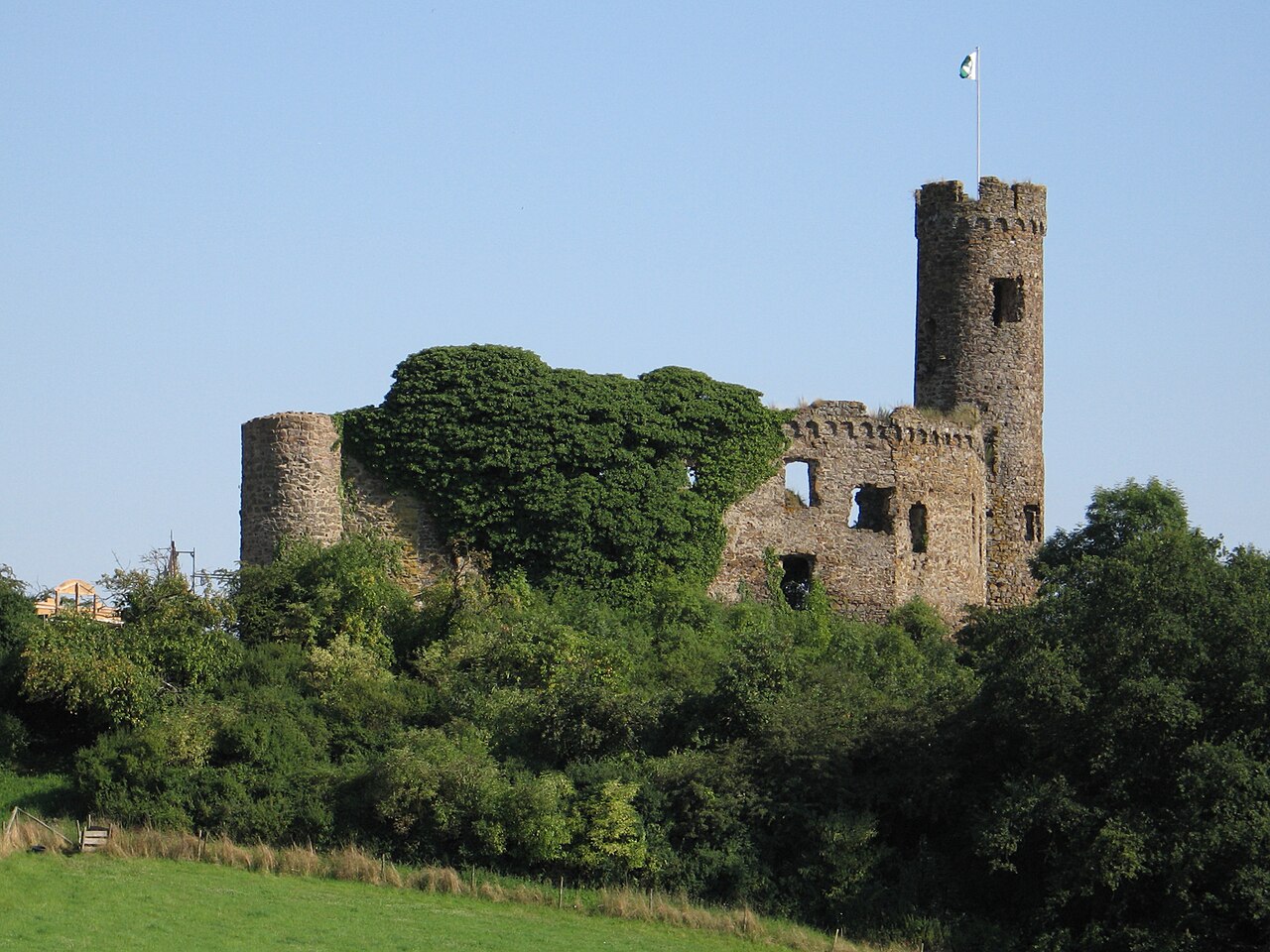
Schaumburg Castle
Schaumburg Castle, located in the scenic region of Rhineland-Palatinate, Germany, stands as a remarkable example of a high medieval hill castle with a rich history spanning nearly a millennium. Originally established in the 12th century, the castle has evolved from a formidable medieval fortress into a neo-Gothic palace, reflecting the architectural and political changes of the region over centuries.
The earliest possible origins of the site date back to around 915 AD, when the mountain on which the castle stands was mentioned in a donation to the Weilburg monastery. The first documented mention of the castle itself, then referred to as "Schowenburg" or "Schauenburg," appears in 1197. At that time, it served as the center of a territorial rulership encompassing the towns of Biebrich, Cramberg, and Steinsberg. The castle was initially owned by the Counts of Leiningen during the 12th century.
Medieval origins and territorial significance
The castle's ownership became fragmented following the extinction of the male Leiningen line around 1220. The fief was divided among several noble families, including the House of Nassau through Elise, daughter of Count Emicho III of Leiningen, the County of Virneburg, the County of Diez, the County of Weilnau, and the Isenburg family. In 1232, a portion of the castle came under the control of Gerlach I of Limburg, but by 1266, an arbitration award transferred part of the castle to the Electorate of Cologne (Kurköln). Subsequently, in 1276, the Kurköln share was granted to the House of Westerburg.
The House of Westerburg undertook significant expansions starting in 1279, enhancing the castle's fortifications and residential quarters. To counterbalance the Westerburg influence, Balduin of Luxembourg constructed nearby Balduinstein Castle, leading to prolonged disputes that resulted in Balduinstein gaining independent town status in 1321.
Ownership transitions and noble residences
By the 15th century, the Westerburg family had consolidated ownership of Schaumburg Castle. From 1557, it became the residence of the Leiningen-Westerburg-Schaumburg line, a branch of the Westerburgs. In 1656, the castle and lordship were sold by Georg Wilhelm von Leiningen to Agnes von Effern, widow of Count Peter Melander von Holzappel, who merged it with the county of Holzappel.
Following Agnes's death, the castle passed through the hands of several noble houses: the House of Nassau-Dillenburg (1656–1707), Anhalt-Bernburg-Schaumburg (1707–1812), and the Habsburg-Lothringen family (1812–1867). Notably, Archduke Stephan of Austria owned the castle from 1847 to 1867. After fleeing Hungary during the 1848 revolution, he undertook a lavish neo-Gothic conversion of the castle between 1850 and 1855, guided by architect Carl Boos. This renovation transformed Schaumburg into a palace with a picture gallery, library, coin collection, mineral exhibits, and even a small zoo. The grand hall, featuring a prominent bay window flanked by corner towers, remains unfinished in its original shell condition.
Architectural features and restorations
Schaumburg Castle is primarily constructed from basaltic rock and is distinctive for its octagonal shape with towers at each corner. The surviving elements of the original fortress include the outer bailey and the southern gate. The castle's medieval core was fortified with a robust ring wall approximately 1.3 meters thick, built using the opus spicatum (herringbone masonry) technique. Defensive earthworks, including a rock-cut ditch and an outer earthen rampart, further protected the site.
Among the castle's towers, the eastern corner tower known as the "Kühner Henke" or Bell Tower is well preserved. The main tower, or bergfried, dates from the 14th century and originally served as a gate tower. It was raised to a height of 30 meters during restoration efforts in the early 20th century and now serves as an observation point.
The palas, or main residential building, was rebuilt in Renaissance style in 1521 atop medieval vaulted cellars. Adjacent two-story structures to the north may also date from the medieval period. Excavations have revealed additional vaulted cellars beneath later additions, indicating multiple construction phases.
The exact location of the medieval chapel remains unknown, though fragments of late 12th-century stone capitals suggest its presence near the castle. Other defensive structures included a long rectangular building from an early northern extension and a now-demolished round tower named "Wittschrieber" at the southwest corner.
Modern history and current status
In the 19th century, following Prussian annexation in 1866, Schaumburg Castle was adapted for civilian use and opened as a guesthouse in 1873. Architect Albrecht Haupt led restoration efforts between 1908 and 1912, including raising the main tower; however, work was interrupted by World War I.
The castle suffered damage from American artillery fire in 1945 during World War II. Later, it hosted a medieval market starting in 1999, but maintenance challenges led to the closure of its on-site restaurant in 2017. In recent years, ownership has changed hands multiple times, with plans to renovate and repurpose the site. Since 2012, a Turkish investor group has owned the castle, proposing uses such as an educational facility and an international wine institute, though these projects have not yet materialized.
The extensive Schaumburg archive has been preserved and is housed in the state main archive of Koblenz, safeguarding the castle's historical records. The castle grounds include the legendary Blood Linden, a tree approximately 600 years old, linked by local tradition to a witch trial around the 15th century.
Today, Schaumburg Castle remains a significant cultural landmark within the Central Weserbergland region, encompassing a historic cultural landscape of about 2.5 square kilometers. It continues to attract visitors interested in medieval architecture, noble history, and regional heritage.
Frequently asked questions (FAQ)
- What is the historical significance of Schaumburg Castle?
- Schaumburg Castle, dating back to the 12th century, played a vital role in the defense of the region. It was a strategic stronghold for the Counts of Sponheim and later became a symbol of power and nobility in the area.
- When was Schaumburg Castle built?
- Schaumburg Castle was constructed around the year 1100. Over the centuries, it has undergone various renovations and restorations, showcasing different architectural styles that reflect its long history.
- Can I visit Schaumburg Castle?
- Yes, Schaumburg Castle is open to visitors throughout the year. Guided tours are available, allowing guests to explore the castle's rich history and stunning architecture.
- What are the opening hours of Schaumburg Castle?
- Schaumburg Castle is typically open from 10 AM to 6 PM during the summer months and from 10 AM to 4 PM in the winter. It is advisable to check the official website for any seasonal changes or special events that may affect opening hours.
- Is it possible to access Schaumburg Castle with limited mobility?
- While Schaumburg Castle has some pathways that are accessible, certain areas may be challenging for visitors with limited mobility due to uneven terrain and steps. It’s best to contact the castle administration in advance for specific accessibility information and assistance.
- What is the best time to visit Schaumburg Castle?
- The best time to visit Schaumburg Castle is during the spring and early autumn when the weather is pleasant, and the surrounding landscape is particularly beautiful. Additionally, visiting during weekdays can help you avoid larger crowds.
- Are there any nearby attractions to Schaumburg Castle?
- Yes, visitors can also explore the picturesque town of Bad Kreuznach, known for its charming architecture and thermal baths. The surrounding region offers numerous hiking trails and beautiful vineyards to enjoy as well.
- How much do tickets cost for Schaumburg Castle?
- Ticket prices for Schaumburg Castle are generally affordable, with discounts available for students, seniors, and children. Check the official website for the most current pricing and any special promotions that may be available.
Information
Website
Visit websiteSources & official resources
Verify the information above using these authoritative references.
Loading map...
Visitor reviews
No reviews yet. Been here? Write the first review and help other travelers!
Write the first reviewVisited this castle? Share your experience
Your review helps other travelers and adds first-hand knowledge to our encyclopedia.