Langley Castle
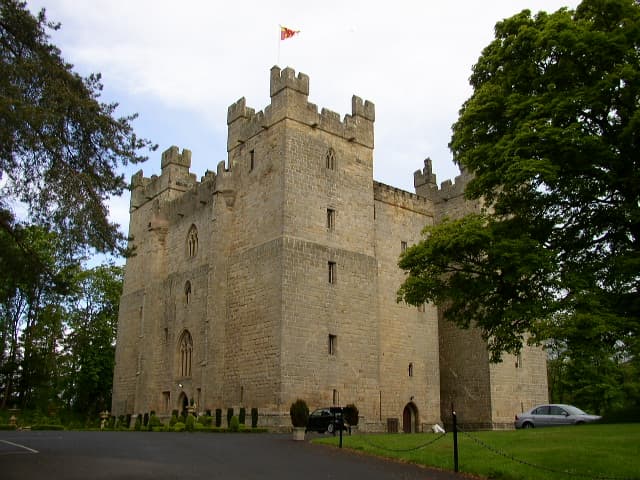
Langley Castle stands as a striking example of a medieval fortified tower house located near the village of Langley in Northumberland, England. Constructed in the mid-14th century, this castle was built to secure the volatile northern borderlands during a period marked by frequent conflict between England and Scotland. Its imposing stone walls and defensive towers reflect the strategic importance of the site amid ongoing border skirmishes.
The castle's origins trace back to the destruction of an earlier manor house in 1346, which was burnt down by forces led by David Bruce, brother of the Scottish King Robert the Bruce. In response to this devastation, Sir Thomas de Lucy commissioned the construction of the present stone fortress between 1350 and 1364. This new structure was designed not only as a military stronghold but also as a symbol of local power and resilience during the reign of King Edward III.
Historical context and ownership
Langley Castle's history is deeply intertwined with the turbulent political landscape of Northumberland and the English-Scottish border region. Over the centuries, the castle passed through the hands of several prominent noble families, including the de Tindal, de Boltby, and de Moulton clans. Later, ownership transferred to the influential Percy and Radclyffe families, both of which played significant roles in English aristocracy and politics.
In 1405, during the reign of King Henry IV, Langley Castle suffered a catastrophic fire. The castle was attacked and set ablaze by royal forces after the Percy family, then custodians of the castle, refused to pay taxes. This event left Langley Castle in ruins, and it remained uninhabited for nearly five centuries, its decaying walls standing as silent witnesses to the region's violent past.
The castle's ownership continued to reflect the shifting tides of political allegiance and rebellion. The involvement of Thomas Percy in the 1568 Rising of the North and James Radclyffe's participation in the 1714 Jacobite Rebellion both resulted in the forfeiture of Langley Castle to the crown. These episodes underscore the castle's ongoing association with uprisings against royal authority.
Architectural features and layout
Langley Castle is a four-storey medieval tower house built on a foundation of massive natural boulders, which provided enhanced stability and defense. The castle's plan is roughly rectangular with an H-shaped layout, a design typical of fortified residences intended to combine defense with domestic comfort.
Each corner of the castle is fortified with substantial towers that rise one storey above the main structure, adding to the defensive capabilities and providing vantage points for surveillance and protection. Additionally, a smaller tower crowns the roof, contributing to the castle's distinctive silhouette.
The original main entrance led into a stairwell containing a spiral staircase, which connected all floors and was a common defensive feature to hinder attackers. During 19th and 20th-century restorations, windows were enlarged to admit more natural light, and a new entrance was added on the south side to improve accessibility.
One of the castle's notable defensive elements is the preserved slot for a portcullis near the main east entrance. This heavy grille could be lowered to secure the gateway against attackers. Above this entrance, a decorative roof boss adds an ornamental touch, reflecting the craftsmanship of the period.
Interior spaces and notable rooms
The interior centers around a large hall on the upper floor, characteristic of medieval hall house designs where the main living and gathering space was elevated above ground level for security and status. Between this hall and an adjoining lobby on the first floor are dual moulded doorways, showcasing the skilled masonry and architectural detailing of the 14th century.
A smaller room within the castle has been dedicated as the Cadwallader Bates Memorial Room, honoring the local historian who purchased and restored the castle in the late 19th century. This room was originally a chapel, indicating the presence of religious functions within the fortress.
Among the most remarkable surviving features is the south-west tower, which houses twelve garderobes (medieval toilets) arranged with four per floor. Each doorway features pointed archways, a hallmark of Gothic architecture. This extensive and well-preserved set of garderobes is considered one of the finest examples of medieval sanitary facilities in Europe.
Restoration and modern use
After centuries of neglect following the 1405 fire, Langley Castle was purchased in 1882 by Cadwallader Bates, a historian passionate about preserving local heritage. Bates initiated extensive restoration efforts to revive the castle's structure and historical character. Following his death, his wife Josephine Bates completed the restoration work by 1914, successfully returning the castle from ruin to a habitable state.
Despite a period of vacancy after 1932, Langley Castle found new roles in the 20th century. During World War II, it served as military barracks, reflecting its strategic potential even in modern times. Later, it was adapted as a girls' school, demonstrating its versatility and continued use as a functional building.
In the latter part of the 20th century, Langley Castle was converted into a hotel, allowing visitors to experience its rich history and architectural grandeur firsthand. Today, the castle occupies a wooded estate of approximately ten acres in the valley of the River South Tyne, about three miles south of Haydon Bridge. Its well-preserved medieval features continue to attract historians, tourists, and architecture enthusiasts alike.
Cultural significance and heritage
Langley Castle is a significant monument in the history of northern England's border defenses. Its construction during the High Medieval period reflects the era's architectural and military innovations designed to withstand the frequent raids and conflicts of the Anglo-Scottish borderlands.
The castle's survival through centuries of political upheaval, rebellion, and neglect, followed by dedicated restoration, highlights its importance as a symbol of regional identity and resilience. The preservation of architectural details such as the portcullis slot, corner towers, and garderobes provides valuable insight into medieval defensive strategies and domestic life.
Today, Langley Castle serves as a tangible link to England's medieval past, offering educational opportunities and cultural enrichment. Its combination of military architecture and residential design exemplifies the dual roles castles played in medieval society as both fortresses and homes.
Frequently asked questions (FAQ)
- When was Langley Castle originally built?
- Langley Castle was constructed between 1350 and 1364 by Sir Thomas de Lucy to defend the northern borderlands during King Edward III's reign.
- What architectural style is Langley Castle built in?
- Langley Castle is primarily built in the Gothic architectural style, featuring pointed archways and defensive elements typical of the 14th century.
- Can visitors tour Langley Castle today?
- Yes, Langley Castle has been converted into a hotel, allowing visitors to experience its medieval architecture and history firsthand.
- What is unique about the garderobes in Langley Castle?
- The south-west tower contains twelve medieval garderobes with pointed arch doorways, considered some of the finest surviving examples in Europe.
- How was Langley Castle restored after centuries of ruin?
- The castle was extensively restored starting in 1882 by historian Cadwallader Bates and completed by his wife Josephine in 1914, reviving the medieval structure.
Photo gallery

Information
Sources & official resources
Verify the information above using these authoritative references.
Loading map...
Visitor reviews
No reviews yet. Been here? Write the first review and help other travelers!
Write the first reviewVisited this castle? Share your experience
Your review helps other travelers and adds first-hand knowledge to our encyclopedia.