Laarne Castle
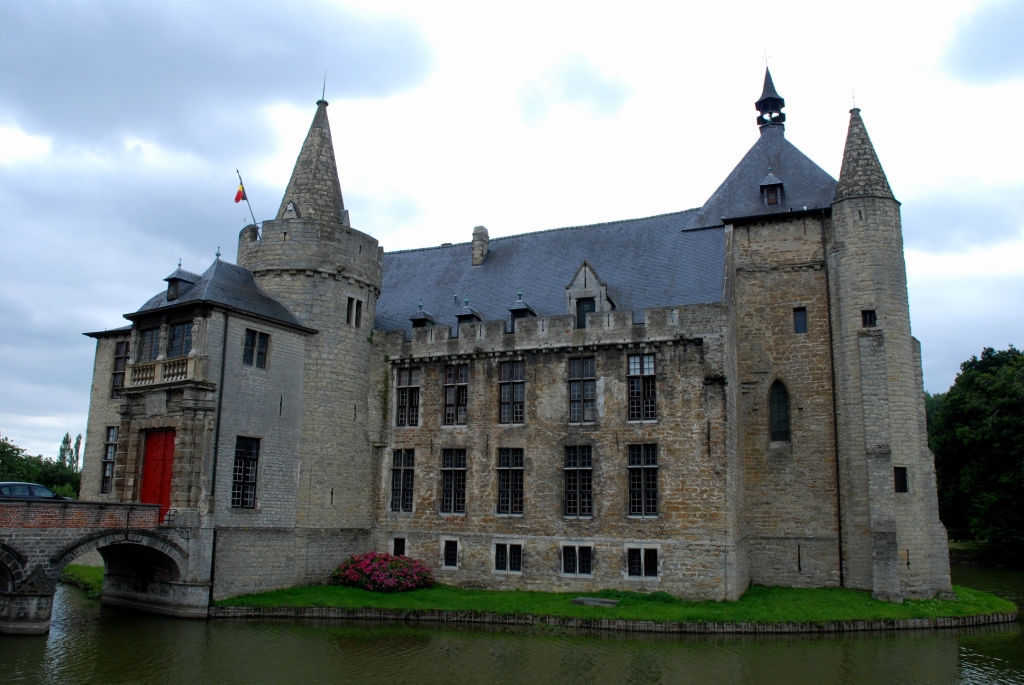
Laarne Castle, also known locally as Slot van Laarne, is a striking example of a moated medieval fortress located in the village of Laarne, within the province of East Flanders in the Flemish region of Belgium. Established in the 11th century, the castle originally formed part of a strategic defensive line protecting the approaches to the important city of Ghent from the sea. Its location was chosen to guard vital routes and to serve as a bulwark against invasions during the High Medieval period.
The castle's origins are closely tied to the military and political history of the region. The first structure was built as a fortified stronghold, and its significance grew when knight Diederik of Alsace returned from the Second Crusade in 1157 with the revered relic of the Holy Blood, seeking refuge within its walls. In the 14th century, the castle underwent significant fortification enhancements, including the construction of a square keep, three circular towers topped with pyramid-shaped stone roofs designed to be fireproof, and robust curtain walls, all crafted from locally sourced Balegem sandstone. These features exemplify the military architecture of the era, combining defensive strength with imposing aesthetics.
Architectural evolution from medieval fortress to renaissance manor
Laarne Castle uniquely exhibits two distinct architectural faces: its original medieval fortress character and the later 17th-century manor house style. During the 16th century, parts of the curtain walls were adapted and rebuilt to serve as residential quarters, reflecting changing needs as the castle shifted from purely military functions to a noble residence.
The castle suffered considerable damage during the wars of religion in 1583, which necessitated further reconstruction. A major rebuilding phase occurred in 1640, when significant alterations transformed the castle's defensive layout: the drawbridge was demolished, the medieval gatehouse was repurposed into a service building, and the main entrance was relocated to the northeast side. At this time, a walled forecourt was also constructed adjacent to the new entrance, enhancing the castle's residential and representational functions.
Defensive features and materials
The castle's defensive structures are notable for their durability and design. The curtain walls enclose the central courtyard and are punctuated by the three circular towers, which provided vantage points for surveillance and defense. The square keep served as the last refuge during sieges, embodying the typical medieval stronghold concept.
The use of Balegem sandstone is a distinctive feature of Laarne Castle. This fine-grained, durable stone was quarried locally and contributed to the castle's imposing appearance and longevity. The pyramid-shaped stone roofs on the towers were an innovative fireproofing measure uncommon in many other castles of the period, highlighting the attention to defensive detail.
Historical significance and military role
Throughout its history, Laarne Castle played a pivotal role in the military defense of the region. In 1362, the Count of Flanders obtained permission to station a garrison within the castle, underscoring its strategic importance. This military presence led to several sieges, reflecting the turbulent political climate of medieval Flanders.
The castle's position guarding the approaches to Ghent made it a key asset in regional conflicts, including during the wars of religion in the late 16th century when it sustained heavy damage. Its fortifications and garrison helped control access to the city and protect the surrounding territories from hostile forces.
Restoration and modern use
By the 20th century, Laarne Castle had fallen into disrepair but was saved through an extensive restoration program in the 1960s. These efforts preserved both its medieval and renaissance elements, ensuring the castle's survival as a cultural and historical monument.
Today, the castle operates partly as a museum, showcasing an important collection of silverware, tapestries, furniture, and weapons that illustrate the lifestyle and craftsmanship of past centuries. The castle's walled forecourt houses a restaurant, adding to its appeal as a tourist destination.
Visitors can explore the castle during the summer months for a fee, experiencing firsthand the blend of medieval fortifications and 17th-century manor architecture. Its well-preserved condition and dual architectural character make Laarne Castle one of the most notable historic sites in Flanders.
Cultural and heritage importance
Laarne Castle stands as one of the best-preserved fortifications in the region, representing centuries of architectural evolution and historical events. Its preservation allows insight into the defensive strategies of the High Medieval period as well as the residential adaptations of the Renaissance. The castle's collections contribute to understanding the material culture of the Flemish nobility.
The castle's location in East Flanders, near Ghent, places it within a rich historical landscape marked by medieval trade, warfare, and political power struggles. As a heritage site, it attracts scholars, history enthusiasts, and tourists interested in Belgium's medieval and early modern periods.
Frequently asked questions (FAQ)
- How do I get to Laarne Castle?
- Laarne Castle is located at Eekhoekstraat 5 in the village of Laarne, East Flanders, Belgium. It is accessible by car and public transport from Ghent, with clear signage leading to the site.
- What is the best time to visit Laarne Castle?
- The castle is open to visitors during the summer months, typically from late April to early October. Visiting during weekdays can provide a quieter experience.
- Can I explore the interior of Laarne Castle?
- Yes, visitors can tour the interior of Laarne Castle, including its medieval keep, circular towers, and 17th-century manor sections. Guided tours are available to provide historical context.
- Is Laarne Castle suitable for families?
- Laarne Castle offers a family-friendly environment with spacious grounds and engaging exhibits. Children can enjoy learning about medieval history through the castle's displays.
- Are there any facilities at Laarne Castle?
- The castle features a restaurant located in the walled forecourt, providing refreshments and meals. There are also restrooms and a gift shop for visitors.
Information
Opening hours
Summer months, daily 10:00-18:00
Ticket prices
€8 adult, €5 child
Current owner
Municipality
Address
Eekhoekstraat 5, Laarne, Belgium
Loading map...
Visitor reviews
No reviews yet. Been here? Write the first review and help other travelers!
Write the first reviewVisited this castle? Share your experience
Your review helps other travelers and adds first-hand knowledge to our encyclopedia.