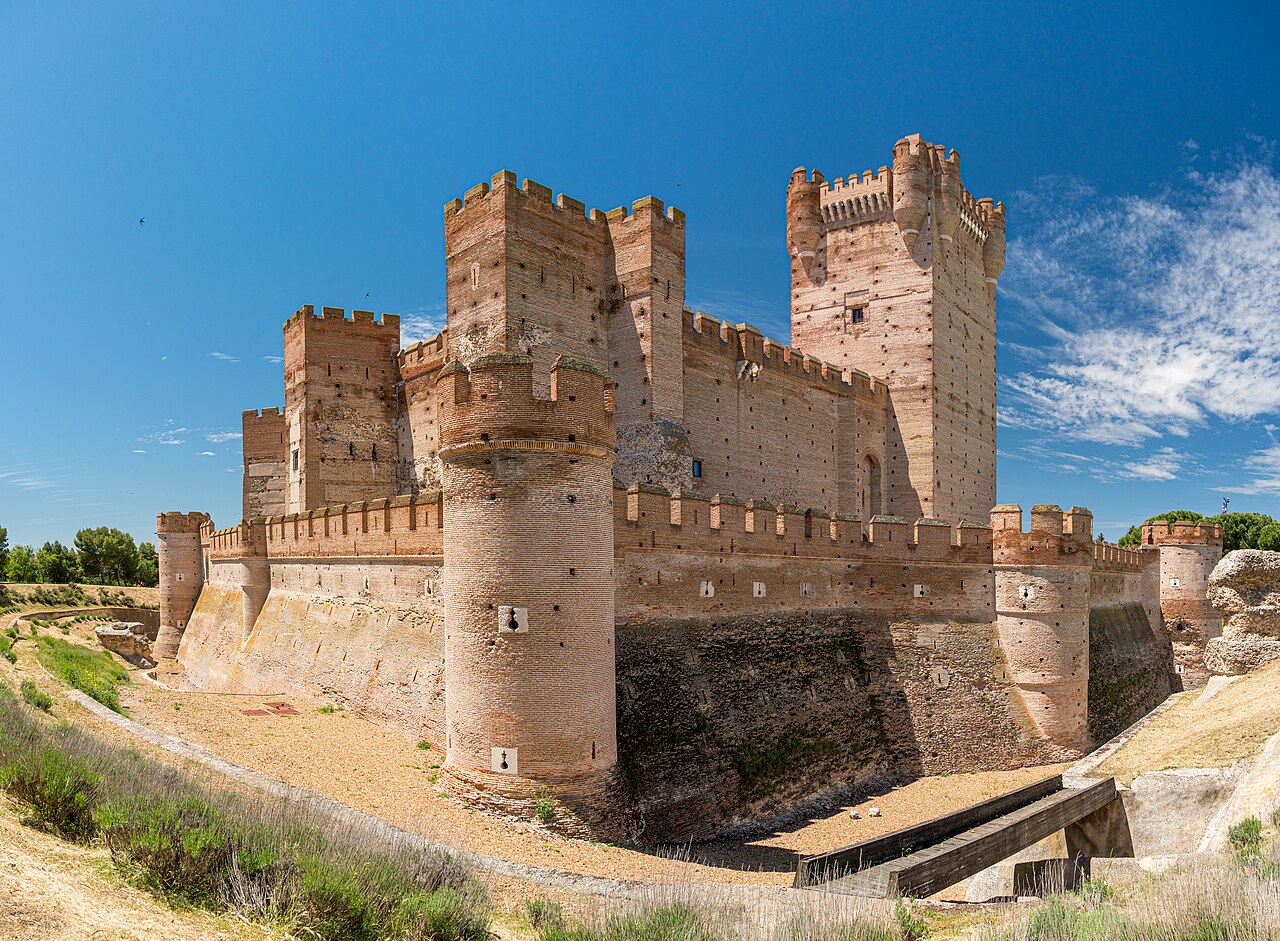
La Mota Castle
La Mota Castle, known locally as Castillo de La Mota, is a prominent late medieval fortress located in the town of Medina del Campo, within the province of Valladolid, Spain. This imposing castle stands as one of the largest and most significant castles in the historic region of Castile, reflecting centuries of military, political, and architectural evolution.
The origins of La Mota Castle are deeply rooted in the strategic importance of its location. Situated on an ancient Roman road, the site likely hosted a fortification as early as Roman times, underscoring its longstanding military significance. The town of Medina del Campo itself was fortified with walls, emphasizing the defensive role of the castle within the broader urban fortifications.
Historical development and construction phases
The castle's foundations date back to the 12th century, with strong indications that these were influenced by Moorish military architecture. Over the 13th and 14th centuries, the castle underwent numerous phases of construction and expansion, adapting to changing military technologies and political circumstances.
The current visible structure primarily dates from 1440, when King Juan II of Castile commissioned the construction of a new fortress on the remains of the earlier Muslim fortification. This phase was executed by the influential Fonseca family, with the design attributed to architects Alonso Niño and Fernando Carreño. The centerpiece of this construction is the massive , a towering symbol of military strength and architectural prowess.
Later in the 15th century, during the reign of Isabel I of Castile, one of the Catholic Monarchs, the castle's defenses were further enhanced with the addition of outer walls. These fortifications were crafted by two skilled Arab artists, Abdallá and Alí de Lerma, whose work contributed to the castle's formidable defensive capabilities.
Architectural features and layout
The castle is characterized by a trapezoidal plan, a design that maximizes defensive coverage. The main entrance is accessed via a fixed bridge, formerly a drawbridge, leading to a grand archway flanked by two turrets. Above the entrance, the royal coat of arms of the Catholic Monarchs is prominently displayed, symbolizing the castle's royal patronage and political significance.
Inside, the castle features four towers and a spacious courtyard, around which various chambers and functional spaces are arranged. These include residential quarters, military facilities, and storage areas. The castle also served as the archive of the Crown during the reign of Henry IV, highlighting its administrative importance.
La Mota Castle's substantial size and robust construction made it a key military stronghold, including its use as an artillery warehouse. Its thick walls, battlements, and defensive towers were designed to withstand sieges and assaults, reflecting the turbulent political climate of late medieval Castile.
Role as a prison and historical events
During the 16th century, La Mota Castle was repurposed as a state prison. It housed several notable prisoners, including the Duke of Calabria, Hernando Pizarro—brother of Francisco Pizarro, the conquistador of the Inca Empire—and the son of King Fadrique of Naples. One of the most famous inmates was Cesare Borgia, who was imprisoned here after a failed escape attempt from Chinchilla Castle. Remarkably, Borgia managed to escape from La Mota Castle in October 1506 with the assistance of the Count of Benavente.
The castle also played a role during the popular uprising of the Comuneros in the early 16th century, when it was targeted by Royalist forces. Additionally, it housed Joan the Mad in its later years, further cementing its place in Spanish royal history.
Decline, restoration, and current use
By the 17th century, La Mota Castle had fallen into a state of disrepair, prompting consolidation efforts to preserve its structure. Despite these attempts, abandonment led to further deterioration, and by the early 20th century, the castle was largely a ruin, with dismantled interiors and crumbling walls.
Under the regime of General Franco, significant restoration work was undertaken. The castle was repurposed as an educational institute for the Female Section of the Falange, reflecting its adaptation to modern uses while preserving its historical fabric.
Today, La Mota Castle serves as a cultural venue, hosting various events and activities. While access to the castle's interior may be restricted at times, its impressive exterior and historical significance continue to attract visitors and scholars interested in medieval military architecture and Spanish history.
Significance in Castilian heritage
La Mota Castle stands as a testament to the military ingenuity and architectural skill of late medieval Spain. Its combination of Moorish foundations, Christian medieval fortifications, and later enhancements by the Catholic Monarchs encapsulates the complex cultural and political history of Castile. As one of the largest castles in the region, it played a crucial role in the defense, administration, and political intrigues of the kingdom.
The castle's imposing keep, extensive curtains walls, and strategic location on a historic trade and military route underscore its importance as a fortress designed to project power and control. Its use as a prison for high-profile figures adds a layer of dramatic history that enriches its cultural narrative.
Visitors to La Mota Castle can appreciate not only its architectural grandeur but also its embodiment of the shifting tides of Spanish history, from medieval warfare to royal politics and modern restoration efforts.
Frequently asked questions (FAQ)
- What is the historical significance of La Mota Castle?
- La Mota Castle is a prominent example of medieval military architecture in Spain, dating back to the 15th century. It played a crucial role in the defense of the region and has been witness to many historical events, including the Catholic Monarchs' campaigns.
- When was La Mota Castle built?
- Construction of La Mota Castle began in the late 15th century, around 1456, under the orders of the Duke of Alba. The castle has undergone various renovations and expansions over the centuries, contributing to its rich architectural heritage.
- What are the opening hours for La Mota Castle?
- La Mota Castle is open to visitors year-round, with varying hours depending on the season. Generally, it opens at 10 AM and closes at 6 PM in winter, and at 8 PM in summer, but it's advisable to check the official website for specific dates and times.
- Can I purchase tickets online for La Mota Castle?
- Yes, tickets for La Mota Castle can be purchased online through the official website or at the entrance. Buying tickets in advance is recommended, especially during peak tourist seasons, to ensure a smooth entry.
- Is La Mota Castle accessible for visitors with disabilities?
- La Mota Castle is committed to providing accessibility for all visitors. Ramps and designated pathways are available, making it easier for those with mobility challenges to explore the castle grounds.
- When is the best time to visit La Mota Castle?
- The best time to visit La Mota Castle is during the spring and fall when the weather is mild, and the surrounding landscapes are particularly beautiful. Additionally, these seasons tend to attract fewer crowds, allowing for a more enjoyable experience.
- What nearby attractions can I visit while in Medina del Campo?
- While visiting La Mota Castle, you can also explore the Church of San Miguel, the Royal Palace of La Alhambra, and the vibrant local markets. Each of these sites offers a glimpse into the rich history and culture of Medina del Campo.
- How much is the entry fee for La Mota Castle?
- The entry fee for La Mota Castle is quite affordable, generally around €5 for adults. Discounts are often available for students, seniors, and children, making it an economical choice for families and groups.
Information
Address
Avenida del Castillo, Medina del Campo, Valladolid, Spain
Loading map...
Visitor reviews
No reviews yet. Been here? Write the first review and help other travelers!
Write the first reviewVisited this castle? Share your experience
Your review helps other travelers and adds first-hand knowledge to our encyclopedia.