
Castle of La Mota
The Castle of La Mota is a prominent late medieval fortress situated on an elevated hill overlooking the historic town of Medina del Campo in the province of Valladolid, Spain. Its name derives from its strategic location on a 'mota'—the Spanish term for a hill—providing commanding views over the surrounding landscape. This imposing castle is renowned for its extensive artillery fortifications and its significant role as a royal prison during the late Middle Ages and Renaissance period.
Constructed primarily in the 14th century and expanded through the 15th century, the Castle of La Mota exemplifies the evolution of military architecture in response to the advent of gunpowder artillery. The fortress's distinctive trapezoidal plan encompasses two main enclosures, with the outer featuring a large barbican and the inner housing a massive square keep tower (Torre del Homenaje) that rises approximately 38 meters high. Built mainly from the characteristic reddish brick of the Valladolid region, the castle incorporates stone elements for defensive loopholes, heraldic shields, and structural details.
Historical background and strategic importance
The site of the Castle of La Mota was originally fortified between 1070 and 1080 as a defensive enclosure protecting the early medieval settlement of Medina del Campo. The castle's location on a hill was a deliberate choice to oversee and control the surrounding fertile plains and key trade routes. Over the centuries, the fortress played a central role in the complex political and military struggles of the Kingdom of Castile and the Crown of Aragon.
During the 14th and 15th centuries, the castle was a focal point in the conflicts between rival factions, including the infantes of Aragon and Castilian monarchs. In 1390, King John I of Castile granted the castle and town to his son, Ferdinand of Antequera, who later became King of Aragon. After Ferdinand's death in 1416, his son John II of Aragon inherited the fortress. The castle changed hands multiple times amid civil wars and sieges, reflecting the turbulent dynastic disputes of the period.
A notable event occurred in 1439 when the prince of Aragon locked the town gates, imprisoning the Castilian king within the castle walls. By 1445, following the First Battle of Olmedo, the castle definitively came under Castilian control. King Henry IV of Castile constructed the central keep tower in 1460, enhancing the fortress's defensive capabilities.
The castle was also involved in the succession dispute between Princess Isabella of Castile and her cousin Juana la Beltraneja. In 1475, the Crown reclaimed the castle and commissioned the construction of a state-of-the-art artillery bastion, marked by the heraldic symbols of the Catholic Monarchs, Ferdinand and Isabella. This bastion was part of a broader modernization to adapt the fortress to the emerging gunpowder warfare.
Architectural features and military innovations
Layout and defensive structures
The Castle of La Mota features a trapezoidal layout with two principal enclosures. The outer enclosure includes a lower barbican fortified with angular and mid-wall towers. Its walls are scarped—sloping outward to better deflect projectiles—and surrounded by a deep moat, enhancing the castle's defensive perimeter against siege engines and mining attempts.
The inner enclosure is more heavily fortified, with high curtain walls and strong corner towers designed to resist direct assault. Within this inner ward stands the imposing keep tower, a square structure measuring approximately 13 meters on each side and rising to 38 meters in height. The keep comprises five floors featuring complex vaulted ceilings of octagonal and polygonal shapes, demonstrating advanced medieval masonry techniques.
Artillery bastions and gunpowder defenses
Between 1476 and 1483, under the reign of the Catholic Monarchs, the castle underwent significant modifications to incorporate artillery defenses. The construction of a low perimeter artillery barrier with thick walls included firing chambers and vaulted casemates designed to house cannons and protect gunners from enemy fire. Ventilation systems were ingeniously integrated to clear smoke from gunpowder discharge, a crucial innovation for effective artillery use.
The artillery barrier is surrounded by deep moats and protected by large talus slopes or alambores, designed to absorb the impact of cannonballs and prevent undermining by enemy miners. A detached bastion located in the moat defends the main entrance gate. This bastion, semicircular or pentagonal in shape, features robust spherical vaults and lacks a rooftop, allowing it to withstand frontal artillery bombardment. It also provides lateral access to prevent simultaneous attacks on the main gate and barbican.
Additional defensive features
The castle includes listening wells (pozzo Airón), a sophisticated countermining system used to detect underground tunneling by besieging forces. The main entrance gate is adorned with a stone shield dated 1483 bearing the heraldic arms of the Catholic Monarchs, symbolizing royal authority and the castle's strategic importance.
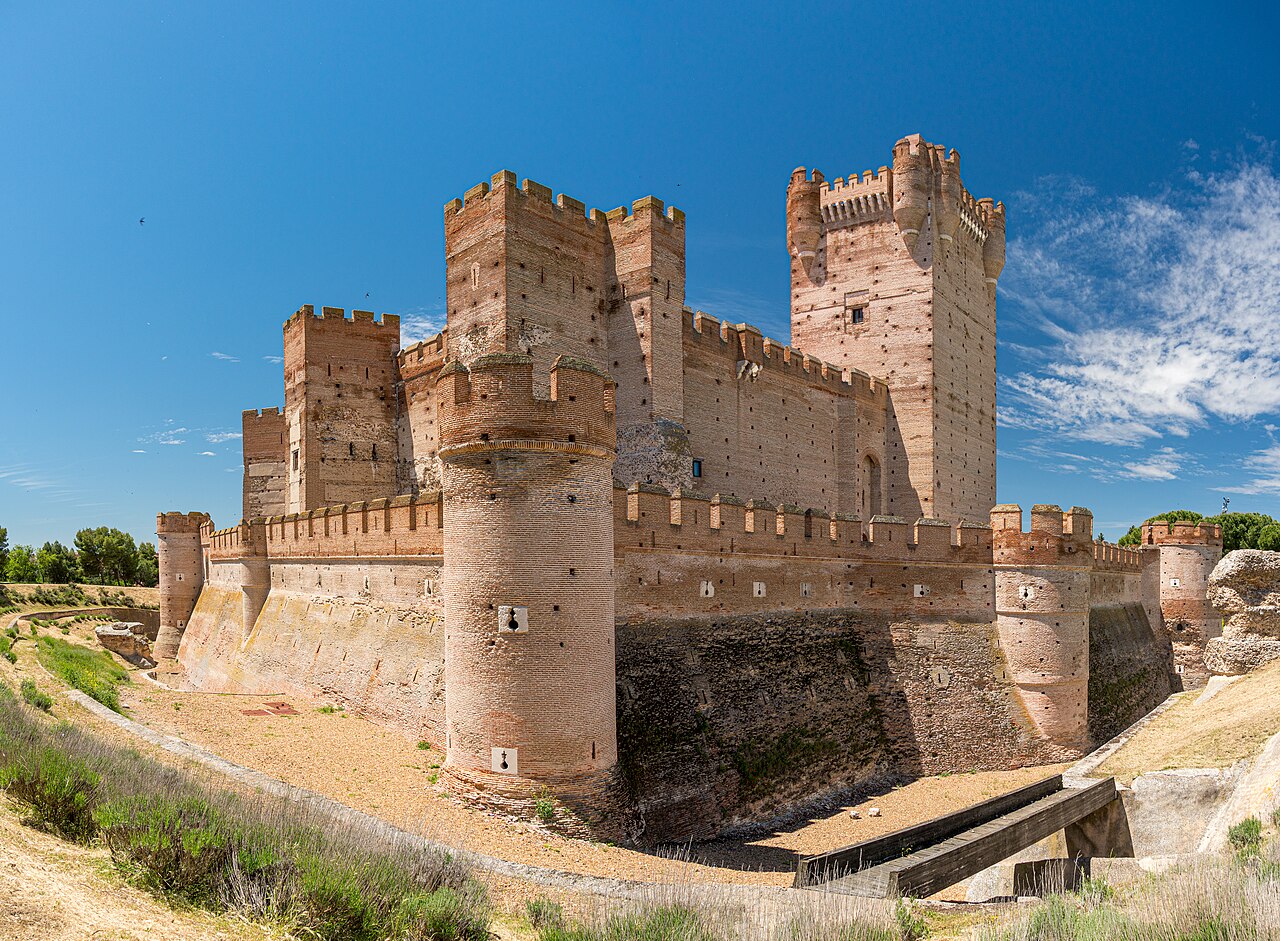
Photo by Fernando • CC BY-SA 4.0
Interior spaces and architectural details
Courtyard and parade ground
Inside the castle, a reconstructed 20th-century Gothic-style parade courtyard features three wings with pointed arches. The courtyard includes a Gothic portal originally from the Hospital de la Latina, attributed to the Arab master builder Hazan. This portal is richly decorated with Muslim-style arches, ball motifs, statuettes, and heraldic emblems, reflecting the cultural fusion characteristic of the region's architecture.
Chapel and religious art
The castle chapel was rebuilt in the 20th century in a Romanesque-Mudéjar style, blending Christian and Islamic architectural elements. It houses a simple altarpiece with bas-reliefs depicting six Spanish saints, a 16th-century ivory statue of Christ, and cherry wood sculptures by José Clara, adding artistic and spiritual significance to the fortress.
Noble chambers and historic rooms
The noble floor is accessed via a neo-Gothic staircase modeled after the Hospital de la Latina. This level contains the Hall of Honor and the "Queen's dressing room," a small vaulted chamber associated with Juana la Loca. This chamber retains fragments of original polychrome decoration and heraldic emblems of the Catholic Monarchs, offering insight into the castle's residential and ceremonial functions.
Historical uses and notable prisoners
From the late 15th century onward, the Castle of La Mota served as a royal prison. It housed several notable figures, including Hernando Pizarro, Rodrigo Calderón, Duke Fernando de Calabria, and César Borgia. The latter's dramatic escape in 1506, descending from the nearly 40-meter-high keep tower using ropes, is one of the castle's most famous episodes.
During the Revolt of the Comuneros (1520-1521), the fortress remained loyal to the Crown despite the town's rebel sympathies. Its extensive artillery park played a crucial role in maintaining royal control over the region.
Restoration and current status
By the 19th century, the castle had fallen into disrepair. In 1904, it was declared a Cultural Heritage Site (Bien de Interés Cultural), sparking restoration efforts. After the Spanish Civil War, General Franco assigned the castle to the Falange’s Sección Femenina as a training school. Restoration work between 1939 and 1942 preserved key architectural elements, with the school operating until 1977.
Since 1992, a comprehensive documentation and restoration program has revealed the castle's significance as one of Europe's prime examples of Renaissance military architecture. The keep tower was reopened to the public in 2010, and today the castle is owned by the regional government of Castilla y León. It functions as a cultural center, attracting visitors interested in its rich history, architectural innovations, and its role in Spanish heritage.
Architectural significance and legacy
The Castle of La Mota stands as a testament to the evolution of medieval fortifications adapting to the introduction of gunpowder artillery. Its combination of traditional defensive features—such as moats, curtain walls, and towers—with innovative artillery bastions and ventilation systems illustrates a pivotal moment in military engineering.
The castle belongs to the Valladolid school of castle architecture, noted for its robust and practical design. Its extensive artillery defenses, including over 200 cannon embrasures arranged across four firing levels and more than 500 meters of vaulted galleries, make it one of the most advanced artillery fortresses of the late medieval period in Europe.
Architectural features such as the machicolations, bartizans, and the use of reddish brick combined with stone details contribute to its distinctive appearance and defensive capabilities. The castle's blend of Gothic, Romanesque-Mudéjar, and Renaissance elements reflects the cultural and historical influences that shaped its development over centuries.
Frequently asked questions (FAQ)
- What is the historical significance of the Castle of La Mota?
- The Castle of La Mota is a remarkable example of medieval military architecture in Spain, dating back to the 15th century. It played a crucial role during the Reconquista and served as a defensive stronghold for the Kingdom of Castile. Its strategic location allowed it to control important trade routes, making it a vital asset in the region.
- When was the Castle of La Mota built?
- The construction of the Castle of La Mota began in the late 15th century, around 1456, and was completed in the early 16th century. It was built under the orders of King Henry IV of Castile as a response to the need for fortified structures during a time of conflict. The castle has undergone various renovations over the centuries to preserve its historical integrity.
- What are the opening hours for the Castle of La Mota?
- The Castle of La Mota is typically open to visitors from Tuesday to Sunday, with varying hours depending on the season. Generally, it opens at 10:00 AM and closes at 8:00 PM during the summer months, while winter hours may be shorter. It is advisable to check the official website for the most current information regarding special closures and holiday hours.
- Can I purchase tickets in advance for the Castle of La Mota?
- Yes, tickets for the Castle of La Mota can be purchased in advance online through the official website or at local ticket offices. Buying tickets ahead of time is recommended, especially during peak tourist seasons, to avoid long lines and ensure entry. Discounts may be available for students, seniors, and groups.
- Is the Castle of La Mota accessible for visitors with disabilities?
- The Castle of La Mota strives to be inclusive and offers accessibility options for visitors with disabilities. There are designated paths and ramps to facilitate movement around the castle grounds, although some areas may still present challenges due to the historical architecture. It is advisable to contact the castle prior to your visit for specific inquiries regarding accessibility.
- What is the best time to visit the Castle of La Mota?
- The best time to visit the Castle of La Mota is during the spring (April to June) and fall (September to October) when the weather is mild and pleasant. During these seasons, the castle is less crowded, allowing for a more enjoyable experience as you explore its rich history and architecture. Summer can be quite hot, while winter might have fewer visiting hours.
- Are there nearby attractions to explore after visiting the Castle of La Mota?
- Yes, there are several nearby attractions to explore after your visit to the Castle of La Mota. You can visit the historic town of Medina del Campo, known for its charming streets and the Royal Palace of the Counts of Benavente. Additionally, the beautiful Church of San Miguel and the local markets provide a lovely cultural experience.
Photo gallery

Information
Website
Visit websiteSources & official resources
Verify the information above using these authoritative references.
Loading map...
Visitor reviews
No reviews yet. Been here? Write the first review and help other travelers!
Write the first reviewVisited this castle? Share your experience
Your review helps other travelers and adds first-hand knowledge to our encyclopedia.