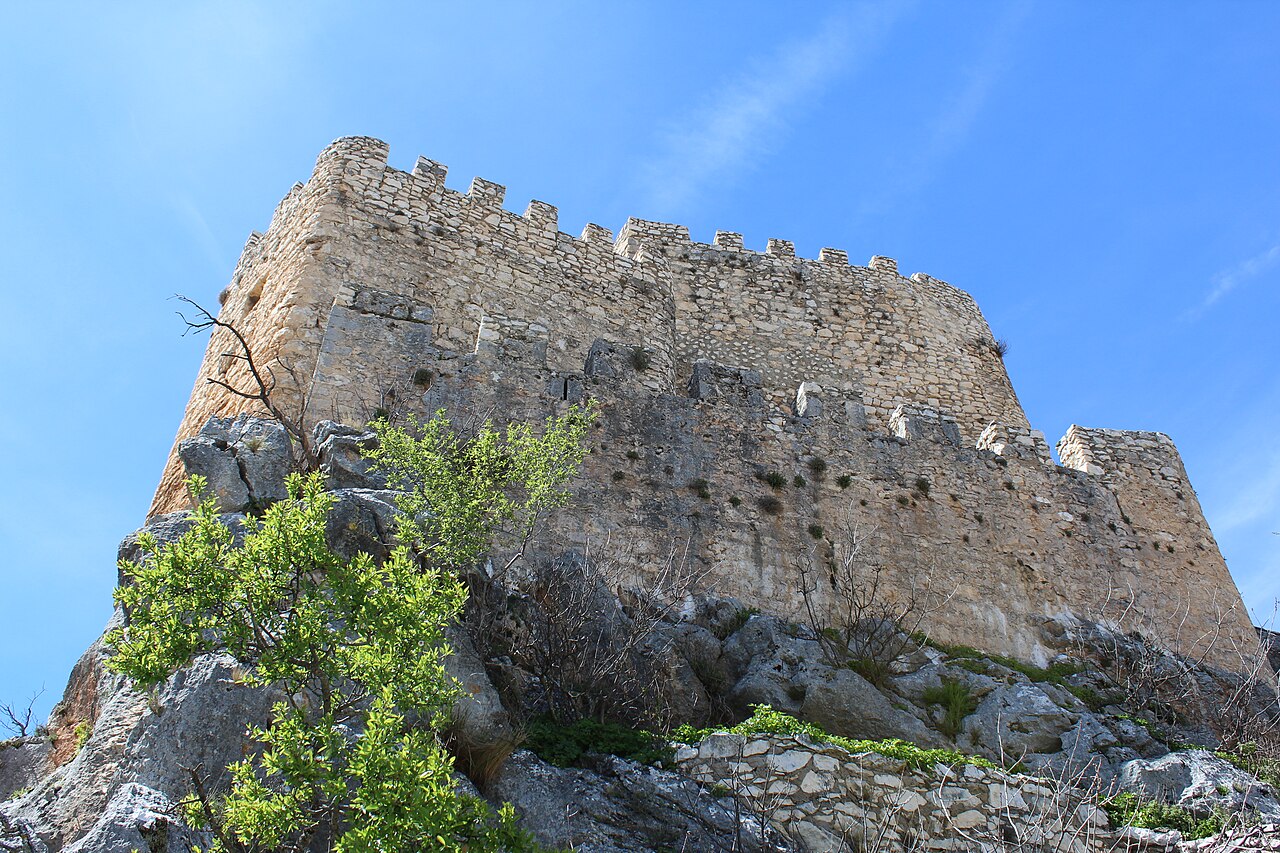
Mata Bejid Castle
Mata Bejid Castle stands as a remarkable example of 14th-century Muslim military architecture in the province of Jaén, Spain. Located near the hamlet of Mata Bejid within the municipality of Cambil, this hill castle was strategically positioned to control the vital passage through the Almadén mountain pass, a key frontier during the later stages of Muslim rule on the Iberian Peninsula.
The castle's rectangular layout reflects the practical and defensive priorities of its builders. Constructed primarily from stone, it features two prominent towers at its northern and southern ends. The northern tower, serving as the keep, contains an interior chamber with a distinctive pointed vault, providing a secure refuge during sieges. The southern tower contrasts with a solid lower section and a habitable upper floor, indicating its dual role in defense and residence.
Architectural features and layout
The fortress is divided into two main areas: the main courtyard or plaza de armas, and the Islamic alcázar or fortified residence. The main courtyard was later converted into a farmhouse, with surviving arches that once formed the zahúrdas (pigsties) overlooking the courtyard. This transformation illustrates the castle's adaptive reuse over time, transitioning from a military stronghold to an agricultural center.
The alcázar occupies a higher level within the castle complex, separated from the main courtyard by defensive walls. Within this section lies a rectangular cistern or aljibe, originally designed to collect and store water vital for the castle's inhabitants during sieges. Although the roof of the cistern no longer survives, the structure remains clearly visible, offering insights into the castle's water management systems.
Historical significance and military role
Constructed during the late medieval period, specifically the 14th century, Mata Bejid Castle played a crucial role in the frontier defense between Muslim and Christian territories. Its location allowed control over the passage from Torres through the Almadén mountain pass, making it a contested site throughout the centuries.
The castle changed hands multiple times as the Christian Reconquista advanced. It was ultimately captured by Christian forces in 1485. Subsequently, in 1494, the Catholic Monarchs granted the fortress to the city of Jaén in recognition of its support during military campaigns that secured Cambil and the nearby Alhabar. This marked the end of the castle's function as a Muslim defensive outpost and its integration into Christian territorial holdings.
Economic and rural functions
Beyond its military importance, Mata Bejid Castle was part of a broader rural complex. Surrounding the fortress are traces of agricultural and pastoral activity, including a large stone threshing floor known locally as an era, and the remains of a tinada, a livestock enclosure.
The castle's location in an area called los Corrales suggests it may have functioned as an albacara, an outer defensive enclosure used to protect livestock and provide a buffer zone outside the main walls. This dual role of defense and agricultural management was typical of frontier fortresses that supported both military and economic needs.
Nearby, the Cueva de los Tocinos ("Cave of the Pigs") was historically used for the disposal of pig carcasses from the castle's pigsties and adjacent tinada. This practical aspect of waste management highlights the integration of livestock husbandry within the castle's economy.
Preservation and current condition
Today, Mata Bejid Castle is in a state of partial deterioration, with both towers showing significant wear. The northern tower's pointed vault remains a notable architectural feature, while the southern tower retains its characteristic two-level structure. The farmhouse conversion of the main courtyard has left behind distinctive arches that continue to evoke the castle's layered history.
The castle's surviving structures, combined with the surrounding agricultural remains, offer valuable insights into the multifaceted role of frontier fortresses during the late medieval period in southern Spain. Mata Bejid Castle exemplifies the intersection of military, residential, and economic functions that defined many such sites during the turbulent era of the Reconquista.
Visiting Mata Bejid Castle
Visitors to Mata Bejid Castle can explore the ruins that reflect centuries of history, from its Muslim origins to its later Christian ownership and agricultural adaptation. The castle's hilltop setting provides scenic views of the surrounding landscape, enhancing the experience of this historic site.
Although the castle is partially ruined, its architectural features, such as the vaulted keep and farmhouse arches, remain accessible and offer a tangible connection to the past. The nearby natural and rural environment further enriches the visit, making Mata Bejid Castle a significant cultural landmark in the region of Andalusia.
Frequently asked questions (FAQ)
- When was Mata Bejid Castle built?
- Mata Bejid Castle was constructed in the 14th century during the Muslim era in Spain, reflecting the military architecture of that period.
- What is the architectural layout of Mata Bejid Castle?
- The castle has a rectangular layout with two towers on opposite ends, a main courtyard converted into a farmhouse, and an Islamic alcázar with a water cistern.
- What historical role did Mata Bejid Castle play?
- It served as a frontier fortress controlling the Almadén mountain pass, changing hands between Muslim and Christian forces during the Reconquista.
- Is Mata Bejid Castle accessible to visitors today?
- Yes, visitors can explore the partially preserved ruins and appreciate the castle's architectural features and scenic hilltop views.
- What economic activities were associated with the castle?
- The castle was part of a rural complex supporting agriculture and livestock, including threshing floors, pigsties, and a livestock enclosure.
Information
Loading map...
Visitor reviews
No reviews yet. Been here? Write the first review and help other travelers!
Write the first reviewVisited this castle? Share your experience
Your review helps other travelers and adds first-hand knowledge to our encyclopedia.