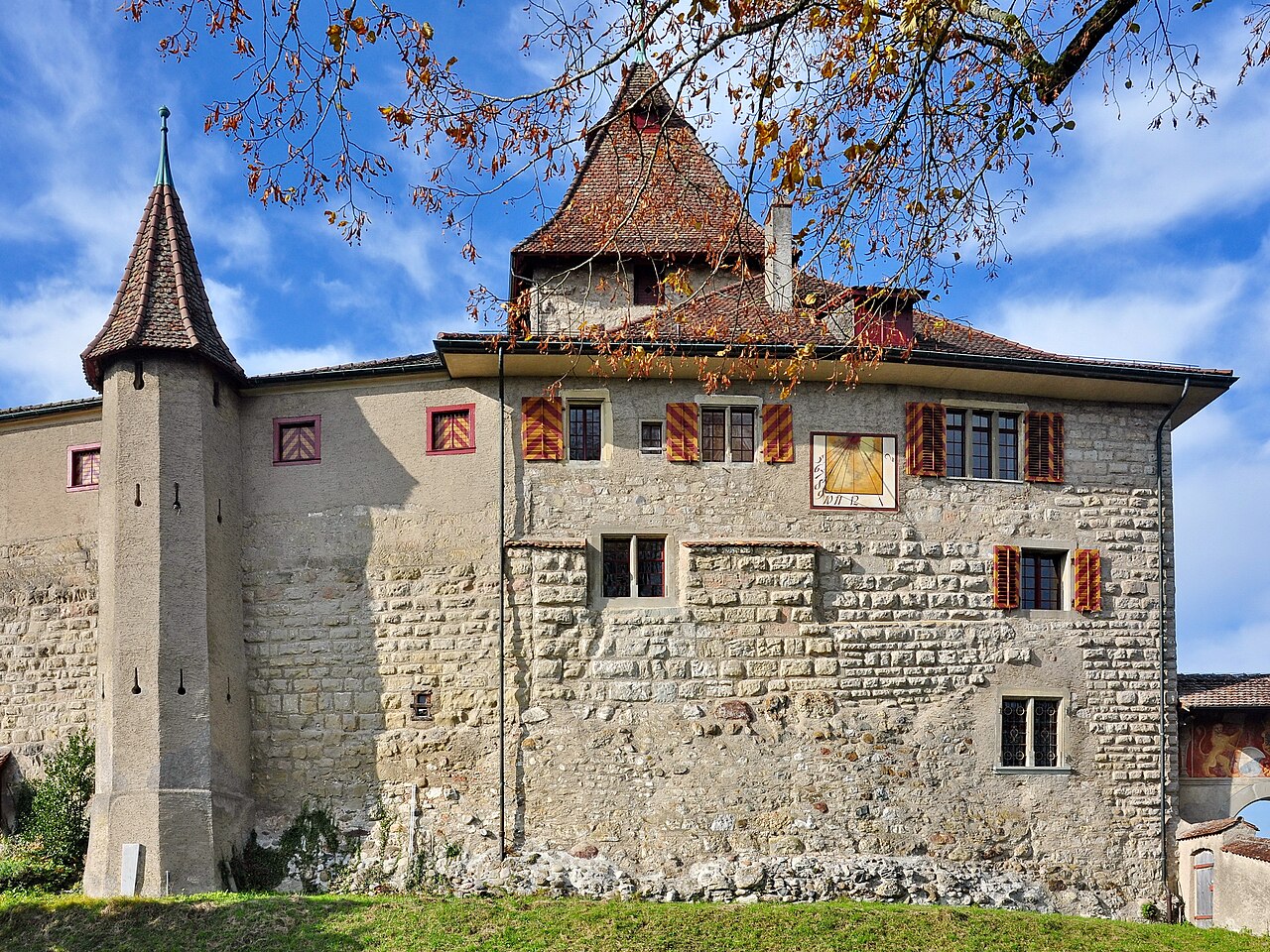
Alt-Wülflingen Castle
Alt-Wülflingen Castle stands as a significant medieval hilltop fortress located in the municipality of Winterthur, Switzerland. Perched on a wooded hill at an elevation of 541 meters above sea level, this castle offers commanding views over the Totentäli valley and the surrounding landscape, including the nearby Töss river and Brüelberg hill. Its origins trace back to the early medieval period, with the site initially fortified by the Alemannic people, a Germanic tribe that settled the region. The nearby village of Wülflingen was first documented in 897 as "Wulfilinga," reflecting its foundation by this tribe, establishing the area's early historical significance.
The castle itself likely emerged by the mid-11th century, possibly evolving from an earlier refuge castle used for defense during turbulent times. From at least the 10th century, the site served as the residence of a local comital family, marking it as a regional power center. The noble lineage of Wülflingen played a prominent role in the castle's history, with notable figures such as Willebirg von Wülflingen and her descendants. Among them was Hunfried, who held important ecclesiastical and imperial positions, including serving as chancellor to Emperor Henry III and later as archbishop of Ravenna. This connection underscores the castle’s historical importance beyond its military function.
Medieval origins and strategic importance
The castle gained historical prominence in 1055–56 when Count Kuno of Achalm, residing at Alt-Wülflingen, detained the Bishop of Regensburg under imperial orders. This event highlights the fortress's strategic role in regional power struggles. In 1089, the castle and its lands were donated to Zwiefalten Abbey, reflecting the common medieval practice of transferring properties to religious institutions. However, disputes eventually led to the castle returning to secular control.
Throughout the following centuries, ownership of Alt-Wülflingen Castle passed through several noble families, including the counts of Horburg. By 1239, the site was under the control of the Habsburg-Kyburg line, a powerful dynasty that shaped much of Central European history. It was during this period, likely in the 13th century, that the castle’s main tower, or bergfried, was constructed. This tower remains the most prominent surviving feature of the castle today.
Architectural features and the bergfried tower
The bergfried of Alt-Wülflingen Castle is a quintessential example of medieval military architecture. Measuring approximately 7.3 by 7.3 meters at its base, the tower’s walls are constructed from large sandstone blocks with a distinctive rusticated finish known as buckelquader. These walls, up to 2.25 meters thick, provided formidable defense against siege weapons and attackers. The tower rises to about 18 meters in height and contains two internal spiral staircases that facilitate movement between floors and access to the upper levels.
Visitors today can ascend 76 steps to reach a viewing platform situated 15 meters above ground level. This platform once served as a lookout point, offering wide-ranging surveillance essential for early warning against approaching enemies. The original entrance to the bergfried was located above ground level, a defensive feature common in medieval keeps designed to impede attackers. This elevated doorway was restored and reopened during renovations in the 1980s, while a later ground-level door added in subsequent centuries was sealed off in 1936 to maintain historical authenticity.
Ownership transitions and historical events
After the Habsburg period, the castle was held by various noble families as a fief, including the von Wülflingen, von Hettlingen, and von Seen dynasties. In 1376, the lordship was pledged to Hartmann von Seen, and later inherited by Ulrich VIII von Landenberg-Greifensee, who made the castle his residence. Toward the end of the 15th century, ownership passed by marriage to the von Rümlang family. Their tenure was marked by financial difficulties and political conflicts, culminating in the execution of Hans Konrad von Rümlang in 1529, a dramatic event reflecting the instability of the era.
The early 16th century brought further change when Hans Steiner acquired the castle and lordship in 1528. The region suffered a devastating plague outbreak in 1596, which severely affected the local population and claimed the life of the then-lord, Sebastian Steiner. Attempts to sell the castle to the nearby city of Winterthur in 1634 initially failed, but later that year, the families Escher and Meiss purchased the property. They built a new residence in the village below, utilizing stones from the castle ruins in the construction, which contributed to the castle’s gradual physical decline.
Decline, restoration, and preservation efforts
The castle’s judicial authority persisted until 1760 when sovereignty transferred to the canton of Zurich. The bergfried was used as a prison until at least 1764, after which the castle fell into disrepair. Outbuildings were removed in 1834, and stones were repurposed locally, accelerating the ruin. A significant earthquake in 1911 caused further damage to the already fragile structure.
Restoration efforts began in 1895, focusing initially on stabilizing the bergfried. These included adding a tiled roof and repairing the walls during the 20th century to prevent further deterioration. In the 2010s, concerns about weather damage led to the installation of protective coverings over the ruin. The most recent extensive masonry restoration was completed in 2018, preserving the bergfried as a prominent medieval landmark in the region.
Castle layout and remaining structures
Alt-Wülflingen Castle’s layout reflects the typical features of a medieval hill castle, with a central fortified tower surrounded by residential and ancillary buildings. While the bergfried remains the dominant surviving structure, only faint traces of the residential wing, inner courtyard, and outbuildings are visible today. Historically, barns and stables were situated near the hill’s base by the Töss river, supporting the castle’s agricultural and logistical needs.
The reuse of castle stones in the 17th century for constructing Schloss Wülflingen in the village below significantly contributed to the castle’s ruinous state. Modern conservation measures have included stabilizing the wall tops with metal straps and installing roofing to shield the masonry from weather erosion, ensuring the site’s preservation for future generations.
Cultural significance and visitor experience
Today, Alt-Wülflingen Castle stands as a well-documented and protected medieval monument that offers visitors insight into the region’s feudal past and architectural heritage. The bergfried tower provides a tangible connection to medieval defensive strategies and noble residence life. Its elevated viewing platform allows visitors to appreciate the strategic location chosen by its builders and enjoy panoramic views of the surrounding Swiss landscape.
The castle’s layered history, from its early Alemannic roots through its association with powerful noble families and its role in regional conflicts, enriches its cultural significance. Preservation efforts have ensured that this historic site remains accessible and informative, making Alt-Wülflingen Castle a valuable destination for those interested in medieval architecture, Swiss history, and heritage conservation.
Frequently asked questions (FAQ)
- What is the historical significance of Alt-Wülflingen Castle?
- Alt-Wülflingen Castle, dating back to the 13th century, is a remarkable example of medieval architecture in Switzerland. It served as a strategic stronghold during various conflicts and has been a symbol of the region's rich history. Today, it stands as a testament to the architectural styles and historical events that shaped Winterthur.
- When was Alt-Wülflingen Castle built?
- Alt-Wülflingen Castle was constructed in the early 1200s, making it one of the oldest castles in the Winterthur area. Its long history reflects the evolution of defensive architecture over the centuries, and it has undergone several renovations to preserve its integrity.
- What are the opening hours for visiting Alt-Wülflingen Castle?
- Visitors can explore Alt-Wülflingen Castle from Tuesday to Sunday, with opening hours typically from 10 AM to 5 PM. It is advisable to check the official website for any seasonal changes or special closures before planning your visit.
- Is it possible to access Alt-Wülflingen Castle by public transport?
- Yes, Alt-Wülflingen Castle is accessible via public transport, with regular bus services connecting it to the Winterthur city center. The journey is convenient, allowing visitors to enjoy the scenic views while traveling to this historical site.
- Can I take guided tours of Alt-Wülflingen Castle?
- Yes, guided tours are available and provide in-depth insights into the castle's history and architecture. These tours enhance the visitor experience, allowing guests to appreciate the details and stories that shaped the castle over the centuries.
- What is the best time to visit Alt-Wülflingen Castle?
- The best time to visit Alt-Wülflingen Castle is during the spring and early autumn when the weather is pleasant and the surrounding gardens are in full bloom. Additionally, these seasons often feature fewer crowds, allowing for a more enjoyable experience.
- Are there any nearby attractions to visit along with Alt-Wülflingen Castle?
- Yes, nearby attractions include the Winterthur Museum of Art and the beautiful gardens at the Eulachpark. Combining a visit to the castle with these sites offers a rich cultural experience in Winterthur.
- What are the ticket prices for visiting Alt-Wülflingen Castle?
- Ticket prices for Alt-Wülflingen Castle are generally affordable, with discounts available for students and seniors. It is recommended to check the official website for the most current pricing and any special promotions.
Information
Website
Visit websiteSources & official resources
Verify the information above using these authoritative references.
Loading map...
Visitor reviews
No reviews yet. Been here? Write the first review and help other travelers!
Write the first reviewVisited this castle? Share your experience
Your review helps other travelers and adds first-hand knowledge to our encyclopedia.