Kutna Hora hradek
Kutná Hora Hrádek is a historic fortified residence located in the town of Kutná Hora in the present-day Czech Republic. Its origins date back to the turn of the 13th and 14th centuries when a wooden guard fortress stood on this site to protect the vital route along the Vrchlice River. The earliest written record of the fortress appears in 1312, marking its importance as part of the town's early defenses.
Originally a wooden stronghold, the fortress was rebuilt in stone during the mid-14th century, reflecting its growing strategic significance. In the early 15th century, between approximately 1410 and 1415, Václav z Donína, the royal reeve of Kutná Hora, transformed the site into a fortified town castle. This reconstruction introduced a three-story stone tower with high gables and additional buildings surrounding a small courtyard, establishing the castle's characteristic layout.
The medieval origins and early fortifications
The original wooden fortress served as a guard post overseeing the road along the Vrchlice River. After the founding of Kutná Hora, the fortress was integrated into the town's defensive walls, becoming an essential element of the urban fortifications. The stone reconstruction in the 14th century included a core tower whose cellar walls still survive beneath the current structure, underscoring the castle's medieval roots.
Transformation under Václav z Donína
During the early 15th century, Václav z Donína significantly rebuilt the fortress into a fortified residence. The new design featured two residential wings facing each other, connected by a defensive wall and supplemented by functional buildings. The earlier tower was incorporated into the palace wing, creating a blend of defensive and residential architecture typical of late Gothic urban castles.
Damage and reconstruction after the Hussite wars
The castle suffered damage during the Hussite wars in the early 15th century, reflecting the turbulent period in Bohemian history. In 1490, the castle was purchased by Jan Smíšek z Vrchovišť, a royal official and prominent mine owner. Smíšek transformed the formerly defensive stronghold into a grand patrician residence, reflecting his wealth and status.
Late Gothic and Renaissance renovations
Jan Smíšek's renovations introduced large rooms with late Gothic ribbed vaults and a private chapel, as well as rich stone decorations featuring mining motifs symbolic of Kutná Hora's silver mining heritage. The ceilings were adorned with early Renaissance frescoes, adding artistic refinement to the castle's interiors. Tradition holds that Smíšek may have engaged in illegal silver smelting, a practice punishable by death, possibly financing his ambitious remodeling.
17th and 18th century transformations and Jesuit ownership
Around 1620, an additional floor was added to the southern wing, further expanding the castle's residential capacity. In the late 17th century, the Jesuit order acquired the property, establishing a seminary in 1686 and later a school that operated until 1776-1910. The Jesuits made modifications to the interiors, including covering or removing some Gothic vaults and altering window openings to suit educational functions.
Adaptation as an educational institution
Following the Jesuit suppression in 1773, the castle continued to serve educational purposes, including as a teachers' training institute. The original defensive features were gradually removed or altered, with steep Gothic roofs replaced by simpler, lower structures. Wooden galleries were removed, and interior partitions were added, reflecting changing functional needs.
20th century restoration and museum conversion
In 1910, the town of Kutná Hora purchased the castle with the intention of restoring it and converting it into a museum. Restoration was delayed by the two world wars but resumed in the 1950s, culminating in the opening of the Czech Museum of Silver in 1996. The museum celebrates Kutná Hora's rich mining and metallurgical history, featuring extensive collections of mining artifacts, currency, and local crafts.
Architectural features and preserved elements
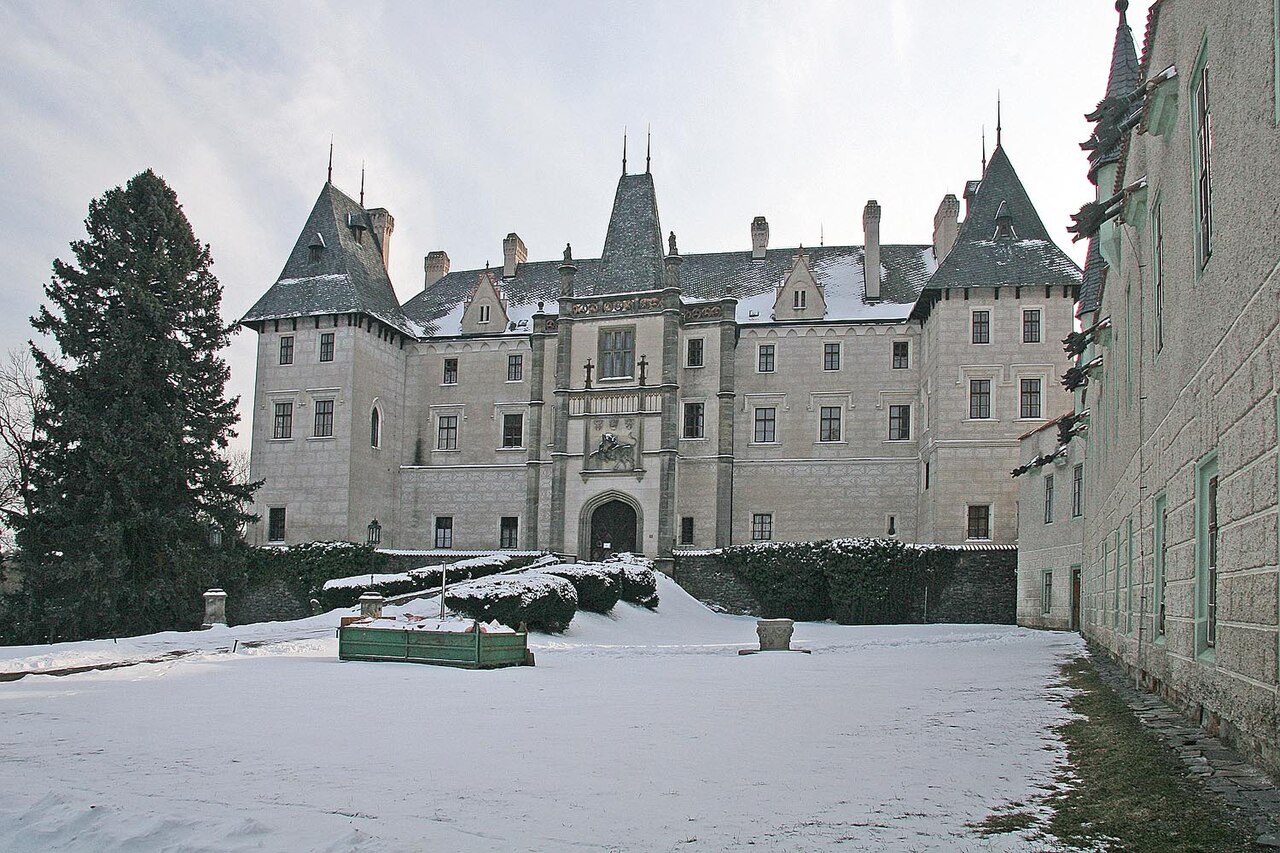
Hrádek's layout combines medieval fortification elements with residential architecture. The surviving medieval tower at the southwest corner retains its cellar walls and features a late Gothic ribbed vault Knight's Hall with an early Renaissance coffered ceiling from 1493. The castle also contains a chapel of St. Wenceslas built in 1504, notable for its Gothic net vault and original frescoes.
The castle's exterior was once adorned with steep gabled roofs covered in colorful glazed tiles, and its stone decorations prominently display mining motifs. Two oriels serve representational functions, including one supported by a column carved with animal figures and cherubs. Later renovations softened the castle's silhouette but preserved significant historic details.
Visitor experience and cultural significance
Today, Kutná Hora Hrádek is a well-preserved hill castle that harmonizes with the historic townscape. It functions as a museum dedicated to the region's mining heritage, offering visitors access to original interiors rich with Gothic and Renaissance architectural details. A highlight is the medieval St. George's adit, a 14th-century mining tunnel that provides an immersive experience of Kutná Hora's metallurgical past.
The castle's combination of defensive and residential architecture, its historical associations with royal officials and mining magnates, and its ongoing role as a cultural institution make it a significant heritage site in the Czech Republic.
Frequently asked questions (FAQ)
- When was Kutná Hora Hrádek castle originally built?
- Kutná Hora Hrádek castle originated as a wooden fortress in the early 14th century, with the first written record dating to 1312. It was rebuilt in stone in the mid-14th century and significantly expanded in the early 15th century.
- What architectural styles are featured in Kutná Hora Hrádek castle?
- The castle showcases a blend of Gothic and Renaissance architectural styles, including late Gothic ribbed vaults, Renaissance frescoes, and decorative stone carvings with mining motifs.
- Can visitors tour the medieval mining tunnel at Kutná Hora Hrádek?
- Yes, visitors can explore the medieval St. George's adit, a 14th-century mining tunnel located beneath the castle, which offers insight into the region's historic silver mining industry.
- What is the current use of Kutná Hora Hrádek castle?
- Today, Kutná Hora Hrádek serves as the Czech Museum of Silver, housing extensive exhibits on mining, metallurgy, currency, and traditional crafts related to the town's history.
- How did the Jesuit order influence the castle's history?
- The Jesuits acquired the castle in the late 17th century, establishing a seminary and later a school that operated until the early 20th century, leading to interior modifications and functional adaptations.
- Is Kutná Hora Hrádek castle well preserved?
- Yes, the castle is well preserved, with many original architectural elements and decorations maintained, reflecting its rich history and cultural significance.
Information
Website
Visit websiteSources & official resources
Verify the information above using these authoritative references.
Loading map...
Visitor reviews
No reviews yet. Been here? Write the first review and help other travelers!
Write the first reviewVisited this castle? Share your experience
Your review helps other travelers and adds first-hand knowledge to our encyclopedia.