Kasperk Castle
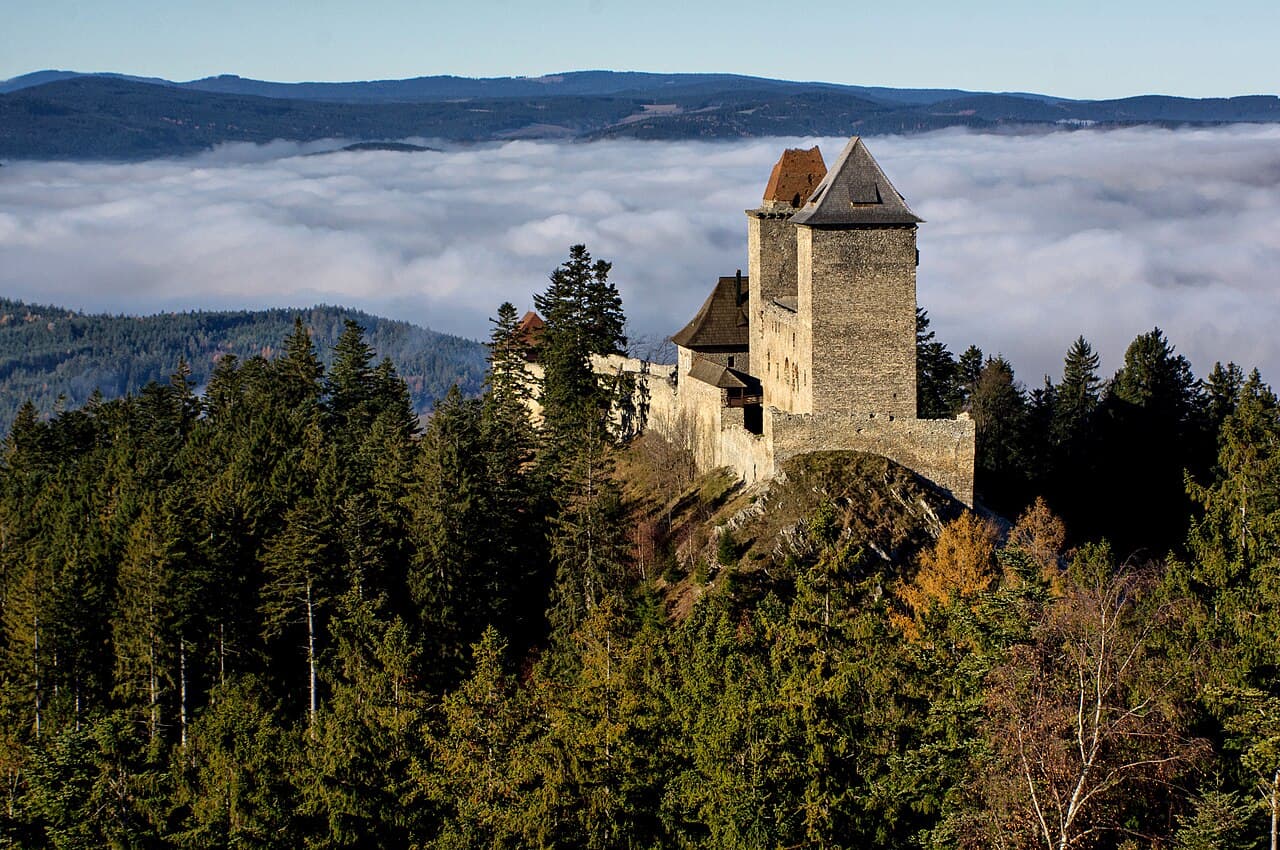
Kasperk Castle, also historically known as Karlsberg, stands as the highest royal castle in Bohemia, perched at an elevation of 886 meters above sea level. Founded in 1356 by the Holy Roman Emperor and King of Bohemia Charles IV, this late medieval hill castle was strategically established to protect the kingdom's borders and assert control over the economically vital gold-rich region near Kašperské Hory. Its position also allowed oversight of the crucial Golden Route, a medieval trade artery linking Bohemia and Bavaria to western Europe’s affluent regions.
The castle was conceived primarily for three strategic purposes: to bolster border defense against Bavarian incursions, to secure the wealth generated by local gold mining, and to control the important trade route that passed through the area. Despite its status as a royal castle, Kašperk never housed a permanent royal occupant; instead, it was administered by the king’s pledge holders who exercised administrative and judicial authority over the surrounding Prácheň region.
Founding and historical significance
Construction of Kašperk Castle began in 1356 under the directive of King Charles IV, with building efforts largely completed by 1361. The castle’s original name, Karlsberg, honored its founder. Its establishment was part of a broader defensive network designed to secure Bohemia’s borders during a time of political volatility in Central Europe.
By 1365, the castle was pledged to Jan Očko of Vlašim, the second Archbishop of Prague and the first Czech cardinal, marking the start of its governance by notable noble families. Over the centuries, the castle passed through the hands of influential houses such as the Zmrzlík of Svojšín and Orlík, Švamberk, and the powerful Šternberkové (Sternberg) family. These families managed the castle as a military stronghold and a center of royal justice, overseeing the administration of the southwestern Bohemian region.
The castle during the Hussite wars and regional conflicts
During the turbulent 15th century, Kašperk Castle played a role in the religious and political upheavals of the Hussite Wars. The castle’s pledge holders, notably the two Peters of the Zmrzlík family, were followers of Utraquism, a moderate Hussite faction. Their religious affiliation helped the castle avoid direct attacks by Hussite forces, although the younger Peter led raids into neighboring Catholic Bavaria.
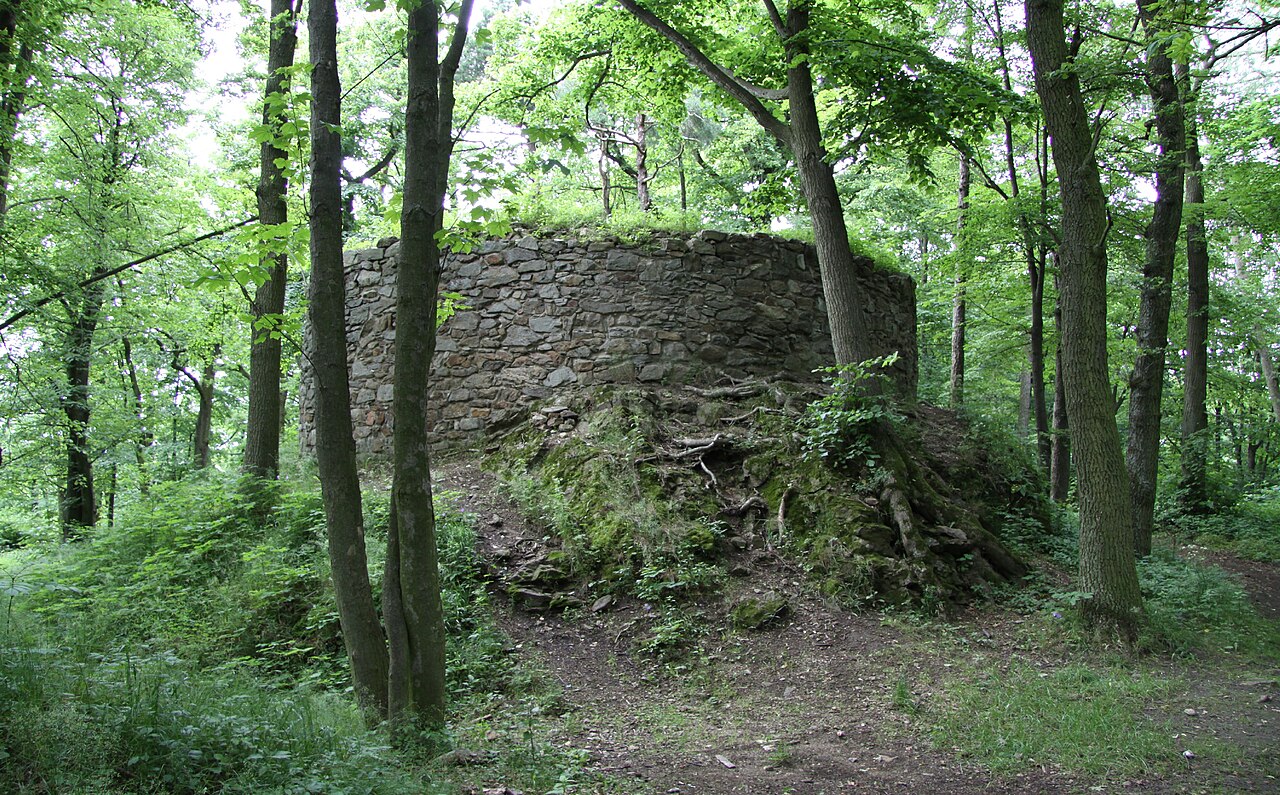
Later in the century, the Šternberkové family took control. In 1465, Zdeněk of Šternberk led a revolt against King George of Poděbrady, thrusting Kašperk into a strategic military role. During this conflict, a small fortress known today as the Deserted Fort was hastily constructed nearby to reinforce defenses.
Architectural features and defensive design
Kasperk Castle is situated on a rocky ridge composed of leptynite metamorphic rock, which provided a natural defensive advantage. The castle complex is divided into three main sections: the entrance zone with the first courtyard, the lower castle with a second courtyard, and the upper castle featuring the main palace and two four-story residential towers.
Upper castle and palace
The upper castle forms a rectangular enclosure approximately 70 by 22 meters, surrounded by a defensive curtain wall originally topped with crenellations that were later adapted for firearms. The curtain wall on the entrance side was constructed lower, with every third merlon pierced by narrow arrow slits allowing defenders to fire while remaining protected.
At the heart of the upper castle lies the main palace, measuring 54 meters in length and 11 meters in width, with walls about 2.5 meters thick. The palace is flanked by two square towers, each rising four stories high. The towers’ fronts are devoid of openings except for a bay window on the western tower, a design choice to enhance resistance against attacks.
Access to the palace was through a single southern entrance approached by a drawbridge connected to a wall pillar. Inside, the palace contained large halls illuminated by rectangular windows with built-in seating niches, connected by corridors. One surviving interior space is a timbered chamber with multiple windows.
Towers and residential quarters
The two residential towers housed living quarters starting from the second floor, illuminated by large windows. The third floors originally contained staircases and smaller wooden rooms. Notably, the eastern tower’s third floor was later converted into a chapel, with traces of 19th-century wall paintings still visible, reflecting the castle’s religious adaptations over time.
Lower castle and entrance defenses
The lower castle is an elongated section separated from the upper castle by a protective moat. It is enclosed by its own defensive wall and ends with a building thought to be the burgrave’s residence. This structure, partly vaulted and embedded into the rock, represents early defensive architecture.
The courtyard of the lower castle was accessed through a gate secured by a drawbridge spanning a moat filled with stone. At the entrance area, remnants of earthworks such as a neck ditch and traces of a round tower and gate with late Gothic masonry survive. Below the terraces are two cascade-like water reservoirs of presumed medieval origin, which served the castle’s water needs.
Military role and strategic importance
Kasperk Castle’s defensive design emphasizes passive fortifications over active defenses. For example, the eastern tower presents a solid wall facing east without openings, designed as a refuge during attacks. The castle’s overall layout suggests a preference for engaging enemies in field battles rather than enduring prolonged sieges.
The lower castle was designed to house a sizeable garrison, supported by ample space for troops and provisions. The castle’s location on a high ridge provided excellent visibility over the surrounding landscape, enhancing its strategic value.
About 300 meters east of the main castle lies Pustý hrádek (the Deserted Fort), a small detached bastion at 924 meters above sea level. Constructed in the mid-15th century by the Šternberg family, it was intended as a siege outwork but never saw combat, illustrating the military tensions of the period.
Decline, preservation, and modern significance
By the late 16th century, Kasperk Castle’s military importance waned, leading to reduced maintenance and gradual neglect. The town of Kašperské Hory eventually leased and later purchased the estate in 1617, by which time the castle was described as deserted and falling into ruin.
During the Thirty Years’ War (1618–1648), although the castle was not directly attacked, locals sought refuge within its walls. Imperial orders mandated partial demolition to prevent its use by enemy forces, but this was only partially executed. Much of the castle’s stone was repurposed for local building projects, accelerating its decay.
Restoration efforts began in the 19th century, recognizing Kasperk as a cultural and historical landmark. More extensive repairs occurred during the 20th century, including stabilization of walls and reconstruction of roofs. Notably, the 2007 Kyrill storm caused damage to the eastern tower’s shingled roof, which was subsequently replaced.
Today, Kasperk Castle is a well-preserved ruin and protected cultural monument. It hosts exhibitions and guided tours that illuminate its layered history from a royal fortress to a regional administrative center and military bastion. The castle remains a popular destination for visitors interested in medieval architecture, Bohemian history, and scenic mountain landscapes.
Access and visitor information
The castle is accessible via a road passing through the towns of Kašperské Hory and Nezdice, with parking available approximately 1,200 meters from the site. Visitors may also reach the castle on foot via several hiking trails originating from Kašperské Hory, providing scenic approaches to the fortress.
Public transport options include railway service to Sušice, with connecting bus routes to Kašperské Hory. From there, visitors can take additional local transport or walk to the castle. The combination of historical significance, architectural interest, and natural beauty makes Kasperk Castle a compelling destination for cultural tourism in the Czech Republic.
Frequently asked questions (FAQ)
- How do I get to Kasperk Castle using public transport?
- You can reach Kasperk Castle by taking a train to Sušice railway station, then catching a bus to Kašperské Hory. From there, local transport or hiking trails lead to the castle.
- What is the historical significance of Kasperk Castle?
- Kasperk Castle was founded in 1356 by Charles IV to protect Bohemia's borders, control gold mining areas, and oversee the Golden Route trade path.
- Can I walk to Kasperk Castle from nearby towns?
- Yes, several hiking trails from Kašperské Hory provide scenic routes to Kasperk Castle, suitable for visitors who enjoy walking in nature.
- What architectural features make Kasperk Castle unique?
- Its high-altitude location, robust curtain walls with arrow slits, two four-story residential towers, and a chapel in the eastern tower distinguish Kasperk Castle.
- Is Kasperk Castle open year-round?
- Visiting hours may vary seasonally; it is best to check local tourist information for current opening times and guided tour availability.
Photo gallery

Information
Sources & official resources
Verify the information above using these authoritative references.
Loading map...
Visitor reviews
No reviews yet. Been here? Write the first review and help other travelers!
Write the first reviewVisited this castle? Share your experience
Your review helps other travelers and adds first-hand knowledge to our encyclopedia.