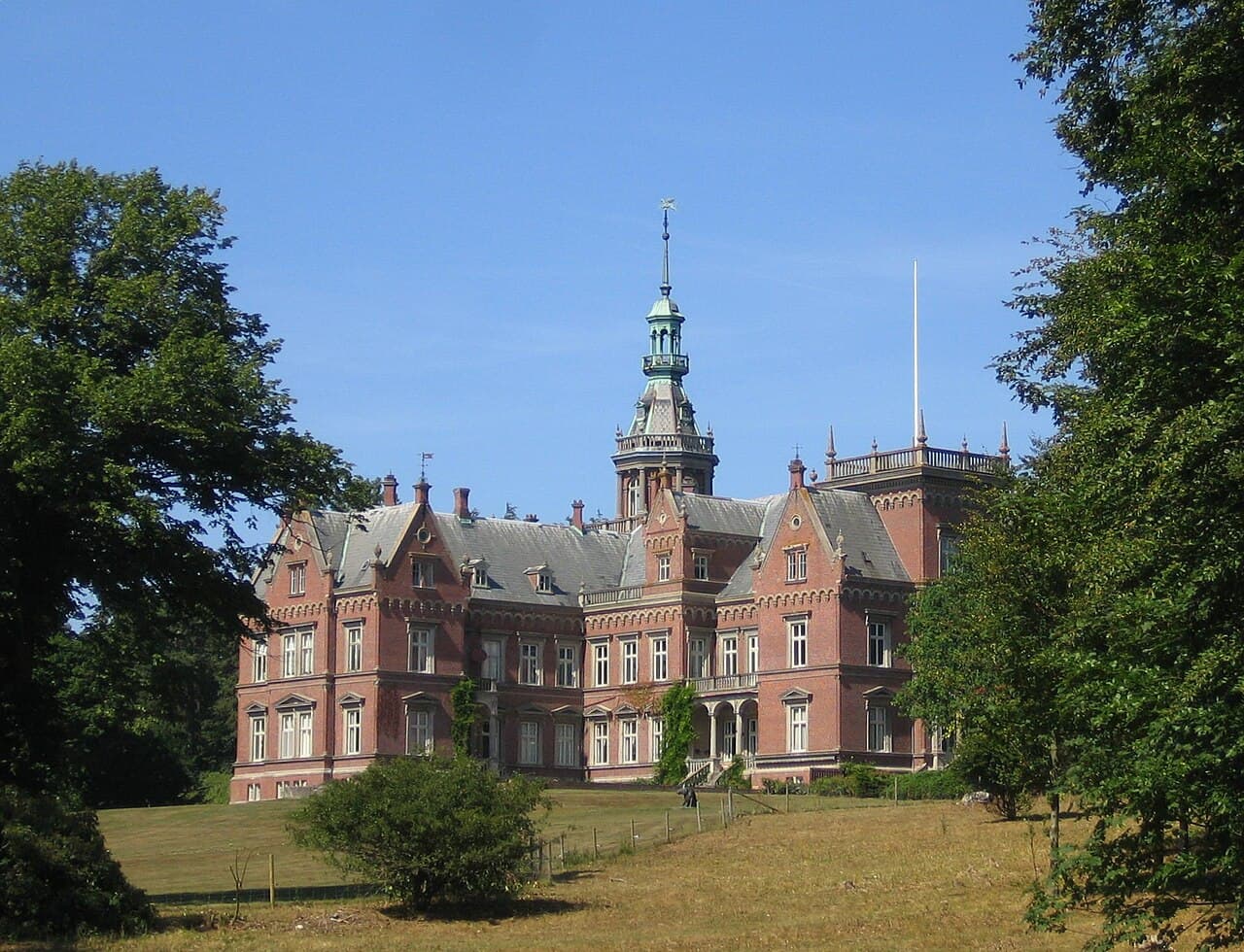
Kulla Gunnarstorp Castle
Kulla Gunnarstorp Castle, located in Helsingborg Municipality in the historical province of Scania in southern Sweden, is a notable example of a hill castle with a layered architectural history spanning from the late medieval period through the 19th century. Situated near the Öresund strait between the villages of Hittarp and Domsten, approximately 10 kilometers north of the city of Helsingborg, the castle occupies a strategic position overlooking the surrounding landscape and waterways.
Early history and ownership
Originally known as Gundestrup in the late 1400s, the estate was owned by the Pardsberg family. In the mid-16th century, ownership transferred to Jörgen Brahe, a prominent nobleman of the era, who constructed the older part of the castle that remains today. The Brahe family played a significant role in the region's history, and their influence is evident in the castle's Renaissance architectural elements.
Subsequent ownership passed through several distinguished Swedish noble families, including the Sparre, De la Gardie, and de Geer families. Each contributed to the estate's development and upkeep, reflecting the changing tastes and needs of the Swedish aristocracy over the centuries.
Architectural evolution and features
The older castle
The original castle constructed by Jörgen Brahe in the 1550s exhibits characteristics typical of the late medieval and early Renaissance periods in Scandinavia. Its design includes fortified stone walls, defensive towers, and a compact layout suitable for both defense and residence. The castle's position on a hill provided natural defensive advantages, complemented by man-made fortifications.
19th-century expansion
Between 1865 and 1868, a newer section of the castle was added by Baltzar von Platen, a notable figure in Swedish history. This expansion was designed by the Danish architect Christian Zwingmann and reflects the Romantic Neo-Gothic architectural style popular in the 19th century. The addition introduced more ornate and picturesque elements, including decorative towers, intricate stonework, and expansive windows, contrasting with the older fortress-like structures.
Location and surroundings
Kulla Gunnarstorp Castle's location near the Öresund strait places it within a historically significant maritime corridor between Sweden and Denmark. The castle's proximity to Helsingborg, a key port city, underscores its strategic importance in controlling land and sea routes. The surrounding landscape features gently rolling hills and coastal views, enhancing the estate's aesthetic and defensive qualities.
Current status and ownership
Today, Kulla Gunnarstorp Castle remains privately owned and is not generally open to the public. The estate is maintained as a historic property, preserving both its late medieval origins and 19th-century Romantic Neo-Gothic additions. Its well-preserved condition offers valuable insights into the architectural and social history of Swedish nobility across several centuries.
Cultural and historical significance
Kulla Gunnarstorp Castle stands as a testament to the evolving architectural styles and noble lineages in southern Sweden. Its combination of Renaissance fortifications and Romantic Neo-Gothic expansions illustrates broader European trends in castle design and aristocratic residence. The castle's association with prominent families such as the Brahe, Sparre, De la Gardie, and de Geer lineages highlights its role in Swedish history.
While not widely accessible, the castle remains a point of interest for historians and architectural scholars studying Scandinavian castles and noble estates. Its preservation contributes to the understanding of regional history and the adaptation of medieval structures to later stylistic movements.
Frequently asked questions (FAQ)
- How do I visit Kulla Gunnarstorp Castle?
- Kulla Gunnarstorp Castle is privately owned and generally not open to the public. Visitors can view the castle from nearby public roads and enjoy the surrounding landscape.
- What architectural styles are present at Kulla Gunnarstorp Castle?
- The castle features a mix of late medieval Renaissance architecture from the 1550s and 19th-century Romantic Neo-Gothic additions designed by Christian Zwingmann.
- When was the original castle built?
- The original castle was built in the 1550s by Jörgen Brahe, incorporating late medieval defensive features with early Renaissance influences.
- Who were the notable owners of Kulla Gunnarstorp Castle?
- Notable owners include the Pardsberg family, Jörgen Brahe, and later the Sparre, De la Gardie, and de Geer noble families.
- What is the significance of the castle's location?
- Located near the Öresund strait and close to Helsingborg, the castle held strategic importance for controlling land and sea routes between Sweden and Denmark.
Photo gallery

Information
Current owner
Private owner
Loading map...
Visitor reviews
No reviews yet. Been here? Write the first review and help other travelers!
Write the first reviewVisited this castle? Share your experience
Your review helps other travelers and adds first-hand knowledge to our encyclopedia.


