Kuglvajt
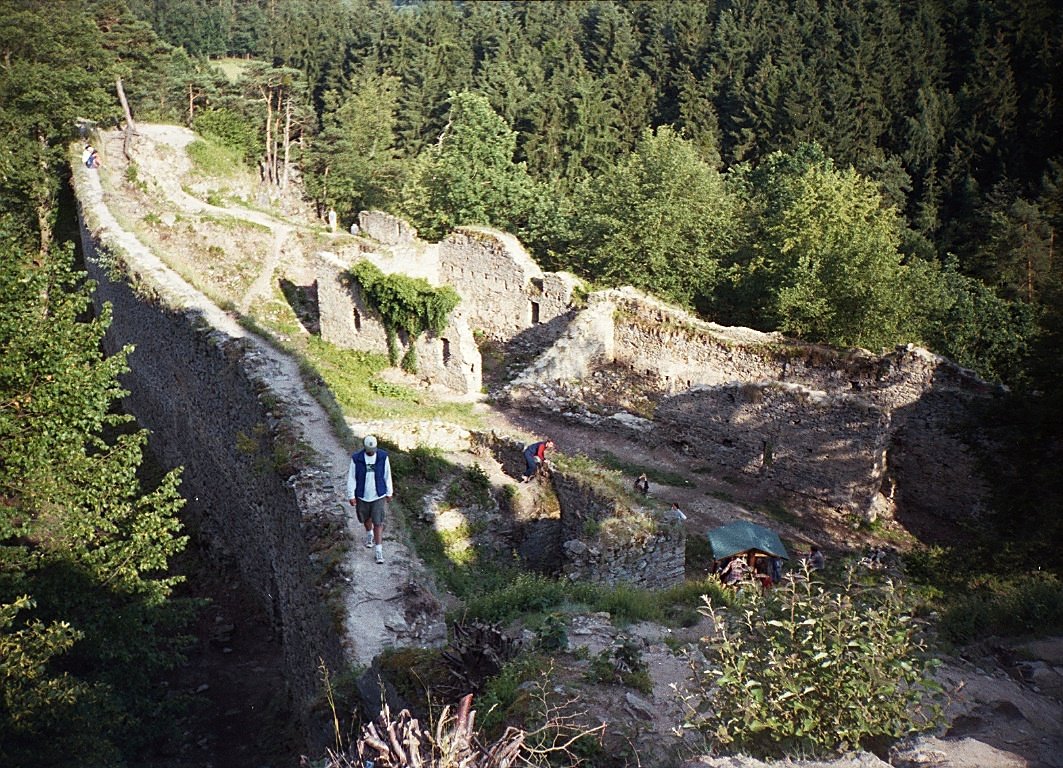
Kuglvajt castle stands as a medieval ruin located near the village of Brloh in the South Bohemian Region of the Czech Republic. Constructed in the 14th century, it served as a royal and administrative stronghold under the Kingdom of Bohemia. Its strategic position atop a rocky granite hill at approximately 740 meters above sea level provided commanding views over the Křemžský potok valley, making it a significant defensive site during its active use.
Historical background and royal connections
The earliest documented mention of Kuglvajt dates back to 1357, linked to Dětrich of Portic, a prominent ecclesiastical figure who was bishop of Minden and an advisor to King Charles IV. Following Dětrich's death in 1367, the castle reverted to the Bohemian royal chamber, placing it under direct royal control. This transition highlights Kuglvajt's importance within the royal administration during the High medieval period.
During the reign of King Wenceslaus IV, Kuglvajt became embroiled in the political unrest that characterized late 14th-century Bohemia. The castle's burgrave, Václav of Švamberk, was involved in tensions between the king and Archbishop Jan of Jenštejn. In 1395, amid widespread noble conflicts, forces led by Jindřich of Rosenberg captured and deliberately destroyed the castle. This event reflected the factional struggles that weakened central authority in Bohemia at the time.
After its destruction, King Wenceslaus IV granted Kuglvajt to Jindřich of Rosenberg, who incorporated it into the Maidštejn estate. The castle was subsequently abandoned and never restored or reinhabited, leaving it to fall into ruin.
Architectural layout and defensive features
The castle's design was heavily influenced by the natural granite terrain of its hilltop location. It comprised two main sections: a lower outer courtyard (vorburg) and an upper inner core. The lower courtyard was rectangular and enclosed by earthworks that once supported defensive walls. These earthworks survive today as rampart-like formations, providing insight into the castle's outer defenses.
The inner core was positioned on a higher rocky outcrop connected to the outer bailey by a surviving passageway. This section was protected by a rock-cut moat on the western side and a narrow rocky ridge on the eastern side, which supported a slender tower with rounded corners. The core contained a principal two-room palace, separated from the moat by a zwinger—a narrow enclosed ward typical in medieval fortifications designed to trap attackers between walls.
Defensive innovations and strategic advantages
The use of natural rock formations combined with man-made fortifications demonstrates the castle's strategic defensive planning. The rock-cut moat was an advanced feature that enhanced protection by creating a physical barrier difficult for attackers to cross. The zwinger added an extra layer of defense, forcing enemies into confined spaces vulnerable to defenders' counterattacks.
Paulaner monastery and religious heritage
Near Kuglvajt castle, approximately three kilometers north of Brloh, lies the site of a Paulaner monastery founded around 1495 by hermits invited by Peter IV and Ulrich of Rosenberg. The monastery included a church dedicated to St. Andrew. However, the complex remained unfinished and was abandoned by about 1530.
The monastery's remains were later destroyed during the Thirty Years' War by Swedish troops. Stone and building materials from the monastery were repurposed in local constructions, leaving only partial ruins visible today. This religious site reflects the Rosenberg family's influence and the broader religious developments in the region during the late medieval and early modern periods.
Current condition and cultural significance
Today, Kuglvajt castle exists as a ruined hill castle, with fragmented walls, earthworks, and foundational remnants visible on the hilltop. The ruins provide valuable archaeological and historical insights into medieval castle construction, defensive strategies, and regional power dynamics in Bohemia.
The site is accessible via hiking trails and offers visitors a tangible connection to the complex history of noble conflicts, royal administration, and monastic life in medieval Czechia. Its preservation as a ruin allows for study and appreciation of the architectural and historical layers that shaped the region.
Frequently asked questions (FAQ)
- How do I get to Kuglvajt castle?
- Kuglvajt castle is located near the village of Brloh in the South Bohemian Region of Czechia. It is accessible by hiking trails from nearby towns and villages, making it suitable for visitors interested in outdoor exploration.
- What remains can I see at Kuglvajt castle?
- Visitors can see the ruins of the castle's outer courtyard earthworks, the rock-cut moat, the remains of the two-room palace, and the slender tower with rounded corners. Nearby are also the ruins of the Paulaner monastery and the partially completed church of St. Andrew.
- When was Kuglvajt castle built and by whom?
- Kuglvajt castle was constructed in the 14th century under the Kingdom of Bohemia. It was initially associated with Dětrich of Portic, a bishop and royal advisor, reflecting its royal administrative role.
- Why was Kuglvajt castle destroyed?
- The castle was deliberately destroyed in 1395 by forces led by Jindřich of Rosenberg during noble conflicts in Bohemia. This destruction was part of wider factional struggles weakening the central power of King Wenceslaus IV.
- Is there an entrance fee to visit Kuglvajt castle?
- There is no formal entrance fee to visit Kuglvajt castle as it is a ruin accessible to the public via hiking paths. Visitors should prepare for a self-guided experience.
Information
Website
Visit websiteSources & official resources
Verify the information above using these authoritative references.
Loading map...
Visitor reviews
No reviews yet. Been here? Write the first review and help other travelers!
Write the first reviewVisited this castle? Share your experience
Your review helps other travelers and adds first-hand knowledge to our encyclopedia.