Krustpils Castle
Krustpils Castle, also historically known as Kreutzburg, stands as one of the most well-preserved medieval castles in Latvia, located in the city of Jēkabpils. Its origins date back to the 13th century, with the first written reference appearing in 1237 when the Archbishop of Riga established a fortress named Kreutz. This castle was strategically positioned on the eastern boundary of the archbishopric along the Daugava River, serving as a vital defensive stronghold and control point for important trade routes in the region.
The castle's early history is deeply intertwined with the political and military struggles of medieval Livonia. Throughout the High Medieval period, control over Krustpils shifted multiple times, reflecting the turbulent power dynamics between the Riga Archbishopric and the Livonian Order, a military and religious brotherhood. The castle was occupied by the Livonian Order in 1297, 1359, during 1416-1426, and again in 1479. It also endured a significant Lithuanian raid in 1375 led by Prince Kęstutis, highlighting its strategic importance in regional conflicts.
Medieval origins and strategic significance
Constructed primarily between 1255 and 1297, Krustpils Castle was initially designed as a hill castle with a robust quadrangular layout centered around a large inner courtyard. The castle's defensive architecture included thick stone walls, a formidable gate tower, vaulted cellars with cross and barrel vaults, and wall buttresses that reinforced the structure. Originally, the castle was surrounded by a moat and outer fortifications, though these have since disappeared.
The castle’s location on a hill overlooking the Daugava River provided a commanding view of the surrounding landscape, allowing it to serve as an effective military outpost and administrative center for the archbishopric. Its position also marked a linguistic and cultural boundary between the Latgalian and Selonian peoples, a distinction that remains evident to this day.
Transition to noble residence and baroque transformation
Following the dissolution of the Livonian Confederation in the mid-16th century, Krustpils Castle became part of the Polish–Lithuanian Commonwealth from 1561 to 1772. In 1585, King Stephen Báthory granted the castle and surrounding lands to General Nikolai von Korff, whose family retained ownership for over three centuries. Under the von Korff family, Krustpils gradually transformed from a military fortress into a noble residence.
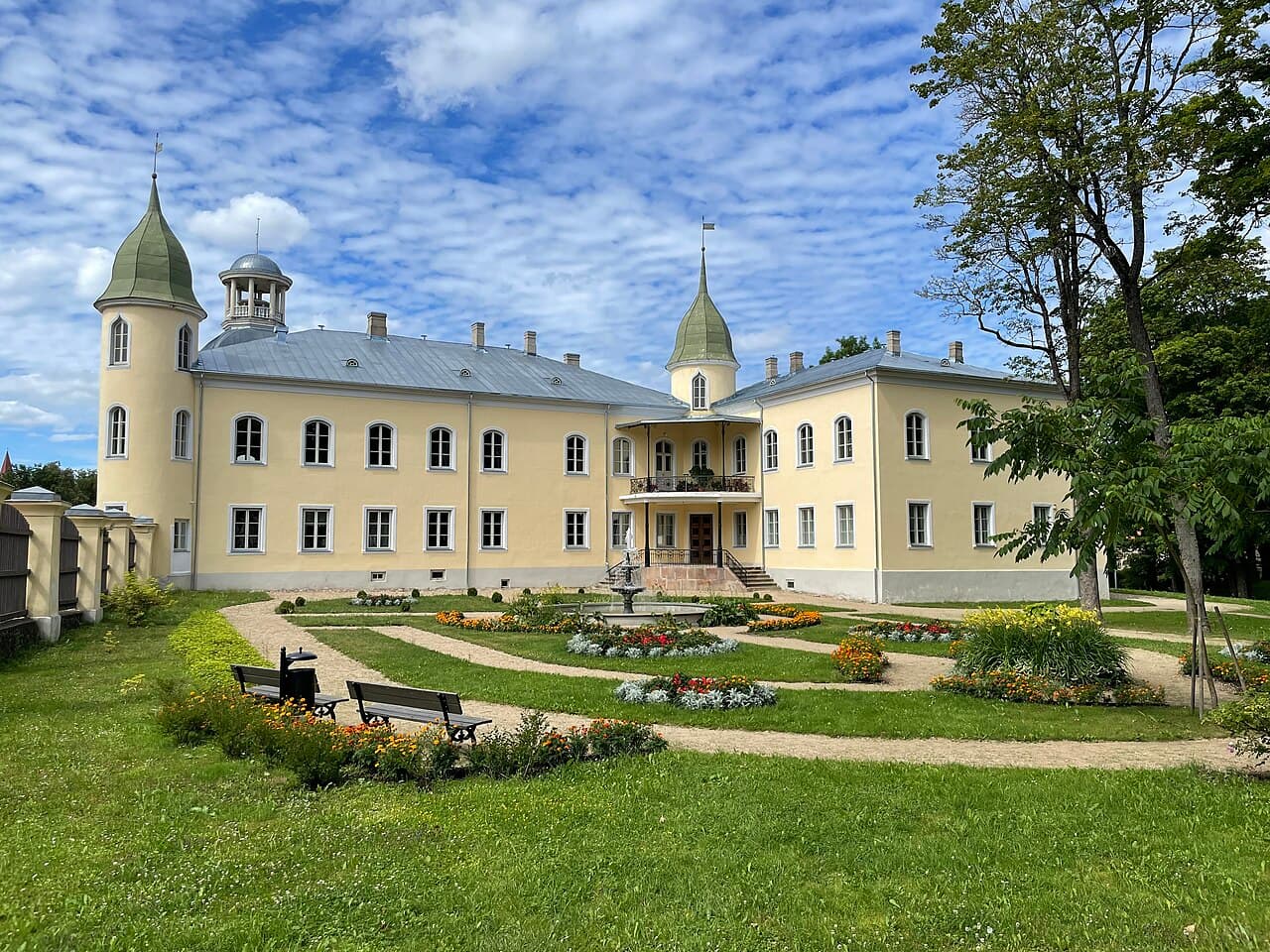
This transition involved significant architectural modifications during the 17th and 18th centuries. The castle’s austere medieval defensive features were softened with the addition of Baroque elements. Large windows replaced narrow arrow slits, mansard roofs were introduced, and the towers were adorned with slender sheet metal spires and Baroque lanterns. Small round corner towers with Baroque domes were also added, enhancing the castle’s decorative appeal.
Inside the castle, fragments of decorative wall paintings survive, including coats of arms of the von Korff and von Rosen families, reflecting the noble lineage and heritage of its occupants. The main southern wing houses an elongated hall with vaulted ceilings, remnants of the castle’s medieval past preserved within the later residential adaptations.
19th and 20th-century adaptations and military use
During the 19th century, Krustpils Castle underwent further practical transformations. The medieval walls were integrated into a manor house design, and the castle tower was converted into a water tower. Modern amenities such as a water supply system, flush toilets, and a telephone line (installed in 1902) were added, reflecting the evolving needs of its residents.
A notable episode in the castle’s history occurred during the Russo-Turkish War (1877–1878), when Krustpils served as a camp for Turkish prisoners of war. Many of these prisoners settled permanently in the surrounding area, adding a unique cultural layer to the region’s history.
In the 20th century, the castle’s role shifted again to military purposes. After Latvia regained independence in 1921, the Latgale artillery regiment was stationed at Krustpils. During World War II, it served as an infirmary for the German army, later becoming a military hospital for the Soviet Red Army after August 1944. Throughout the Soviet era, various regiments, including the 16th regiment of long-range intelligence aviation and the 15th air regiment’s main storehouses, occupied the castle. Unfortunately, this period also saw significant neglect, with the castle’s condition deteriorating towards ruin.
Architectural features and surviving structures
Krustpils Castle’s layout remains largely intact, preserving its characteristic quadrangular form with a central courtyard. Three sides are bordered by two-story buildings, while the fourth side features the imposing gate tower, a key defensive element from its medieval origins. The vaulted cellars beneath the complex, supported by cross and barrel vaults, are notable architectural features that have endured through centuries.
While the original moat and outer fortifications have been lost, their traces can still be discerned in the landscape surrounding the castle. The castle’s thick stone walls, buttresses, and the large square tower—dating from the 18th century—reflect the layered history of construction and renovation.
The castle complex historically included a large economic yard surrounded by numerous auxiliary buildings, such as stables, servants’ quarters, a riding hall, an orangery, and a brewery. Today, approximately 29 of these outbuildings survive, though many have been altered from their original forms.
Restoration and cultural significance
Following Latvia’s independence restoration in 1991, Krustpils Castle entered a new phase of preservation and renewal. Transferred to the Jēkabpils History Museum in 1994, the castle has been the focus of extensive archaeological investigations and restoration efforts aimed at conserving its medieval and Baroque heritage.
Today, Krustpils Castle stands as a prominent cultural landmark and a testament to Latvia’s rich medieval history and architectural evolution. Its combination of medieval defensive features and Baroque residential elements offers visitors a unique glimpse into the region’s past, making it an important destination for those interested in history, architecture, and heritage preservation.
Frequently asked questions (FAQ)
- What is the historical significance of Krustpils Castle?
- Krustpils Castle, built in the 14th century, is an important symbol of Latvian medieval history and architecture. It served as a stronghold for the Livonian Order and has witnessed various historical events, reflecting the region's turbulent past.
- When was Krustpils Castle built?
- Krustpils Castle was constructed in 1320, making it one of the oldest fortifications in Latvia. Over the centuries, it has undergone several renovations, preserving its historical essence while adapting to modern needs.
- Can I visit Krustpils Castle year-round?
- Yes, Krustpils Castle is open for visitors throughout the year, although the hours may vary seasonally. It's advisable to check the official website for the current opening hours to plan your visit accordingly.
- How do I get to Krustpils Castle?
- Krustpils Castle is easily accessible by car and public transport from Jēkabpils. There are local buses that connect the castle with the city center, making it convenient for visitors.
- What are the ticket prices for Krustpils Castle?
- Admission to Krustpils Castle typically costs around €5 for adults, with discounts available for students and seniors. Children under a certain age may enter for free, so it's recommended to check the latest pricing details before your visit.
- Is it possible to take guided tours of Krustpils Castle?
- Yes, guided tours are available and highly recommended for those interested in the rich history and architecture of the castle. These tours provide in-depth insights and make for a more enriching experience.
- What is the best time to visit Krustpils Castle?
- The best time to visit Krustpils Castle is during the late spring and early autumn months when the weather is pleasant. Additionally, the castle often hosts special events and exhibitions during these seasons, enhancing the visitor experience.
- Are there any nearby attractions to visit along with Krustpils Castle?
- Yes, there are several attractions near Krustpils Castle, including the beautiful Jēkabpils city center and the scenic Daugava River. Visitors can also explore local museums and parks that showcase the cultural heritage of the region.
- Is Krustpils Castle accessible for visitors with mobility issues?
- Krustpils Castle has made efforts to improve accessibility for visitors with mobility challenges. However, due to its historic nature, some areas may still be difficult to navigate, so it's best to inquire ahead regarding specific needs.

Information
Website
Visit websiteSources & official resources
Verify the information above using these authoritative references.
Loading map...
Visitor reviews
No reviews yet. Been here? Write the first review and help other travelers!
Write the first reviewVisited this castle? Share your experience
Your review helps other travelers and adds first-hand knowledge to our encyclopedia.