Aizkraukle Castle Ruins
Aizkraukle Castle ruins stand as a significant testament to the medieval history of Latvia, located on the right bank of the Daugava River in the town of Aizkraukle. Originally constructed by the Livonian Order in the early 13th century and later expanded in the 14th century, the castle played a crucial role in the military and administrative control of the region. Its strategic position on a triangular peninsula formed by the Daugava and Karikste rivers made it a formidable stronghold during the turbulent medieval period in the Baltic region.
The castle’s origins trace back to the destruction of a local Liv settlement's hillfort known as Ascrad or Asscrade by crusaders in 1205 during the Livonian Crusades. Following this, the Livonian Brothers of the Sword established a stone fortress nearby under the leadership of Master Wenno, consolidating their power by 1211 over the Aizkraukle district and surrounding areas. This early phase marked the castle’s initial role as a military bastion and administrative center in the Baltic crusader states.
Historical significance and political context
Throughout the 13th and 14th centuries, Aizkraukle Castle was a focal point of conflict and power struggles among the Livonian Order, local Baltic tribes such as the Semigallians, and neighboring powers including the Lithuanians and later the Poles and Russians. Notably, the Semigallian king Viestards briefly occupied the fortress around 1226, and a battle in 1229 near the castle underscored its strategic importance. The castle also witnessed the defeat of Livonian forces by a Lithuanian-Semigallian alliance in 1279, reflecting ongoing resistance to crusader expansion.
From 1252 to 1478, Aizkraukle served as the seat of the Livonian Order’s Aizkraukle Commandry, administering a key region within the Order’s territories. Afterward, it came under the jurisdiction of the Livonian Land Marshal. The castle’s commanders were involved in notable political intrigues, including a conspiracy to assassinate the Archbishop of Riga in the 15th century, highlighting the turbulent internal politics of medieval Livonia.
Architecture and fortifications
The castle was originally built as a rectangular stone fortress typical of the "kastel" style, enclosing a courtyard approximately 25 by 30 meters. It was situated on a triangular peninsula formed by the Daugava and Karikste rivers, with outer walls about 60 meters long. The fortress was protected by two moats on the landward side: a nearer moat about 10 meters wide separating the castle from additional fortifications, and a second moat approximately 100 meters further marking the boundary between the first and second outer baileys.
The main courtyard was surrounded by four buildings serving economic functions, with a distinctive four-sided southern tower measuring roughly seven by seven meters and walls up to 1.8 meters thick. This tower’s placement was unique among Livonian castles, emphasizing its defensive role. Two outer baileys extended the defensive perimeter: the first bailey, about 130 by 100 meters, housed craftsmen and merchants, while the second bailey measured roughly 50 by 125 meters, with foundations still visible.
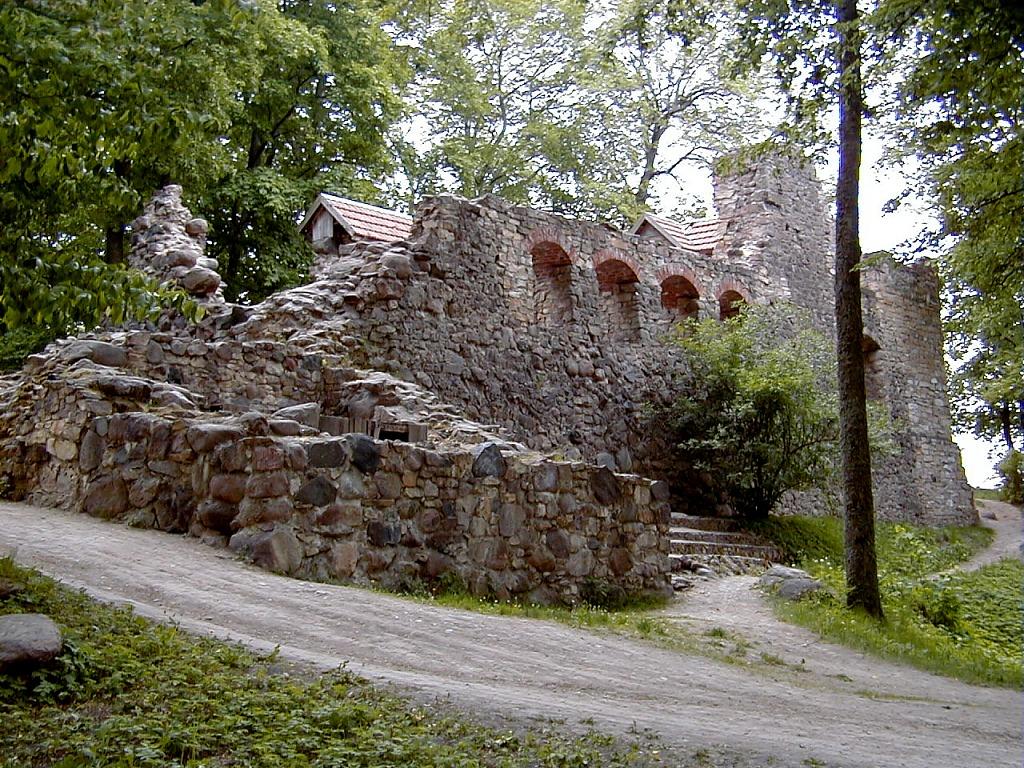
Construction materials included locally sourced dolomite from the Daugava riverbank, fieldstones, and red bricks primarily for interior finishing. The walls were plastered, and pointed arches above doorways and windows added both structural strength and architectural character. A dam and mill on the Karikste River supported the castle’s self-sufficiency.
Defensive enhancements and later modifications
In the 15th century, the castle adapted to evolving military technology by adding two towers designed for mounting firearms. The fortress’s defensive system also included a parcham, a double ring wall characteristic of Livonian Order castles, providing an additional layer of protection east of the main fortress.
Decline and historical events
Aizkraukle Castle endured significant challenges during the Livonian War (1558–1583). In 1559, it was seized by Polish forces, and in 1577, Russian troops captured and destroyed much of the fortress after its surrender to Duke Magnus, an ally of Tsar Ivan IV. A grim episode involved Tsar Ivan IV ordering the blinding and execution of Kaspar Münster, the last Livonian Land Marshal, within the castle, marking the decline of Livonian Order power.
Following the war, the 1582 Treaty of Jam Zapolski assigned the castle to the Cēsis Voivodeship within the Duchy of Livonia. By 1599, the castle was heavily damaged and abandoned. The nearby manor estate, built by Lieutenant Colonel Simon von Schultz in 1630, shifted the local center of power away from the medieval fortress. Over time, the castle fell into ruin, with stones repurposed for local buildings, including a church constructed in 1694.
Current condition and archaeological remains
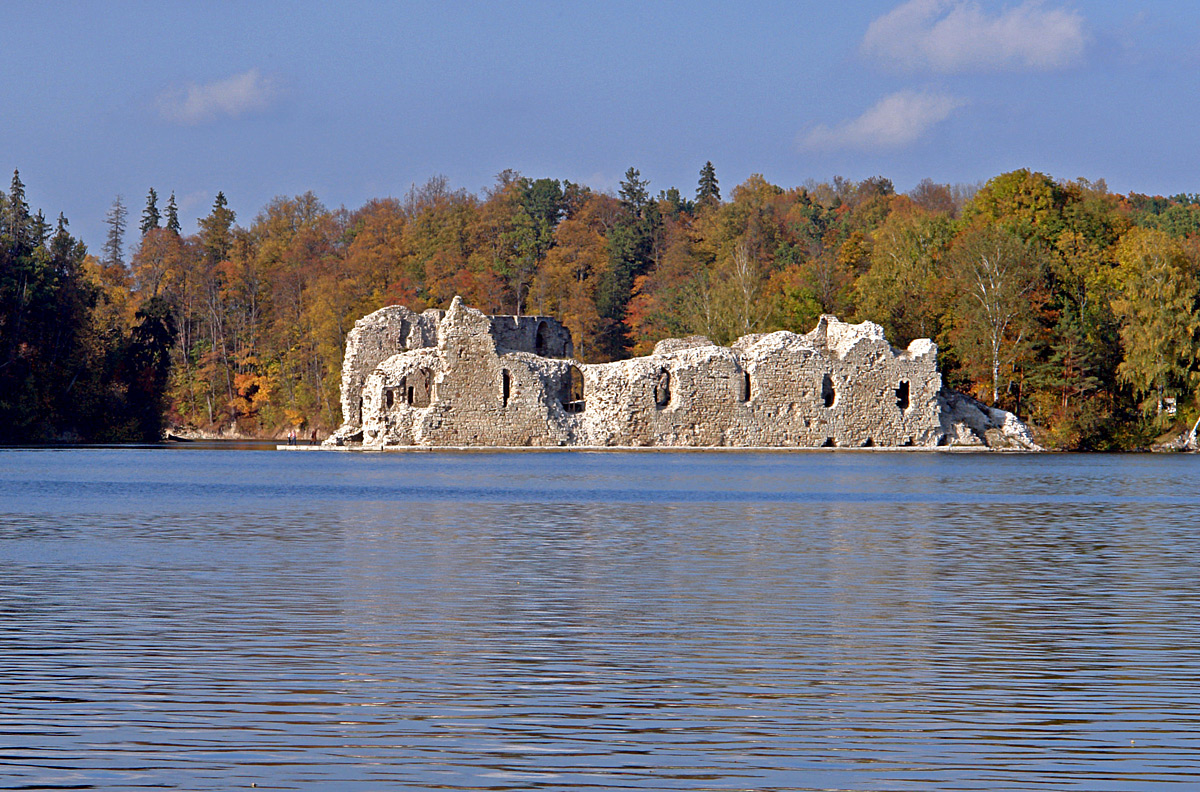
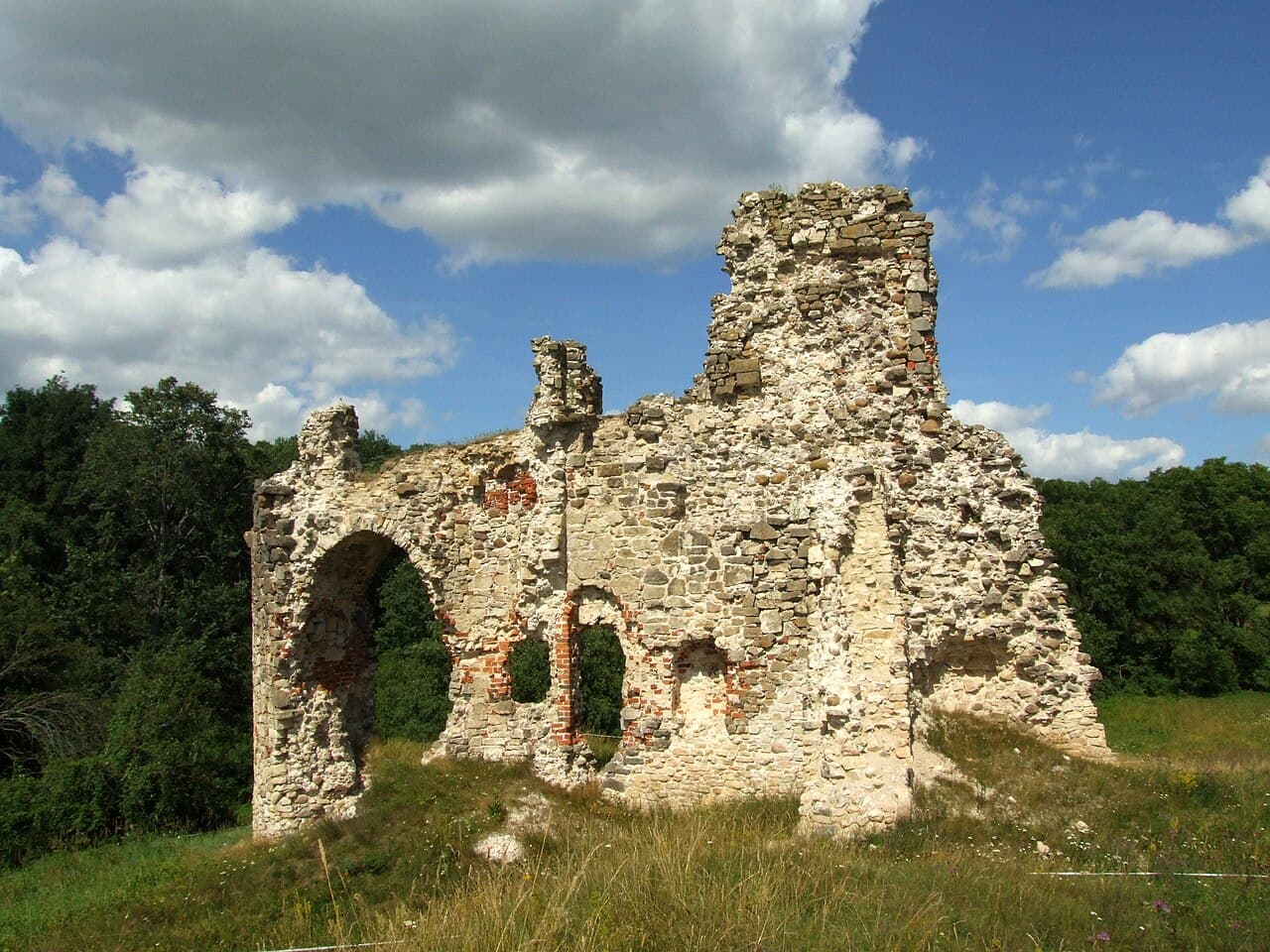
Today, Aizkraukle Castle exists as ruins, with remnants of its foundational walls and fragments reaching up to 10 meters high. The northern corner wall of the main castle is notably preserved for about 15 meters in length and 10 meters in height. Foundations of the southern tower and collapsed sections of the southwestern walls remain visible near the Daugava riverbank.
The outer baileys’ fortifications are partially traceable through surviving foundations and earthworks. The castle’s stones have been extensively reused in local construction, which contributed to its gradual decay. Conservation efforts initiated in 2023 aim to stabilize and preserve the ruins, recognizing their cultural and historical significance.
As a popular local tourist destination, the ruins offer visitors a glimpse into Latvia’s medieval past and the architectural legacy of the Livonian Order. The site’s picturesque setting on the riverbanks enhances its appeal, making it an important heritage landmark in the Aizkraukles novads region.
Visitor information and accessibility
The castle ruins are accessible to the public and provide an evocative experience of medieval fortification architecture. While the site is largely in ruins, informational signage and guided tours help visitors understand the castle’s historical context and architectural features. The surrounding landscape offers opportunities for hiking and exploration along the Daugava and Karikste rivers.
Frequently asked questions (FAQ)
- What is Aizkraukle Castle Ruins?
- Aizkraukle Castle Ruins are the remnants of a medieval castle built in the 14th century, located in Aizkraukle, Latvia. The castle played a significant role in the region's history and is a notable example of Livonian architectural style.
- When was Aizkraukle Castle built?
- Aizkraukle Castle was constructed in the 14th century, specifically around 1350. Over the centuries, it has undergone various changes and witnessed numerous historical events that shaped the area.
- What are the opening hours for Aizkraukle Castle Ruins?
- Aizkraukle Castle Ruins are typically open to visitors year-round, with the best time to visit being during daylight hours. However, it’s advisable to check local resources for specific opening times and any seasonal variations.
- Can I visit Aizkraukle Castle Ruins for free?
- Yes, visiting Aizkraukle Castle Ruins is free of charge, allowing everyone to explore the historical site without any entry fees. This accessibility encourages visitors to learn about the rich history of the castle and its surroundings.
- Is it possible to take guided tours of the castle ruins?
- While there may not be regular guided tours offered, visitors can often find local guides available for hire. Additionally, informational signage around the ruins provides insights into the castle's history and architecture.
- What is the best time to visit Aizkraukle Castle Ruins?
- The best time to visit Aizkraukle Castle Ruins is during the late spring and early autumn months when the weather is mild and the landscape is beautiful. This timing allows for a pleasant outdoor experience while exploring the ruins.
- Are there any nearby attractions to visit?
- Yes, the area surrounding Aizkraukle Castle Ruins offers several attractions, including the picturesque Daugava River and various parks for outdoor activities. Visitors can also explore the town of Aizkraukle for additional cultural experiences.
- How do I get to Aizkraukle Castle Ruins?
- Aizkraukle Castle Ruins are easily accessible by car or public transportation from major cities in Latvia. The castle is located within walking distance from the center of Aizkraukle, making it convenient for visitors.
- What is the historical significance of Aizkraukle Castle?
- Aizkraukle Castle played a crucial role in the defense and governance of the region during the medieval period. It was a strategic stronghold for the Livonian Order, which significantly influenced the history and development of Latvia.
Photo gallery

Information
Website
Visit websiteSources & official resources
Verify the information above using these authoritative references.
Loading map...
Visitor reviews
No reviews yet. Been here? Write the first review and help other travelers!
Write the first reviewVisited this castle? Share your experience
Your review helps other travelers and adds first-hand knowledge to our encyclopedia.