Krumbach Castle

Krumbach Castle: historic fortress in Austria's Krumbach
Krumbach, Austria
High Medieval (11th–13th c.)
Well Preserved

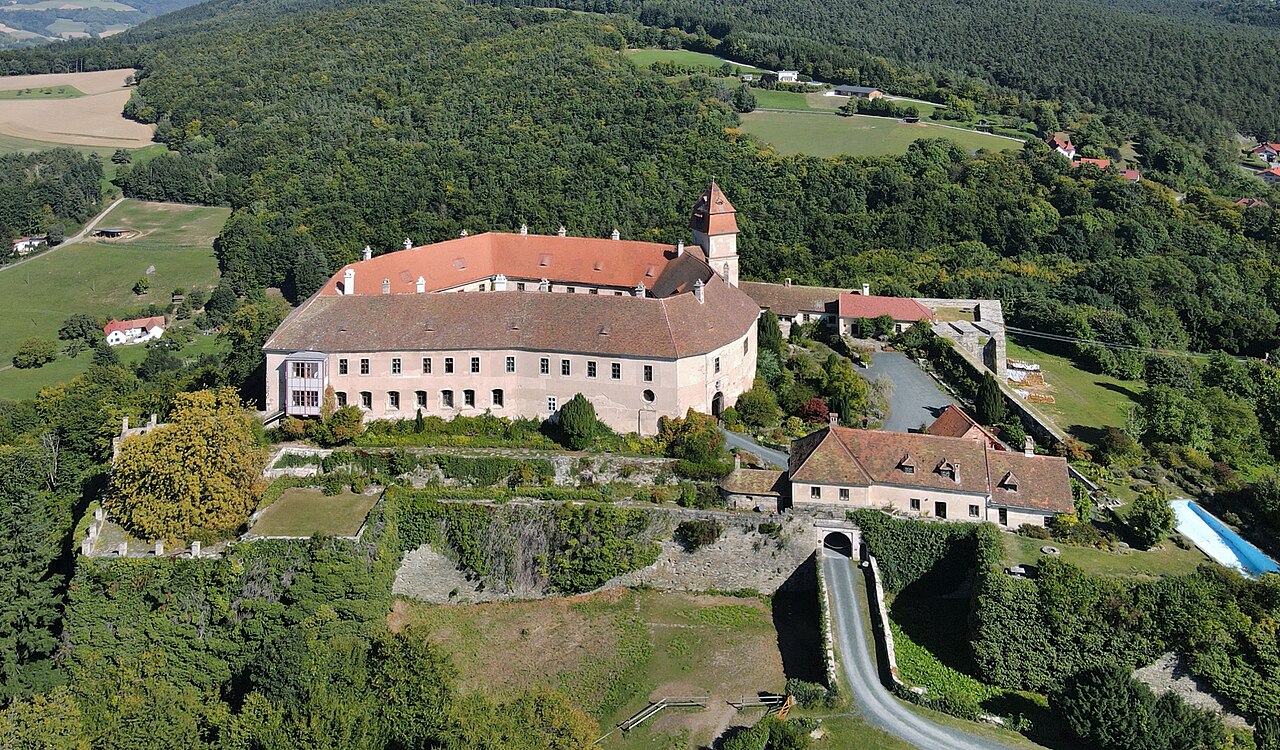
Krumbach Castle is a historic fortress located in the town of Krumbach, Austria. Originally constructed in the 11th century, the castle's earliest documented mention dates to 1192 with Gerhardus de Chrumpach. This medieval stronghold played a significant role in regional defense and governance during the High Medieval period.

Early history and medieval significance

The castle was built as a defensive fortress, strategically positioned to oversee and control the surrounding territory. In 1260, the fortress suffered destruction at the hands of the Magyars, reflecting the turbulent political and military conflicts in Central Europe during the Middle Ages. Despite this devastation, the castle was rebuilt and remained an important noble residence.

Ownership and architectural evolution

For over two centuries, Krumbach Castle was under the ownership of the Pálffy von Erdöd family, a prominent noble lineage in the region. Their tenure contributed to the castle's maintenance and likely modifications aligning with evolving defensive and residential needs. In 1875, the castle was sold to an Austrian lawyer, marking the beginning of multiple changes in private ownership.

19th and 20th century transformations

During the late 19th and 20th centuries, the castle's role shifted from a noble fortress to a private estate. In 1993, it underwent a significant conversion into a hotel, adapting the medieval structure for modern hospitality purposes. By 2009, ownership had passed to Mirko Kovats and the Artis Hotel Group, an Austrian investment company.

Modern use as an educational institution

Since 2020, Krumbach Castle has been repurposed as the Schloss Krumbach International School, a private boarding school offering an international curriculum. This adaptive reuse preserves the castle's historic fabric while giving it a contemporary function as an educational facility. The transformation includes modern amenities integrated within the castle's medieval architecture, supporting both academic and residential needs of students.

Architectural features and preservation

While the original fortress dates to the 11th century, much of the surviving structure reflects the 13th-century High Medieval architecture. The castle likely retains characteristic features such as defensive walls, towers, and a central courtyard, typical of medieval fortifications. Over centuries, renovations and restorations have adapted the castle to changing uses, balancing preservation with functional updates.

Castle type and style

Krumbach Castle is classified as a hill castle, built on elevated terrain to maximize defensive advantage. Its architectural style is primarily High Medieval, with possible elements of Romanesque and early Gothic influences typical of the 13th century. The castle's condition is well preserved, reflecting ongoing maintenance and adaptive reuse efforts.

Cultural and historical importance

The castle embodies the historical evolution of medieval fortifications in Austria, illustrating the shifts from military stronghold to noble residence, then to private estate, hotel, and finally an educational institution. Its long history, spanning nearly a millennium, makes it a significant cultural landmark in the region of Krumbach.

Visitor information and accessibility

Currently functioning as an international school, public access to Krumbach Castle is limited. However, its historical significance and architectural heritage continue to attract interest from scholars and enthusiasts of medieval architecture and Austrian history.

Frequently asked questions (FAQ)

How do I get to Krumbach Castle?
Krumbach Castle is located in Krumbach, Austria, easily accessible by car and public transport. If you are driving, there are parking facilities nearby, and if you prefer public transport, local buses connect to the castle from major towns.
What is the historical significance of Krumbach Castle?
Krumbach Castle dates back to the 12th century and has played a vital role in the region's history. It has served various purposes throughout the centuries, including a defensive stronghold and a noble residence, reflecting the architectural styles of different eras.
When was Krumbach Castle built?
The construction of Krumbach Castle began in the late 12th century, making it one of the oldest structures in the area. Over the years, it has undergone several renovations and expansions, preserving its historical essence while adapting to modern needs.
Can I take guided tours of Krumbach Castle?
Yes, guided tours are available at Krumbach Castle, providing visitors with in-depth knowledge of its history and architecture. These tours are typically offered during the peak visiting season, allowing guests to fully appreciate the castle's heritage.
Why is Krumbach Castle considered an architectural gem?
Krumbach Castle showcases a blend of Gothic and Renaissance architectural styles, making it a stunning example of historical design. Its well-preserved towers, intricate frescoes, and expansive courtyards offer insight into the craftsmanship of the era.
Is it possible to host events at Krumbach Castle?
Yes, Krumbach Castle is a popular venue for various events, including weddings, corporate gatherings, and cultural events. The picturesque setting and historical ambiance make it an attractive choice for memorable occasions.
What are the opening hours for Krumbach Castle?
Krumbach Castle is open to visitors from April through October, with specific hours varying by season. It is advisable to check the official website for the most current visiting hours and any special holiday openings.
What are the ticket prices for visiting Krumbach Castle?
Ticket prices for Krumbach Castle are generally affordable, with discounts available for students and seniors. Family tickets and group rates may also be offered, making it accessible for all types of visitors.
What is the best time to visit Krumbach Castle?
The best time to visit Krumbach Castle is during the late spring or early fall when the weather is mild and the surrounding scenery is at its most beautiful. Additionally, this period often features fewer crowds, allowing for a more enjoyable experience.
Are there any nearby attractions to visit while at Krumbach Castle?
Yes, there are several nearby attractions, including beautiful hiking trails and local museums that showcase the region's history and culture. Exploring the charming town of Krumbach itself can also enhance your visit to the castle.

Information

Hill Castle

Loading map...

Visitor reviews

No reviews yet. Been here? Write the first review and help other travelers!

Write the first review

Visited this castle? Share your experience

Your review helps other travelers and adds first-hand knowledge to our encyclopedia.

Write a review

(5/5)

0/2000 characters

Your review will be visible after admin approval

Nearby castles

7.6 km

Burgruine Kirchschlag

Kirchschlag in der Buckligen Welt, Austria

Burgruine Kirchschlag is a remarkable example of a medieval hill castle situated in the town of Kirchschlag in der Buckligen Welt, Austria. Constructed in the 12th century, this fortress was originally built by local nobles to secure the eastern border of their territories. Perched strategically on the Schlossberg hill approximately 480 meters above sea level, the castle's elevated position provided significant defensive advantages, overseeing the surrounding landscape and controlling access routes. Its close integration with the town through a fortified ring wall exemplifies the medieval approach to combining urban and military architecture for enhanced protection. Early history and construction The initial construction of Burgruine Kirchschlag dates back to the 12th century, during a period when noble families across Europe were fortifying their domains amidst frequent territorial disputes. The castle's location on the Schlossberg was chosen for its natural defensive qualities, rising about 80 meters above the surrounding terrain. Early phases of the castle's development remain largely undocumented above ground, as later reconstructions have obscured much of the original fabric. Throughout the high medieval period, the castle underwent several phases of expansion and modification. It was initially owned by various prominent noble families who recognized its strategic value. A significant event in its early history was its partial destruction during a noble revolt against Duke Friedrich the Fair in the early 14th century. This conflict underscored the castle's importance as a military stronghold in regional power struggles. Reconstruction and architectural evolution Between 1320 and 1325, the Pottendorfer family undertook major reconstruction efforts that shaped much of the castle's enduring form. This rebuilding phase introduced robust stone fortifications and refined defensive structures, aligning with contemporary military architectural trends of the late high medieval period. The castle's design incorporated a fortified ring wall that connected the stronghold to the adjacent town, creating a continuous defensive perimeter that integrated civilian and military spaces. The castle's most prominent surviving architectural feature is its bergfried, locally known as the "Feuerturm" or fire tower. This main tower stands approximately 22 meters tall and was strategically positioned on a small rise about 50 meters southwest of the castle entrance. The bergfried served multiple defensive functions: as a last refuge during sieges, an observation point for monitoring enemy movements, and a signaling tower to warn of attacks by lighting fires. Today, it remains a key landmark and serves as a viewing platform offering panoramic vistas of the castle ruins and the surrounding countryside. Historical significance and ownership Over the centuries, Burgruine Kirchschlag played a vital role in regional defense and governance. It passed through the hands of several influential noble families, including the Styrian Lords of Wildon, the Kuenringers, the Güssingers, the Pottendorfers, the Puchheimers, and ultimately the Hungarian Counts Pálffy. These families contributed to the castle's maintenance and adaptation to evolving military needs. Notably, the castle was under the lordship of King Matthias Corvinus of Hungary until his death, after which it was reclaimed by Emperor Maximilian I. The fortress withstood numerous military challenges, including two major sieges during the Turkish invasions of 1529 and 1683. It also faced raids by Haiduks in 1605, attacks led by Hungarian rebel leader Gábor Bethlen in 1621, and the Kuruc uprisings in 1703. These conflicts highlight the castle's enduring strategic importance across several centuries of regional turmoil. Decline and preservation The castle's decline began around the mid-17th century when its noble residents began relocating their primary residences. Hans Christoph III von Puchheim constructed a manor house within the town of Kirchschlag and shifted his residence there, signaling a reduced military and administrative role for the castle. Subsequently, the Pálffy family also moved their seat to Burg Krumbach, a better-preserved fortress nearby. This transition marked the gradual abandonment and decay of Burgruine Kirchschlag as a defensive stronghold and noble residence. Following the political and social changes after 1848, the castle changed ownership multiple times before being acquired by the municipality of Kirchschlag in the 20th century. Although detailed records of archaeological excavations or restorations are limited, preservation efforts have been undertaken to stabilize the ruins. These efforts have focused on maintaining key structural elements such as the bergfried and sections of the stone walls, allowing visitors to appreciate the castle's medieval character and historical significance. Architectural features and layout The castle was originally part of a larger fortified complex that included a ring wall connecting the fortress to the town below, creating a continuous defensive barrier. The surviving ruins primarily reflect the early 14th-century reconstruction by the Pottendorfer family. The castle courtyard and various adjoining buildings were enclosed within this wall, although specific details about their size and arrangement are not extensively documented. The bergfried remains the most intact and visually striking feature of the site. Its robust construction and elevated position made it an effective lookout and defensive refuge. The castle walls, built from stone, have been partially restored and maintained, providing visitors with a tangible sense of medieval fortification techniques. Cultural significance and modern use Beyond its historical and architectural importance, Burgruine Kirchschlag continues to serve as a cultural landmark for the local community. The castle ruins host an annual Advent market that draws thousands of visitors, celebrating regional traditions in a historic setting. Additionally, the site has previously accommodated a summer rock festival, demonstrating its versatility as a venue for contemporary cultural events. These activities underscore the ongoing connection between the castle and the people of Kirchschlag, ensuring that the ruins remain a vibrant part of the town's identity and heritage. The preservation of the castle not only honors its medieval past but also fosters community engagement through cultural celebration.

High Medieval (11th–13th c.)
Details
9.4 km
Schloss Bärnegg — Austria castle

Schloss Bärnegg

Schäffern, Austria

Schloss Bärnegg stands as a notable example of a late medieval hill castle located in the municipality of Schäffern, Austria. Constructed originally in the 14th century, this castle occupies a commanding hilltop at approximately 604 meters above sea level, a strategic position typical for defensive structures of its era. The castle's elevated site provided extensive visibility over the surrounding landscape, which transitions from rolling hills to flatter agricultural land, underscoring its role in regional defense and control. Historical background and ownership The earliest written mention of Schloss Bärnegg dates to 1312, confirming its establishment as a fortified stronghold by the early 14th century. Over the centuries, the castle passed through the hands of several distinguished noble families, including the Perner, Teuffenbach, Reichenberg, and Rindsmaul lineages. Each family influenced the castle's evolution, adapting its functions to meet changing residential and military needs. During the 17th century, Schloss Bärnegg underwent significant architectural modifications. Notably, the castle's courtyard was expanded and surrounded by arcades—covered walkways with arches—that enhanced both its aesthetic appeal and practical use as a sheltered communal space. This transformation reflected broader trends in castle design, where comfort and status increasingly complemented defensive considerations. In 1703, a chapel was constructed within the castle complex, indicating the integration of religious functions alongside the castle's residential and military roles. This addition marked a significant phase in the castle's history, emphasizing its importance as a local center of faith as well as fortification. Architectural features and layout The remains of Schloss Bärnegg reveal a typical hill castle layout designed to exploit the natural topography for defense. The castle's most prominent surviving feature is its arcaded courtyard, which dates to before the 17th century but was notably enlarged during that century. The courtyard's arcades consist of a series of arches supported by columns, creating a covered walkway that would have served both practical and social functions. The chapel built in the early 18th century remains partially standing, with foundations and walls that illustrate its original placement within the castle grounds. This religious structure adds a layer of cultural significance to the site, highlighting the dual military and spiritual roles castles often fulfilled. Other structural elements typical of hill castles, such as defensive walls, gatehouses, and towers, are now largely in ruin, but their foundations and partial walls provide insight into the castle's comprehensive defensive system. Decline and current condition Despite its long history of occupation and use, Schloss Bärnegg fell into disrepair in recent decades. The castle is now classified as ruins, with many of its original features partially preserved but showing significant wear due to lack of maintenance. The site is protected as a cultural heritage monument, ensuring the preservation of its historical and architectural value for future generations. Visitors to the site can explore the remains of the arcaded courtyard and the chapel's foundations, gaining a tangible sense of the castle's layered history. The surrounding landscape, combining natural vegetation and farmland, offers a glimpse into the castle's historical context within a rural working environment. Cultural significance and heritage protection Schloss Bärnegg is recognized as an important cultural monument in Austria, representing the architectural and historical development of hill castles in the region. Its preservation as a ruin allows scholars and visitors alike to study the evolution of medieval fortifications and their adaptation to residential and religious uses over several centuries. The castle's arcaded courtyard and chapel remain key features that illustrate the blending of military, residential, and spiritual functions typical of many European castles transitioning from the medieval period into the early modern era. Efforts to maintain and protect Schloss Bärnegg contribute to the broader understanding of Austria's medieval heritage and the role of hill castles in shaping regional history.

Late Medieval (14th–15th c.)
Details
11.9 km
Bernstein Castle — Austria castle

Bernstein Castle

Bernstein im Burgenland, Austria

Bernstein Castle is a striking medieval fortress located in the municipality of Bernstein in Austria's Burgenland region. Perched atop a hill at 615 meters above sea level, it holds the distinction of being the highest castle in Burgenland. The castle's origins date back to the 12th century, with historical records first mentioning it in the early 13th century. However, archaeological and toponymic evidence suggests the site hosted an earlier fortification, as indicated by the nearby village of Grodnau, whose old Slavic name translates to "the village belonging to the castle." This connection points to the strategic importance of the location since early medieval times. Throughout its long history, Bernstein Castle has been a significant stronghold at the crossroads of Central European powers, primarily under the Kingdom of Hungary. The surrounding region was part of the Archbishopric of Salzburg in 860 AD, with early settlements such as Rettenbach established near the castle hill. By 1199, the fortress had come under Hungarian control, marking the beginning of a complex history of ownership involving prominent rulers and noble families. Medieval origins and shifting sovereignties The castle's early history is marked by a series of transfers among powerful figures. Initially controlled by Hungarian kings, it was briefly under the rule of Duke Frederick II of Austria in the early 13th century, before being reconquered by King Béla IV of Hungary in 1236. Subsequently, in 1260, the castle was granted to Count Heinrich II of Güssing, a notable nobleman of the region. In 1336, after the defeat of local aristocrats, King Charles Robert of Anjou incorporated Bernstein Castle into the Hungarian crown lands. Later, in 1388, Queen Maria of Anjou bestowed the castle upon the influential Kanizsai family, who initiated significant rebuilding efforts starting in 1389. The fortress briefly returned to royal possession under King Matthias Corvinus in 1482, before being pledged by Emperor Frederick III to Hans von Königsberg in 1487. These shifts reflect the castle's strategic importance at the borderlands between Austria and Hungary. Defense against ottoman sieges and architectural evolution Bernstein Castle is renowned for withstanding two major Ottoman sieges during the reign of Sultan Suleiman the Magnificent in 1529 and 1532. These attacks underscored the need for enhanced fortifications, leading to the construction of a ring of bastions around the castle complex. Designed by the Italian architect Francesco de Pozzo, these bastions were built to provide refuge for the local population and to strengthen the castle's defenses against artillery and prolonged assaults. In 1604, the castle endured another prolonged siege by a coalition force of Turks, Hungarians, and Tatars led by the rebel leader István Bocskai. Despite the intensity of the attack, Bernstein remained unconquered, demonstrating its formidable defensive capabilities. The castle suffered significant damage in 1617 when an explosion in the powder magazine destroyed parts of the interior. Following this event, Ludwig Königsberg ordered a comprehensive reconstruction of the castle's inner sections in the Baroque style. This renovation involved the removal of the original Gothic keep and towers, reflecting changing architectural tastes and military needs. The knights' hall from this period remains a highlight, featuring an elaborate stucco ceiling that exemplifies Baroque artistry within a medieval fortress. Architectural features and preserved elements The castle's layout is characteristic of a hill castle, with a well-defined defensive complex including an inner gate and an outer courtyard. The bastion ring encircling the fortress is a notable example of early modern military architecture adapted to withstand cannon fire and siege warfare. These bastions, combined with thick stone walls and strategic positioning, underscore the castle's role as a refuge and military bastion. Inside, visitors can explore unique historical spaces such as a 16th-century alchemists' kitchen, which hints at the presence of early scientific or mystical practices within the castle. Additionally, a preserved torture chamber offers insight into the judicial and punitive measures employed during the castle's operational period. Ownership transitions and modern use Following its long tenure under the Königsberg family, ownership of Bernstein Castle passed to Count Ádám Batthyány in 1644. The Batthyány family controlled the fortress until 1864, when Gustav Batthyány sold it to his steward Edward O’Egan. Shortly thereafter, the castle was acquired by Eduard von Almásy, whose descendants continue to own the property. In the mid-20th century, part of the castle was converted into a hotel and restaurant, blending historical preservation with modern hospitality. The castle remains privately owned but is accessible to visitors by prior arrangement, allowing guests to experience its rich history and architectural grandeur firsthand. Cultural significance and legends Bernstein Castle is steeped in local folklore, most famously the legend of the "White Lady". This ghostly figure is said to be the restless spirit of Giovanna de’ Frescobaldi, wife of Lorentz von Ujlak, whose tragic love story dates back to the reign of Matthias Corvinus. The tale has contributed to the castle's mystique and cultural heritage, attracting visitors intrigued by its haunted reputation. The castle's scenic location overlooking the Tauchental valley and its well-preserved fortifications have also made it a popular site for filmmakers and cultural events, further cementing its place in Austria's historical landscape.

High Medieval (11th–13th c.)
Details