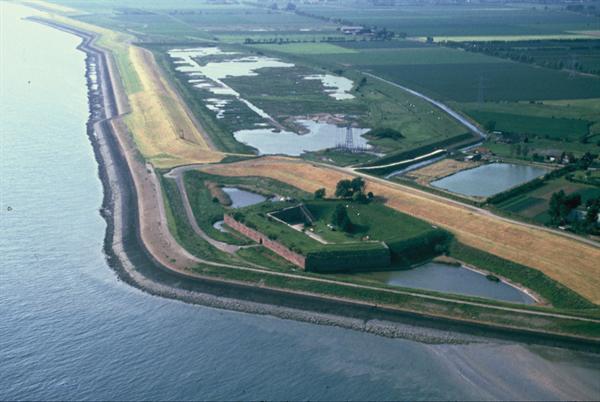
Hellenburg Castle
Hellenburg Castle, locally known as Kasteel Hellenburg, is a historically significant late medieval fortress located west of the village of Baarland in the province of Zeeland, Netherlands. The castle's origins date back to the early 14th century, with the first recorded mention in 1312. Although archaeological evidence has not confirmed it, it is likely that the site initially featured a wooden tower before the construction of the stone keep.
Architectural evolution and structure
The original castle was built by the Lords of Renesse and featured a robust square keep with sides approximately 7 meters long and walls about 2 meters thick. This keep formed the core defensive structure of the castle. Over the 14th and 15th centuries, the castle underwent several renovations and expansions, culminating in its final form around 1450.
By this time, hellenburg castle consisted of a fortified castle proper and an adjoining bailey, both surrounded by a moat. The bailey's walls were relatively thin, about 60 centimeters thick, indicating that it was not intended for serious military defense but rather as a protected courtyard or service area.
The castle complex was notable for its nine towers, which enhanced its defensive capabilities and architectural prominence. The entire castle measured approximately 40 meters in length and 30 meters in width, with curtain walls ranging from 1.20 to 1.40 meters thick. These substantial walls and towers reflected the typical late medieval military architecture of the region, designed to withstand sieges and attacks.
Historical context and decline
Despite its formidable construction, Hellenburg Castle's strategic position in Zeeland made it vulnerable to natural disasters. In 1477, a catastrophic storm caused severe flooding that resulted in the castle being lost to the waters. This event marked the beginning of the castle's decline, as it was no longer habitable or defensible.
By the 17th century, the castle had fallen into ruin. The remaining structures deteriorated significantly, and in the 18th century, the ruins were systematically demolished. Stones from the castle were repurposed by the villagers of Baarland for local building projects, which led to the near-complete disappearance of the castle's physical presence and the gradual forgetting of its exact location.
Rediscovery and preservation efforts
The site of Hellenburg Castle was rediscovered in the 1950s during land division work following the devastating 1953 North Sea flood. Excavations uncovered the castle's foundations, revealing the ground plan and confirming its historical significance.
Further consolidation efforts took place in 1960 and again in 1977 to stabilize the foundations and protect them from stone robbing, which had become a problem as people sought the stones for garden decoration. These preservation measures have allowed visitors to appreciate the castle's layout and understand its historical footprint.
Visitor experience and significance
Today, Hellenburg Castle exists as an archaeological site with preserved foundations that are freely accessible to the public. While the remains may not be visually impressive compared to fully intact castles, the site offers valuable insight into medieval castle architecture and the historical landscape of Zeeland.
The castle's story reflects the broader themes of medieval fortification, the impact of natural disasters on historical sites, and the challenges of preserving cultural heritage in regions prone to flooding. Hellenburg Castle stands as a testament to the resilience of history and the ongoing efforts to maintain connections to the past.
Architectural highlights
- Square keep with thick walls approximately 2 meters wide
- Nine defensive towers enhancing the castle's fortifications
- Moat surrounding the castle and bailey for protection
- Bailey walls notably thinner, indicating non-military use
- Castle dimensions roughly 40 by 30 meters with substantial curtain walls
Historical timeline
- 1312: First documented mention of Hellenburg Castle
- 14th-15th centuries: Renovations and expansions culminating in final form by 1450
- 1477: Castle lost due to storm-induced flooding
- 17th century: Castle in ruins
- 18th century: Ruins demolished and stones repurposed
- 1950s: Rediscovery of foundations after 1953 flood
- 1960 and 1977: Consolidation of foundations for preservation
Frequently asked questions (FAQ)
- What is the historical significance of Hellenburg Castle?
- Hellenburg Castle is a remarkable example of medieval architecture and has played a vital role in the region's history since its construction in the 14th century. It served as both a fortress and a residence for nobility, reflecting the socio-political dynamics of its time. Today, it stands as a monument to the rich heritage of the Netherlands.
- When was Hellenburg Castle built?
- Hellenburg Castle was built in the late 1300s, specifically around 1380. Its strategic location was chosen for defensive purposes, allowing it to protect the surrounding lands. Over the centuries, it has undergone various renovations, preserving its historical essence while adapting to modern needs.
- What are the opening hours for Hellenburg Castle?
- Hellenburg Castle is open to visitors from Tuesday to Sunday, with hours varying by season. Typically, it opens at 10 AM and closes at 5 PM, but it is advisable to check the official website for any changes or special events. Guided tours are available during opening hours, enhancing the visitor experience.
- Can I visit Hellenburg Castle year-round?
- Yes, Hellenburg Castle welcomes visitors year-round, although some areas may be restricted during the winter months. The best time for a visit is from late spring to early autumn when the weather is pleasant, and outdoor areas are fully accessible. Be sure to plan ahead, as certain tours may require advance booking.
- Is Hellenburg Castle accessible for visitors with disabilities?
- Hellenburg Castle strives to be accessible for all visitors, with designated paths and facilities for those with mobility challenges. However, due to the castle's historic nature, some areas may still present challenges. It's recommended to contact the castle staff in advance to inquire about specific accessibility options.
- What are the ticket prices for Hellenburg Castle?
- Tickets for Hellenburg Castle are reasonably priced, with discounts available for children, students, and seniors. Adult tickets typically cost around €10, while children under 12 often enter for free. Special family packages and group rates are also available to make visiting more affordable.
- Are there any nearby attractions to Hellenburg Castle?
- Yes, there are several attractions near Hellenburg Castle, including picturesque villages, scenic parks, and other historical sites. Visitors can explore local museums and enjoy nature trails that showcase the beautiful Dutch landscape. These nearby locations make for a perfect day trip when combined with a visit to the castle.
- When is the best time to visit Hellenburg Castle?
- The best time to visit Hellenburg Castle is during the spring and summer months when the gardens are in full bloom and the weather is generally favorable. Special events and themed tours are often hosted during this period, providing a more enriching experience. Fall can also be lovely, with the changing foliage adding to the castle's charm.
Loading map...
Visitor reviews
No reviews yet. Been here? Write the first review and help other travelers!
Write the first reviewVisited this castle? Share your experience
Your review helps other travelers and adds first-hand knowledge to our encyclopedia.