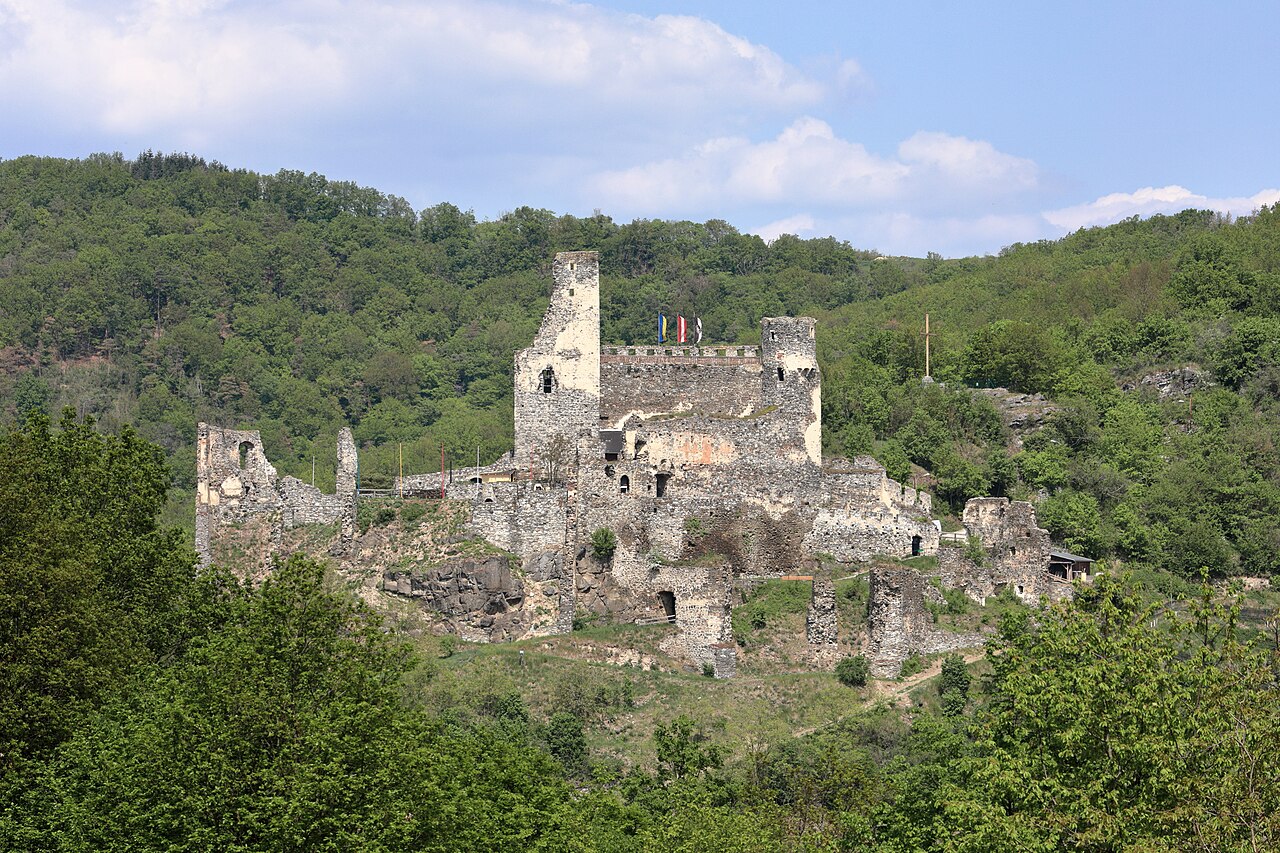
Kronsegg Castle
Kronsegg Castle, located near the town of Langenlois in Austria, stands as an evocative example of a high medieval hill castle whose ruins tell a story of centuries of strategic importance, architectural evolution, and historical turbulence. Likely constructed in the late 12th century by the Lords of Maissau, this castle first appears in written records around 1250 as property of the Bishopric of Passau. Over the ensuing centuries, Kronsegg Castle witnessed a succession of owners, extensive reconstructions, sieges, and eventual abandonment, leaving behind a remarkable archaeological site that offers insight into medieval defensive architecture and noble life.
Historical background and ownership lineage
The origins of Burgruine Kronsegg lie in the late 12th or early 13th century, a period marked by the consolidation of feudal power in Austria. The castle was initially built by the Lords of Maissau, a noble family influential in the region. The earliest written mention dates to 1250, confirming its ownership by the Bishopric of Passau, a significant ecclesiastical principality of the Holy Roman Empire.
In the early 14th century, the castle became a fiefdom under the Kuenring family, a powerful noble house known for their extensive holdings in Lower Austria. A notable figure, Arnold the Praunsdorfer, is documented as a resident in 1309, indicating the castle's role as a noble residence and administrative center.
By 1354, ownership transferred to Eberhard V. von Walsee through purchase. He likely initiated major reconstruction efforts, blending new architectural elements with the existing medieval fabric. This period reflects a trend of castle modernization to enhance defensive capabilities and residential comfort.
Later in the 14th century, Kronsegg passed by marriage into the hands of the Brandenburg-Hohenzollern dynasty. Despite its location within Habsburg-controlled territory, it remained an enclave of Brandenburg authority until the late 18th century. This unique political status underscores the castle's strategic and symbolic importance.
Throughout the 15th and 16th centuries, Kronsegg saw numerous changes in ownership, eventually coming under the control of the Leisser family in 1569. The castle's role as a fortified noble residence continued amid the shifting political landscape of the region.
Sieges, damage, and military significance
The early 17th century brought significant challenges during the Thirty Years' War. In 1619-1620, the castle suffered severe damage inflicted by Bohemian forces. This initial assault compromised its defensive structures, necessitating urgent repairs and fortification enhancements.
By 1629, Christoph Leisser undertook expansion of the castle's defenses, transforming Kronsegg into a more formidable fortress capable of withstanding contemporary military threats. However, further destruction occurred in 1645 at the hands of mercenary leader Heinrich Konrad Schreyer, reflecting the ongoing volatility of the period.
Despite these setbacks, the castle retained enough structural integrity to serve as a refuge for thirteen neighboring villages as late as 1717, highlighting its enduring defensive value even after partial ruin.
Architectural features and layout
The ruins of Kronsegg Castle are situated on a narrow rocky ridge approximately 50 by 16 meters, overlooking the Lois valley and adjacent to the Gföhler Forest. The site exemplifies typical medieval hill castle construction, utilizing natural topography for defense.
The complex includes several notable structures: a gate tower with an integrated chapel, two bergfriede (defensive towers), a main residential building (palas), multiple inner courtyards, and a prominent four-story residential tower approximately 15 by 8 meters in dimension.
The western side of the castle was protected by a deep rock-cut neck ditch, a defensive feature designed to impede attackers. Although this ditch is now mostly filled, it originally served as a formidable obstacle. Surrounding the castle, a curtain wall with battlements enclosed three narrow outer courtyards resembling zwingers, which functioned as kill zones to trap and expose attackers. The outer gate was accessed via a drawbridge, adding an additional layer of defense.
Bergfriede and chapel
The two bergfriede date from the 13th century and played dual roles in defense and religious observance. The southern bergfried, strategically positioned to protect the adjacent gate, houses a two-story Gothic chapel first documented in 1429. This chapel was vertically divided: the lower floor served the castle servants, while the upper floor was reserved for the lord of the castle.
The chapel features a rib-vaulted ceiling with a weathered keystone bearing the coat of arms of the Schad von Lengenfeld family. Nearby, a granite stone carved with a half-figure of the Man of Sorrows reflects the devotional art of the period. Although much of the original high altar and late 14th-century wall paintings have been lost, the chapel doorway retains its original flat trefoil arch crafted from finely dressed ashlar stone blocks.
Residential and defensive structures
The western bergfried is a massive tower with sides measuring about eight meters and walls over two meters thick, connected to the palas by a pointed-arch entrance and a gallery at the first-floor level. This design allowed defenders to move between structures while maintaining strong defensive positions.
The palas served as the central living quarters, reflecting the dual function of castles as military fortresses and noble residences. The four-story residential tower, despite missing its original floors, reveals interior features such as beam holes, funnel-shaped seating recesses with built-in benches, finely dressed stone door frames, a large fireplace, and traces of a garderobe (medieval toilet).
Supporting facilities and water management
Essential to the castle's sustainability were cisterns located within the first and second inner courtyards, providing water storage for the inhabitants. Remnants of the kitchen building include a distinctive pyramidal smoke vent designed to channel smoke away from cooking areas.
Staircases built into the towers allowed movement between levels and offered commanding views across the surrounding forested hills and the nearby Kronsegg reservoir. These features illustrate the castle's thoughtful design balancing defense, habitation, and resource management.
Decline, preservation, and cultural significance
Following the damage sustained during the Thirty Years' War and subsequent repairs, the castle was gradually abandoned in the late 17th century in favor of more comfortable residences such as Schloss Schiltern. Ownership passed through various noble families, including the Geymann, Hackelberg, and Aichelburg families, before the ruins were acquired by the local municipality in 1928.
Between 1988 and 1994, extensive efforts were undertaken to stabilize and preserve the ruins, ensuring their safety for public visitation. Today, Kronsegg Castle stands as a protected historic monument, offering visitors a tangible connection to Austria's medieval past and an excellent example of medieval castle architecture and defensive design.
The castle's location overlooking the Lois valley and proximity to the Gföhler Forest make it a scenic and culturally significant site. Its ruins attract history enthusiasts, scholars, and tourists interested in the evolution of fortifications, noble residences, and religious spaces within a medieval castle complex.
Frequently asked questions (FAQ)
- How do I get to Kronsegg Castle from Langenlois?
- Kronsegg Castle is accessible by a short hike from the town center of Langenlois. Visitors can follow marked trails leading to the castle ruins, which are situated on a rocky ridge overlooking the Lois valley.
- What are the opening hours for visiting Kronsegg Castle?
- The castle ruins are open to the public seasonally, typically from spring to autumn. It is advisable to check with the local municipality or tourist information center in Langenlois for current visiting hours and any guided tour availability.
- Is there an entrance fee to visit Kronsegg Castle?
- Visiting the ruins of Kronsegg Castle is generally free of charge, as it is maintained by the local municipality as a historic site open to the public.
- What architectural features can I expect to see at Kronsegg Castle?
- Visitors can explore the remains of the gate tower with its Gothic chapel, two defensive bergfriede towers, the palas, several courtyards, and a four-story residential tower. The site also features a rock-cut neck ditch, curtain walls with battlements, and remnants of medieval water cisterns.
- Why is Kronsegg Castle historically significant?
- Kronsegg Castle is significant for its long history dating back to the 12th century, its role as a feudal stronghold under various noble families, and its status as an enclave of Brandenburg-Hohenzollern authority within Habsburg lands. Its ruins offer insights into medieval military architecture and noble life.
Information
Current owner
Municipality
Loading map...
Visitor reviews
No reviews yet. Been here? Write the first review and help other travelers!
Write the first reviewVisited this castle? Share your experience
Your review helps other travelers and adds first-hand knowledge to our encyclopedia.